As recent events in Connecticut and along the New Jersey coastline have shown, a disaster can happen anywhere. An accident, a weather event, a hostage situation, a shooting—they all can occur without warning and put many lives in jeopardy. How does a town prepare for such a catastrophe? And how does a town deal with the aftermath of tragedy?
These are questions that will be discussed at an all-day Public Safety Symposium the town is preparing to host for public safety and health care workers and educators from across the state on March 23 in Cronin Auditorium. The symposium is the work of Harvard Ambulance Director Steven Beckman, Assistant Director for Human Resources Jill Reiter, and other members of a six-month-old working group who have assembled an impressive panel of speakers from both in and out of state to discuss their personal experiences in preparing for and dealing with the unthinkable. It’s an event that is unprecedented for Harvard, and unique for a small town of its size.
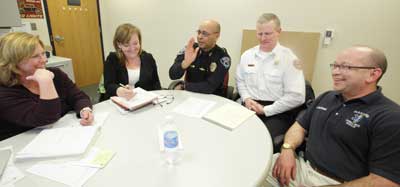
From left: Ambulance Assistant Director for Human Resources Jill Reiter, Bromfield nurse Colleen Nigzus, Police Chief Ed Denmark, Fire Chief Rick Sicard, and Ambulance Director Steve Beckman iron out last-minute details for the March 23 forum. (Photo by Lisa Aciukewicz)
One of the many positive outcomes of the symposium, Beckman told the Press in a recent interview, will be a more clear understanding among police, fire, and ambulance services of their respective roles and responsibilities in the event of a mass casualty incident (MCI) and how they can work together to save lives. Fifteen years ago the MCI protocol was for local public safety workers to wait for outside resources, such as a SWAT team, to arrive. That is no longer true: town police, fire, and ambulance are the first responders and need to act immediately.
Believing that improved communication and collaboration among town public safety services would result in better preparedness to meet a mass casualty incident, Ambulance Director Beckman says he pulled together a working group that began meeting in August 2012. In addition to Beckman and Reiter of Harvard Ambulance, the group includes Harvard Police Chief Ed Denmark, Harvard Fire Chief Rick Sicard, and Bromfield nurse Colleen Nigzus representing Harvard Public Schools. Other members are from the regional Office of Emergency Medical Services of the state Department of Public Health and area hospitals.
Beckman says his initial idea was for the group to discuss, plan, and then execute a large-scale disaster drill to test response, skills, equipment, and inter-service cooperation of Harvard’s public safety workers. But the members quickly concluded that “they didn’t need to prove the obvious”— a drill wouldn’t work. Instead, they first needed to strengthen trust and cooperation among Harvard’s public safety services and put their focus on education before considering a mock MCI for the town.
Positive outcomes of training
To start the process, Beckman says, each of Harvard’s public safety services (ambulance, police, fire) identified core skills and capabilities—so called “building blocks”—that needed development and practice prior to any large-scale MCI exercise. Througout the fall and winter, the Ambulance Service organized or participated in several joint hands-on training drills with police, fire, and regional EMS resources. According to Beckman, “The building-block exercises have begun to sensitize Ambulance members to the heightened stressors of an MCI that challenge conventional patient care practices. Drills in these challenging settings begin the process of developing new ‘muscle memory’ necessary to perform our functions well in inherently chaotic and distracting environments.” He explained that responders are accustomed to dealing with three or four people daily, and for this their skills and care are excellent. But what about a critical situation where dozens of people are in need? Beckman stresses that it is too easy to lose hold of one’s usual calm and routine care responses. Only training sessions that mimic a simulated mass crisis can help a safety worker learn to hold on to ingrained knowledge and professionalism in the midst of chaos.
In addition to improving skills and awareness of public safety workers, Beckman believes that the training events have already increased cooperative efforts to share resources and educational opportunities and enhanced communication and working relationships among Harvard’s first responders. Even on routine events, there is a heightened degree of respect and communication among the services.
Beckman seems justifiably proud of the bridge building that has occurred and will continue to occur through this inter-agency work. As an example, Beckman cites the conversations held between the police and the ambulance squad prior to a lockdown drill at Bromfield earlier this year. Their discussions raised questions that they worked through together to clarify policies and procedures. One important conclusion was that EMTs’ radios should be on “standby” while they were in the building, so as not to give information to intruders who might still be present and pose further threats to safety. They also came to an agreement on the use of terms like “hot zone” and “cold zone” and strategies on where to send people in case of a catastrophe.
To complement the productive course training and increased collaboration, the working group felt ready to tap into another resource: lessons learned by public safety workers who had been through real mass casualty incidents. They envisioned an event that would join regional and national expertise to help first responders to fine-tune their preparedness and response protocols to increase public safety. The result is the March 23 Public Safety Symposium.
Beckman credits Reiter with the initiative and connections that enabled the Public Safety Symposium to come together. Reiter, a licensed clinical social worker and professional EMT, had direct experience caring for victims of several such tragedies through personal and family connections. It was through her roots and work while in Ohio and Colorado that she established professional relationships with many of the nationally recognized, invited speakers.
Nationally known speakers
The symposium will be an unprecedented event for Harvard and seems unique for any small town—perhaps even for a city. It will feature seven out-of-state speakers, all of whom have had direct involvement in a mass casualty situation and/or its aftermath. Among the speakers are the principal of Columbine High School in Colorado and the superintendent of Chardon Public Schools in Ohio, both of whom had to deal with catastrophic shootings at their schools.
Among the other speakers are a sheriff, a parent/advocate/educator, incident commanders, and a police psychologist. Because of the personal connection with EMT Reiter, all speakers have agreed to participate on their own time without an honorarium; they will be reimbursed for travel, lodging, and food expenses only.
Also speaking is Dr. Madeleine Biondolillo, the Bureau Director of Health Care Safety and Quality at the Massachusetts Department of Public Health, who is expected to stress the importance of public safety inter-agency communication and coordination in meeting the department’s objectives.
Beckman says that the symposium has been well publicized across the state and an easy-to-access on-line registration has been set up for the event. Last week over 1,000 fliers were sent statewide to every ambulance, police, fire department; public and private schools; and many of the regional hospitals. A turnout of about 140 people will cover the expense of hosting the event. Should event receipts exceed expenses, Beckman sees the funds being reinvested in the cost of future MCI drills, training and equipment for the ambulance, as well as strategic supplies for emergency response by the town’s first responders.
Lessons learned
Although the out-of-state guests will speak in the context of single-shooter incidents, Beckman asserts that the lessons learned can be applied to other crises. He says that a party involving misuse of alcohol or prescription drugs, or a highway accident, or an illness resulting from a public building’s faulty heating system, or a school bus incident could involve multiple victims. New conversations and actions growing out of the symposium will help public safety workers be better prepared to deal with any catastrophe. Beckman is convinced that each town department will find at least one very important “lesson” from the day. And it sounds as though ordinary people across the state will be better served because of Harvard’s initiative in holding this unique educational event.