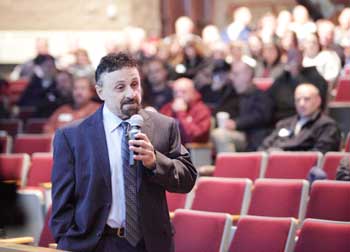
Columbine High School Principal Frank DeAngelis addresses an audience of 200 public safety workers at Bromfield, March 23. DeAngelis talked about some of the lessons learned from the massacre at his school in 1999. (Photos by Lisa Aciukewicz)
It was a beautiful April day in 1999, when Principal Frank DeAngelis’s secretary burst into his office to tell him there was a report of a shooting and bombs exploding. DeAngelis ran out to the hall, where he immediately faced gunfire and a gun pointed directly at him. “What is it going to feel like to be shot?” he thought.
DeAngelis was—and still is—principal of Columbine High School in Littleton, Colo. He told the story of that day, its aftermath, and what he learned to a pin-drop-silent audience in Cronin Auditorium, last Saturday morning.
DeAngelis was one of nine compelling speakers who addressed a gathering of law enforcement, fire, emergency medical, school, and other safety-service professionals and volunteers from across Massachusetts and bordering states at Saturday’s Public Safety Symposium, organized by a working group of Harvard’s public safety services.
The club no one wants to be part of
The speakers, from a “club no one wants to be a part of,” as one speaker put it, came to Bromfield to share their experience and, most importantly, their hard-gained knowledge. Seven of their resumes are shorthand for a modern plague—Columbine High School, Platte Canyon High School, Chardon High School, Virginia Tech. The incident at Sandy Hook Elementary was too easy for them to picture.
Littleton, Chardon, Bailey, Newtown—Anywhere, USA? To a person, they said, if you don’t think it can happen here, think again. But that wake-up message was just an opener for the store of valuable information and experience they offered the 200 or so participants.
“You can’t determine what happens to you, but you can determine how you react,” DeAngelis said, as he outlined the leadership and self-examination he needed to draw on to heal a community and himself after a life-altering incident.
Another high school, another tragedy
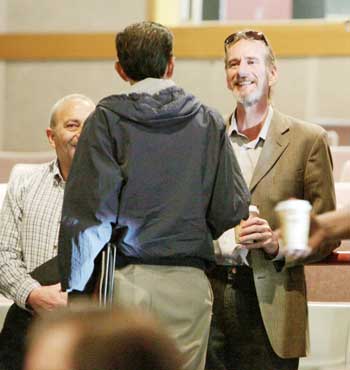
John-Michael Keyes, executive director of the I Luv U Guys Foundation, speaks with symposium attendees.
In 2006, a gunman took seven girls hostage at Platte Canyon High School in Bailey, Park County, Colorado. Park County sheriff Frank Wegener and John-Michael Keyes, father of the single victim in the event, gave a minute-by-minute account of the tragedy.
In detailing how Park County and Jefferson County services responded —Columbine High School is in Jefferson County—Wegner showed how well-trained services, each bringing its specialized skills to a situation, could work together. While negotiators tried to talk to the suspect, Jefferson County’s SWAT team prepared for action.
Wegener illustrated the need to delegate. “All I had to say was ‘take care of medical’ and I knew Jeff [the medical service director] could handle it all,” he said. Asked what he would do differently, Wegener told the Denver Post in a 2007 interview, “I would have asked God to remove Sept. 27 from the calendar.”
Keyes gave a stark and loving account of being a parent that day. The Keyes’ only contact with their daughter, Emily, after she left for school Sept. 27, 2006, was two text messages, “I love U guys” and “I love U guys K.”
In the end, six of the seven hostages escaped. Emily was shot and killed by the gunman before he killed himself.
Keyes and his wife Ellen chose to support and honor their daughter by helping others. In the aftermath, the Keyes started the I Love U Guys Foundation “to restore and protect the joy of youth through educational programs and positive actions in collaboration with families, schools, communities, organizations and government entities.”
A lot like Chardon, Ohio
“Harvard looks a lot like Chardon,” said Superintendent of Chardon Public Schools Joe Bergant. Like others, Bergant never thought a serious school incident would happen in his town. But, in the wake of Columbine and other school shootings, Chardon’s school system had installed surveillance cameras, tightened its door security, and trained its emergency services. In 2009, they conducted a service-wide active shooter drill, simulating what might happen if a gunman was in the school. The drill was controversial. Some thought it could traumatize students or put ideas in their heads.
That view changed one February morning in 2012, when a student opened fire in the Chardon High School cafeteria. The schools’ surveillance camera captured the incident—the 35 seconds from when a shooter opened fire until he was off campus. The actual shootings happened in 22 seconds. In less than a minute, everything changed for Chardon. Three students died and three were injured.

Sheriff Fred Wegener from Fairplay, Colo. chats with Chief Ed Denmark and Jill Rieter before the start of the symposium.
“Crisis management is not a plan for everything, but a process for anything,” Bergant said. It can’t prevent everything, but, in Chardon’s case, strengthening the community’s public safety plans and relationships helped the community respond and begin to recover. Bergant said the drill “knocked down silos.” EMS, fire, police, “community groups all came together. Had we not had that planning and relationships with community response teams, we would not have had the same response.”
The biggest challenge: the aftermath
The biggest challenge in the aftermath of a tragedy is trauma recovery. Psychologist John Nicoletti, a specialist in crisis intervention and trauma recovery, has frequently been called in to help, including in the Columbine High School and the Virginia Tech shootings.
Nicoletti underscored what previous speakers had made clear: post traumatic stress is real. He explained that the damage is physical and should be treated as one would treat a physical injury. Left unattended, the effects of trauma will not go away.
Communication is a challenge
Communication was and continues to be a constant challenge for all of the speakers. Those responsible after an incident had to balance the right to know with the right to privacy and protection. In an environment of instant messaging and imaging, how and what is communicated can either pull a community together or open it to unceasing pain.
Bergant emphasized the need for clear, accurate, and timely information. Staying ahead on communication issues reduced the potential for rampant rumor and speculation at Chardon, he told attendees. He made obvious the reality that the time and effort required to manage communication, especially the intrusive nature of national and social media, was time that could be better spent on healing the community, yet it is a challenge public safety professionals must face.
Honoring victims, families, responders
The nine-hour symposium was about the events, the victims and families, the responders, and the communities. At no time was it about the perpetrators.
DeAngelis began his talk by slowly naming each of the Columbine students and staff who died, and the audience came to know Emily Keyes through her father’s loving and sometimes humorous stories. The stark reality of post trauma stress and the need to heal were ever present. But no speaker ever mentioned the name of a perpetrator. Nor were they described or explained.
According to Ambulance Squad Director Steve Beckman, “John-Michael’s point to me over dinner was simple—his family’s agreement to allow limited access by the media was predicated on and required that the perpetrator’s name would never be mentioned in the article.”

From left: Columbine Principal Frank DeAngelis, Bromfield student EMT Emma Noyes, EMT Jill Reiter, and Harvard Ambulance Squad Director Steve Beckman.
How this amazing symposium came to Harvard is not a mystery. “It was a lot of work by a lot of people,” said Beckman.
The symposium was a joint effort of a town working group made up of professional and volunteer public safety representatives—police, fire, emergency medical, school health, hospital, and the state Department of Public Health. The group initially formed last August to plan and execute an all-services disaster drill that would test Harvard’s response to a mass-casualty incident. As was reported in the March 15 edition of the Press, the working group quickly recognized they needed to focus on developing skills and on building trust and cooperation among the public safety stakeholders, before staging a large-scale incident. Their attention turned to education and skill building.
The Ambulance Squad was fortunate to have EMT Jill Reiter, a licensed clinical social worker whose direct experience with school tragedies in Colorado and Ohio had formed professional relationships with the nationally recognized professionals who shared their knowledge at the symposium.
Seven of Saturday’s speakers traveled from Ohio or Colorado; all nine volunteered their time, as well as their knowledge. They were compensated only for meals and travel expenses.
Beckman offered insight on why they wanted to speak. “Over dinner, many of the speakers talked about the therapeutic value they derive from sharing their feelings openly and amongst peers. It’s clear to me that they are willing to expose their most personal and emotionally charged life events if there’s an expectation that their efforts can help other first responders learn and prepare for their own unthinkable encounter.”
“The day honored the victims with an emphasis on planning, responding, and putting the community back together,” Beckman said.