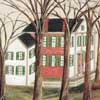
In the delightful drawing on the masthead of the Harvard Historical Commission’s new website, the town Common has a friendly familiarity but also a disconcerting strangeness. There stands the Pollard House on Fairbank Street, with its intriguing octagonal turret, and there is the steeple of the Congregational Church at the other end of the scene, with just a bit of the Nason-Whitney house beyond, painted the same warm yellow as today. The layout of the roads, the slope of the Common, and even the trees all seem quite recognizable. But what is that other building with a cupola next to the church? And what became of those impressive houses east of Massachusetts Avenue, where none exist today?
The Historical Commission’s website, at hhcommission.wordpress.com, will answer those questions and many more. The website has been in the works for “the better part of a year,” according to commission member Joe Theriault, who did much of the work, helped by feedback from other members.
Valuable assets
Some of the most valuable features of the website are tucked under the unassuming tab, “Assets.” There you will find a listing of historic areas, including Old Mill Pond, where John Prescott built a mill in 1668, two full generations before Harvard was even incorporated as a town. Also listed under Assets are Harvard’s two historic districts, the Common and the Shaker Village.
But the real treasure trove of information under Assets is the Register, a listing of more than 500 historic buildings, objects, areas, and structures to be found throughout Harvard, including many in Devens. For anyone who has driven past a handsome, old house in town and wondered who built it and when, the Register may well have the answers. Many entries have a link to a downloadable inventory that shows a picture of the building and also provides a summary of its history and architectural features.
Another strength of the website is its wealth of links to other sites. If you want to repair a historic wooden window, you can find help under the “Bookshelf” in the Preservation Briefs from the National Park Service. (Much of the information probably works just as well for nonhistoric wooden windows, too.) Plaster, cast iron, tile, concrete, and more—there are briefs on how to deal with all of their aging problems, provided by way of another local history organization, Freedom’s Way.
A promise for the future
Some sections of the website are still a little short on content, but they offer promise for the future. For example, the section on “Walks” has an attractive map of the “perambulation” around the Common developed by the commission’s current chairman, Ken Swanton. But the accompanying descriptions are very brief. If they can be filled out, however, they will be an enjoyable introduction to local history for residents, visitors, and students.
The website also clarifies the perplexing question of the different roles filled by the Harvard Historical Commission and the Harvard Historical Society. “This has been a point of confusion with many of my buddies in town,” says Theriault, who recently added a blog post to the website to explain the difference.
Overlapping interests
As the blog entry states, “The Historical Society is a private, non-profit organization, while the Historical Commission is part of our town government.” The commission deals with Harvard’s historic assets, a category that includes buildings, areas, monuments, and structures. The commission’s focus is on preserving those specific assets for future generations. The Historical Society, on the other hand, is concerned with a broad range of artifacts and documents—letters, tools, clothing, toys, diaries—while sharing the commission’s interest in historic houses and structures. Given their overlapping interests, Theriault says, the two organizations often cooperate.
In short, the Harvard Historical Commission’s website is an enjoyable and informative place to poke around. The deeper you look, the more you will find. Consider those now-vanished houses that once graced the southern end of the Common. Both perished in a 1917 conflagration. And that building with a cupola, next to the Congregational Church, was the Center School, which was moved to Ayer in 1905.

The masthead on the home page of the Historical Commission’s new website features Luke Pollard’s painting of the south side of Harvard Town Common as if looked in the late 19th century.