
Directed by: Quentin Tarantino
Starring: Jamie Foxx, Christoph Waltz, Leonardo DiCaprio
Rated R, 165 minutes
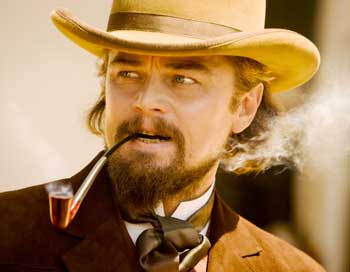
Leonardo DiCaprio stars in “Django Unchained.” (Courtesy photo)
So, Quentin Tarantino finally takes on the Western, that most bloody of genres. At least, that’s how he perceives it: as a genre devoid of most everything besides gore and violence. “Django Unchained” is perhaps his goriest movie yet, an excessive display of abolitionist pulp fiction (pun intended) in the same vein as his anti-Nazi revenge fantasy “Inglourious Basterds.” It’s wildly entertaining, of course it is. I just don’t know if it’s good.
A German-born bounty hunter, Dr. King Schultz (Christoph Waltz, “Inglourious Basterds”), strolls into slaveholder territory, looking to collect some bounties. One is for a trio of brothers, but he has no idea what they look like, so he recruits a slave named Django (Jamie Foxx, “Ray”) who does. Schultz makes Django a free man, and they eventually become partners. It happens that Django and his wife, Broomhilda, were separated by their former owners after a failed escape attempt. Now that he is free, Django is resolved to find her, and Schultz agrees to help.
Their search takes them to an enormous plantation in Mississippi, Candieland, run by Calvin Candie (Leonardo DiCaprio, “Inception”). Since Candie is one of the wealthiest and most brutal slaveholders around, Schultz and Django know that simply offering to buy Broomhilda won’t suffice, so they pretend to be wealthy slavers looking for some good “specimens” to purchase. The ruse works only for so long, though, and Candie sees through their ploy. Candie then turns on Django and Schultz, thus threatening their quest to save Broomhilda, as well as their lives.
It’s hard to form any thoughts about the movie as you’re watching it for the first time. Every one of its 165 minutes slams you like a brick to the face. But slowly, some general conclusions take shape: that the acting is very good, for instance, or that the movie looks and sounds excellent. These are all standard fare for Tarantino, of course. He has always cared as much about the look of his movies as he does about the stories behind them, or perhaps even more. And his actors have always embraced whatever campiness or extreme moral compass or violent nature comes with their characters.
Many of the characters in “Django Unchained” are caricatures, though, which makes it harder to get behind them. For instance, Waltz, who absolutely stole the show in “Inglourious Basterds,” is back as an awkwardly formal-tongued killer, but this time that intelligence comes across as an affectation that lacks depth or the capacity for surprise. Maybe it’s unfair to compare this role to his former one, but Tarantino is begging us to do exactly that, and it doesn’t work in the movie’s favor.
DiCaprio and Foxx, meanwhile, both shine in their first Tarantino film appearances. Foxx is unrestrained, brazen, and heroic, although Tarantino skimps on creating depth and motivation for him, relying too often on long meaningful looks rather than substantial scenes. As for DiCaprio, Calvin Candie is so far from his usual roles and is so unabashedly evil we can’t help but be intrigued. His scenes are tense because of his presence, and his sudden mood reversal is easily the most intense moment of the film.
The problems lie with Tarantino’s script and his aimless desire for blood. The film has been criticized for mocking slavery, but frankly I don’t think it says anything about that; rather, slavery is used merely as a setting in which a story of gruesome vengeance can take place. Tarantino revels in violence and sure, it’s stylish, but what’s the point? It isn’t an emotional story (Django, our hero, is motivated by a wife whom we only ever see crying in corners) or a political story (Schultz’s interesting take on slavery is briefly mentioned and mostly ignored). It’s not offensive—if anything, Tarantino has deemed the country mature enough to watch what is essentially a Blaxploitation movie without overreacting to any suggestion of “racial tension” — but there’s very little to take away from the film besides that.
“Django Unchained” is one of the best movies of the year, but I think that’s by default, more a result of Tarantino’s ability to create cinematically interesting moments than a result of an intelligent, fully realized story. Put it this way: the movie ends when the action at Candieland ends, but a proper ending for the characters is absent. Two hours and forty-five minutes is plenty of time, but it feels like Tarantino picked the wrong two hours and forty-five minutes to show.
Danny Eisenberg is a 2010 graduate of the Bromfield School and is currently a student at the University of Pennsylvania.