
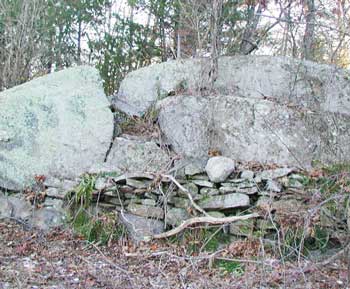
The sun rises above the notch in this wall during the summer and winter solstices. (Courtesy photo by Jim Salem)
This morning (Friday), early risers were expected to have gathered on a knoll in nearby Boxborough to witness the sunrise after the longest night of the year. Standing on the same 4-foot length of stone as people did hundreds and perhaps thousands of years ago, and weather permitting, they would have witnessed the first rays of the winter solstice as they appeared through a notch between two boulders that, together, resemble a giant turtle.
Solstice Sunrise Rock, as the “turtle” has come to be known, is at Half Moon Meadow in Boxborough, a property of the Sudbury Valley Trustees, a regional land trust for land and wildlife habitat conservation.
The origin of the site is unknown. Recent research suggests that it is not an anomaly but a Native American formation similar to other astronomically oriented stone structures that have been identified throughout New England.
For more than a dozen years, George Krusen, who owns a small farm next to Half Moon Meadow, has led a Sudbury Valley Trustees tour of the site for visitors hoping to welcome the sun and the start of longer days or to learn more about Native American stone structures.
Discovering the site
In the 1980s, Krusen was curious about the many stone walls he saw around him, particularly some that were in locations that did not make sense for field clearing or field boundaries. A local librarian told him that another man, Byron Dix, was also looking for information about local stone walls. Krusen recounted that after the two met, he invited Dix over to see the land around him. On the walk, Dix spotted a piece of quartz embedded in a large rock. Dix didn’t think it should be there naturally, Krusen said. Working back from the rock, Dix found a large, flat stone in a stone wall.
“I think this is a solstice alignment,” Krusen remembers Dix saying.
Krusen had to wait for the winter event to prove Dix right. Another Dix prediction, a summer solstice alignment, was found between the platform rock and a mound of stones.
Conventional wisdom would have said the stone wall that supported the viewing platform was a Colonial construction, but also would have questioned whether any colonists would have created the astronomical orientation or seen or manipulated two boulders to resemble a creature.
As it turns out, Dix, a professional optical mechanical designer and an amateur field researcher, had been exploring New England stone formations for 20 years. He and his research partner James Mavor, a naval architect with the Woods Hole Oceanographic Institution, published their findings and interpretations of regional Native American stone work in a book, “Manitou,” that turned conventional wisdom on its head.
A new perspective
Until recently, mainstream archaeology had attributed almost all rock piles, stone walls, and stone chambers in the northeast to Colonial settlers who cleared fields, marked boundaries, and built root cellars. Dix and Mavor’s exploring eyes, measurements, and calculations revealed another possibility.
They argued that many rock piles were deliberately placed rocks with directional, astronomical, calendar, or ritual meaning; some stone rows, like the one found at the Flagg Saw Rock Shelter site in Marlborough, were built by early Native Americans. They documented stone-marked burial sites and u-shaped areas of individual stones.
“There is a tremendous amount of stone construction in New England, which has gone unnoticed,” the researchers wrote.
It is largely amateur astro-archeaologists and enthusiasts who are uncovering and documenting Native American rock work. They share their findings with groups like the New England Antiquities Research Association and on blogs and websites such as rockpiles.blogspot.com and stonestructures.org. The numerous pictures on those sites quickly suggest that evidence of past Native American life is all around New England.
Half Moon Meadow and the solstice site were saved from development when the Sudbury Valley Trustees purchased the land in 1999 at Krusen’s urging.
Krusen also had a hand in persuading the Nature Conservancy to protect the Boxborough esker and its Native American stone structures.
The Flagg Swamp Rock Shelter, documented to be at least 3,000 years old, gave way to an exit ramp for Route 290. The Boxborough rock stack used as a pulpit by Colonial Rev. John Eliot was bulldozed for a real estate development. A cairn field with hundreds of four- or five-foot piles of rocks was reputed to have once been where Route 495 passes near the Boxborough esker.
Local evidence of Native American spiritual and physical life is routinely being discovered, and some of it is disappearing.