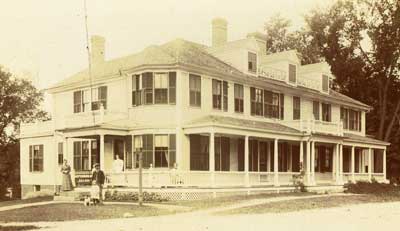
The old inn served as a private home in a bygone era. (Photo courtesy of Harvard Historical Society)
While its current iteration is a four-condominium complex (see related story), the building at 11 Fairbank St. has had many different identities over its nearly 200-year history. At one point it housed a roller skating rink, and in the early 20th century it came close to burning down. But regardless of what it is now or was originally, to Harvard locals it will always be “the old inn.” Its glory days were 1945 to 1953 when it had eight rooms for guests and could seat 50 people at a time in its three small dining rooms.
The structure was built around 1825 by Reuben Whitcomb Jr. for a store and dwelling. According to a 1979 article in the Harvard Post, “The north end was used as a store, with an outside stairway leading to chambers on the second floor long occupied by Enoch Perkins, businessman; Squire Abel Whitney, a lawyer; and a tailor. The south end and center of the house were tenements.”
The word “tenement” is being used in its original sense of “a dwelling,” but it is interesting to note the use of “chambers” rather than “tenement” for the rooms on the north side.
In “History of the Town of Harvard,” Henry Stedman Nourse points out that two rooms of the structure displayed murals by Rufus Porter, who was an itinerant painter of the time, traveling the countryside doing scenic tempera wall paintings. One wonders whether it was by chance or some connection that Porter stopped in Harvard. At some point – probably during the Victorian period – these murals were covered over with wallpaper. The first floor on the north side continued to be used as a store by Whitcomb’s successors, among them Trumbull Bull and Gale and Dickson. The latter pair, owners of the general store, used the space for grain storage and later turned it into a roller skating rink.
Whitcomb’s widow sold the building in 1865 to Alfred Farwell, who later converted it to a private residence. A photo dated July 27, 1917, shows Devens soldiers and local firefighters protecting the Farwell house. Two similarly elegant homes to the southeast were destroyed by fire.
In 1946, Rachel McTigue bought the home from Gertrude Farwell Sawyer and with her husband, John, began extensive renovation. In the process, according to newspaper reports, they uncovered the Porter murals beneath multiple layers of wallpaper. The McTigues stripped the wide-plank floors of layers of paint and restored the building’s fireplaces. There were eight rooms for guests on the second floor. Downstairs, a kitchen and one of the dining rooms were at the back of the house; two other dining rooms and two sitting rooms at the front.
A year later, the Harvard Inn opened for business. The location was perfect for the time, as the building sat at the intersection of two “major state highways,” routes 110 and 111. Vacationers from the south would stop for a night on their way to New Hampshire or Maine. In the winter, rooms were booked for months at a time, some of them by Harvard residents. A room at the Inn cost $2.50 to $4 per night with breakfast, and weekly rates, which included three meals a day, ran $35 to $40 per person.
The Inn served home-cooked meals and was open to the public for lunch and dinner except on Mondays. Sundays, the dining rooms were open from 12:30 to 7 p.m. A Sunday or holiday could see up to 200 diners. Party luncheons or dinners for up to 100 people could be arranged.
One would call Harvard 177 to reach Mrs. McTigue for reservations.
The time came when, to stay in business, the Inn would have had to expand. As with so many other buildings in town, there was no room to extend the septic system and so the Harvard Inn, once “open the year round,” closed its doors. The McTigues converted the Inn into apartments and after her husband’s death in 1961, Rachel McTigue sold the building to Kenneth and Margaret Jennings who in turn sold it to Raymond Warren.
In 1984 then-owner Peter Warren put the building up for sale. While to many in town the old inn seemed like the perfect solution to the need for housing for the elderly, because the town did not have a Housing Authority, it could not act on a purchase.
The members of the Harvard Conservation Trust felt strongly that it was important to preserve the historic landmark and in March of 1985, the trust purchased its first building. The following January it passed ownership to the Harvard Inn Limited Partnership, an investment trust formed specifically to manage the property.
In 1993 Harvard Trust Non-profit Properties bought the building. The old inn, together with Great Elms on Stow Road, became the first affordable housing in Harvard. After 18 years, the Trust was no longer able to sustain the property, and with no other support available, the bank foreclosed and put it up for auction. Richard J. Curtin and Robert J. McGinty bought the old inn in 2012.