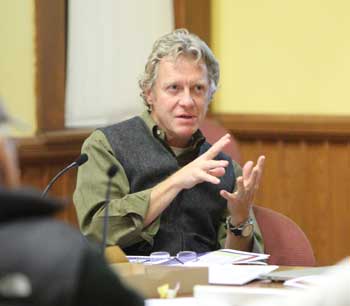
Doug Coots discusses LEED-recommended roofing materials Nov. 26. (Photo by Lisa Aciukewicz)
In a meeting with its architect, the Town Hall Building Committee spent more than two hours this week discussing whether to seek the endorsement of a prestigious international program that promotes construction of “green,” energy efficient and sustainable buildings.
But when they adjourned for the evening, one question remained unanswered: would Harvard citizens care? And if not, why bother?
The program in question is LEED, or Leadership in Energy and Environmental Design, an initiative of the non-profit U.S. Green Building Council, which evaluates construction and renovation projects—like the one planned for Harvard’s Town Hall—for their energy efficiency, their use of green building practices and materials, and their sustainability. As a Green Community, Harvard is already committed by law to the Massachusetts “stretch” code for building renovations. But the LEED program is entirely voluntary.
To win LEED certification, a project must gather a certain number of points by meeting 63 criteria set by the Green Building Council. Projects are checked for compliance during construction, but a final score is not awarded until a project is complete and all systems have been checked for compliance. The maximum number of points available to the Town Hall project is 110. LEED certification requires at least 40 points; platinum certification, the highest possible LEED rating, requires at least 80 points.
There is a certain prestige associated with a LEED certification, building committee chair Pete Jackson told the Press this week.
“It’s good ‘PR’,” he said, but the real value is in the higher quality building that results, whether or not certification is achieved.
The meeting Monday night, held in Volunteers Hall, was billed as a LEED “charrette,” a meeting to review preliminary designs for Town Hall and look for ways to increase its potential point score. Unfortunately, with the town’s email system temporarily out of order and no public announcement posted on the town website, Selectman Tim Clark and energy advisory member David Fay were the only residents present besides building committee members, professionals from LLB Architects, and project manager John Sayre-Scibona. Building committee member and Town Administrator Tim Bragan was absent.
63 criteria
To be LEED certified, projects must meet tough criteria for water use, indoor environmental quality, energy efficiency (including impact on the atmosphere), use of “green” materials, and the site’s contribution towards creation of a sustainable environment. Eric Broadbent, a member of both the building committee and the town’s Energy Advisory Committee, walked the other nine attendees through the 63 items of the LEED checklist, pausing at each to estimate how many points were likely, possible, or unlikely.
Most items, such as measures to reduce light pollution or control water runoff, are worth a single point. But others are worth substantially more. For example, because the Green Building Council favors projects that build on existing sites in densely populated areas, it awards up to five points for such projects. Town Hall can likely earn the full amount; the building has been a fixture in the center of town since 1872.
Other criteria, however, though valuable, can’t be met. Because Town Hall is without access to bus or rail transportation, for example, the six points available to locations with such amenities are out of reach. Ditto the seven points available for onsite renewable energy.
The mother lode of points is the score available for improving energy efficiency. A project can gain as many as 19 points—nearly half the score required for certification—by increasing its performance by 8 to 44 percent over that of an existing building. Prior to the meeting, committee members estimated 15 credits were possible, but LLB architect Drayton Fair said a 12- to 14- point score was more likely.
The building and energy committees have yet to set an efficiency goal for the reconstructed building or to choose systems for heating and cooling, lighting, and insulation.
More costly, but green and sustainable
On its website, the Green Building Council acknowledges that LEED-compliant buildings are typically more costly to construct. In addition, projects that join the LEED program must register with the Green Building Council, pay an upfront fee, and hire an independent LEED “commissioning” agent to track and measure compliance. LLB architect Fair estimated the total program cost at $5,000. The town would also have to bear the administrative costs of assembling documents for review and submitting periodic online reports, which Fair described as time consuming, though volunteers could help with the work. Some grant money is available, Fair said, but would be unlikely to cover more than 5 percent of the total cost of administering the project.
Fair said it would cost LLB engineers more time to review plans “for specific LEED criteria” and it would cost contractors more to document their work. However, he said, “If the [materials and systems] are specified to be LEED certifiable in the first place, which usually they are, it won’t cost more to analyze them [for compliance].”
As the evening drew to a close, talk turned to the value of a LEED certification. By his calculation, Fair told attendees, the Town Hall project might reach 40 to 42 points: 24 “probable” and 18 “possible,” barely enough to qualify.
“I think the benefit comes with the process,” Fair said.
LEED certification ensures that all systems are checked for compliance, especially the energy systems, which the town is relying upon to manage fuel and electrical bills and ensure a comfortable working environment to its employees.
“Though frankly,” Fair added, much of that is his firm’s job.
If certification is not pursued, said project manager Sayre-Scobona, residents are more likely to ask “why didn’t you” rather than “why did you.”
“What people don’t understand,” he said, “is how much extra it costs.”
“It would be nice to have a dollar estimate,” said building committee chair Jackson. “Then we can answer the question, ‘Why didn’t you get it certified?'”
Selectman Clark asked if the real issue was “more about benchmarking performance.”
“If our goal is to have lower operating costs down the road and the installed equipment does not perform…then that’s a ‘lose’ for us,” he said. The LEED process could be a hedge against failure, Clark said.
Coots replied: “If rigor can be achieved without relying on [Green Building Council] certification, then the project is no better or worse.” But the LEED checklist, he said, “allows us to understand that a ‘healthy building’ is not just one whose energy systems and building envelop work efficiently, but also how comfortable a work environment it provides town employees and users and how little environmental damage it causes.”
If the town doesn’t care about those factors, Coots said, and cares more specifically about how much energy the building uses, then it should set energy goals and find a way to design for them and measure them. “But who can determine that?” he asked.
“Perhaps we’ll hear from the town,” mused committee member Broadbent, and shortly thereafter the committee moved to new business, postponing a decision until a later meeting. The committee next meets on Dec. 18.