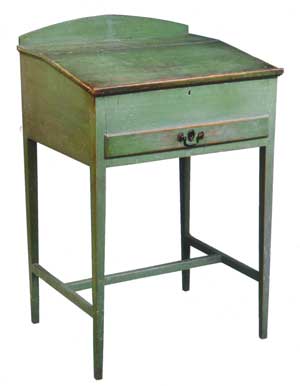
Shaker desk built by Alfred Collier in 1861, now at Fruitlands Museum. (Courtesy photo)
Every object tells a story, no matter how mundane or fascinating. The Shaker desk recently acquired by Fruitlands Museum tells the latter sort of story. It embodies a rich narrative of the object itself, the man who made it, the man who used it for 19 years, the relationship between them, and, ultimately, the crisis of faith and decline of the Harvard Shakers.
This is the story that Dr. Michael Volmar, chief curator of Fruitlands Museum, will relate in his presentation “Insights into Harvard Shaker History,” at the annual meeting of the Harvard Historical Society on Thursday, Dec. 6, at the society’s meetinghouse in Still River.
Volmar admits that he could not be more surprised–and he is obviously delighted–that Fruitlands was able to purchase the desk. His pursuit of it began in the 1990s and along the way was fraught by uncertainties and skepticism, but also by some serendipitous events. Fittingly, Volmar heard the good news of his winning bid on Sep. 15, the day of the Harvard Historical Society’s Shaker Village House Tour.
Volmar describes the desk as typical of Shaker craftsmanship, but with some unique features.
“It would be hard to identify a better documented Harvard Shaker community piece of furniture,” he said.
Volmar said he sees the desk as an excellent addition to the rich history of Harvard, epitomizing the Shaker past.
Brother Alfred Collier built the desk. Collier, whom Volmar says has always been his “favorite Shaker,” was brought to the village at the age of 8 and played changing roles in the community until he left it in 1864. Volmar points out that during the 1840s, Collier was a true believer whose role was to be a conduit of faith.
A decade later, Collier was deacon in the Church Family and Head of the Farm. As such, he was required to keep a journal, as was everyone in an official role.
Volmar’s affinity for Collier is shared by many people who have reading Shaker journals because of the way in which Collier reveals himself as a man; he comes alive through his writing. While most of the other journals are rather impersonal accounts of weather, work done, visitors from “the world,” illness, and references to comings and goings of people in the village, Collier’s are infused with his personal feelings.
As a member of the “second generation” of Shakers, Collier became caught up in a crisis of faith. In 1857 he wrote, “…Since last April my mind has been subjected to some changes in my vein of religious matters but not as yet to effect a change in my manner of life.”
A later entry notes, “I have lived to see Believers few and weak and hired men stalking abroad in the place of young men brought up among believers.”
Collier felt the increasing tension between the generations: “The friendship that is extended to me in these days is cold as Charity.” And he was deeply burdened by the exodus of young people from the community: “I have at times felt very sorrowful but the loss of friends has effected me deeply & has at times wrung out the bitter tears of agony.”
In 1861, when Collier was 38, he was asked to make a desk. The recipient of the piece was to be Elder Grove Blanchard, a man 20 years Collier’s senior who had been a ministry Elder for over four decades. Volmar notes that the core values of the Shaker religion were not open to modification; it was a faith that “did not evolve.” Elder Blanchard was the one responsible for protecting the core values from changes being pushed by the second generation. It was he who had to ensure that “union” continued to flow and try to stem the tide of young people leaving the community.
Volmar finds it fascinating that it is these two men who come together in this Shaker desk, two men whose relationship had been close in earlier years but had undoubtedly been strained by the controversy in the village. Puzzling to Volmar is the fact that the desk is signed. He notes that it was very rare for a piece of Shaker work to be signed. And, even more mysterious, the signature is not in an obscure spot but written large on the inside of the lid. Volmar ponders what Collier meant by this and what the reaction was.
“I can’t help but wonder what Elder Grove thought the first time he lifted the desk’s lid and saw Collier’s large signature,” he said.
In his talk, Volmar will explore how this unique object speaks of two very different men, of a relationship mirrored in the generation gap throughout the Shaker community, and, ultimately, of the changing values of mid-nineteenth century America.
In addition to Volmar, special guests of the evening will be the residents who opened their historic homes for the Harvard Historical Society’s Shaker Village House Tour and the many volunteers who helped to make the day such a success.
The business meeting will begin at 7 p.m., followed around 8 p.m. by Volmar’s talk and refreshments. The community is welcome to join members at the meeting as well as to attend the presentation.