
Directed by: Ben Affleck
Starring: Ben Affleck, Bryan Cranston, Alan Arkin
Rated R
120 minutes
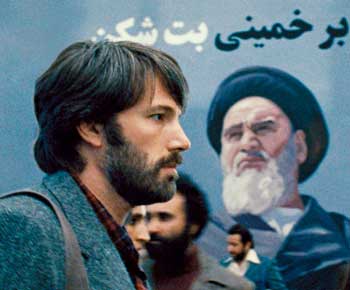
Ben Affleck directs and stars in “Argo.” (Courtesy photo)
I’m conflicted about “Argo.” On one side is my enjoyment of the movie—the suspense I felt, the humor that hit at the right times, the impressiveness of the movie’s accuracy in reenacting historical events—but something on the other side is keeping me from calling it great or even memorable. That something, I think, is the sheer number of tropes and clichés that fill the scenes of this movie. “Argo” is very good, but take any scene out of context and I guarantee you, you will have already seen a version of it somewhere else.
The third feature film directed by Ben Affleck (“The Town” being his most recent), “Argo” centers around the Iranian hostage crisis, beginning in November of 1979 as revolutionaries storm the U.S. Embassy in Tehran and take all the employees hostage. All the employees except six, that is.
The film follows these six employees, who escape to the Canadian ambassador’s house nearby. Back in the United States, Tony Mendez (Affleck), an exfiltration expert, is informed by a high-level CIA executive, namely Jack O’Donnell (Bryan Cranston, TV’s “Breaking Bad”), that he has to figure out how to get the six escapees out of Iran. After explaining why all the suggested methods of extraction are implausible, Mendez comes up with one that’s utterly insane by comparison: he’s going to go into Iran posing as a filmmaker scouting locations for a movie, and is going to walk out with the six Americans, who will pose as his crew.
Needless to say, the idea doesn’t go over well, but with no other good options, the CIA okays the operation. Mendez hightails it to LA, where producer Lester Siegel (Alan Arkin, “Little Miss Sunshine”) agrees to produce a fake movie. They find a sci-fi script called “Argo,” which becomes the basis for the movie they’re not going to make. They bolster the cover story with an office, a read-through of the script, posters, storyboards, the whole nine yards. Once the fake movie is set up, all Mendez has to do is walk into Iran and walk out.
Of course, it won’t be that easy. It never is. The six Americans aren’t thrilled, the CIA isn’t exactly fond of the plan, and oh yeah, there are thousands of angry revolutionaries who would like to see them all dead.
There’s a running joke throughout the film comparing the CIA and Hollywood. Mendez walks a thin line between two distinct worlds—the movie world and the secret agent world. Combining them in the cheesiest and yet most dangerous way possible, he attempts to save the day. And it’s all good fun, of course, except that it’s so unabashedly a crowd-pleaser that you start to feel pandered to. We get a lot of “Well, that’s Hollywood!” wisecracking jokes from Alan Arkin, and we get the same sort of “Well, that’s the CIA!” quips from Bryan Cranston.
That isn’t to say it’s a bad thing, it’s just not a particularly clever story. It’s predictable. Tony Mendez is our hero, the loner with a few problems of his own but who’s got a Herculean inner strength that can move mountains. Siegel is the crusty old-timer who knows everything and everyone in Hollywood. O’Donnell is the suit, sworn to secrecy on all matters, a stickler for rules and protocol. The six stranded Americans are a band of colleagues brought together by circumstance, among whom tensions run high, emotions go up and down, yadda yadda yadda…
Even though the script is formulaic, “Argo” avoids feeling generic, mostly through technical elements. The handheld camerawork is just the right amount of jarring, as is the quick-cut editing. Affleck achieves a very ’70s look through grainy film and terrific costumes and makeup; during the credits, we see movie stills placed next to historical photographs, and the resemblance is uncanny. Affleck and Co. did their homework.
The result is a very satisfying movie. If “Argo” is a great movie, it’s because of the technical side, because of the way suspense builds, because of the look it has. It’s a bit of a cheesy story (thankfully not as cheesy as the fake movie it’s about), that’s for sure, but the important thing is that it still satisfies. If I were an angrier critic, I’d call it just another example of the standard, unsophisticated Hollywood story, but I’m not angry, and I enjoyed the movie. Sometimes, the standard Hollywood story can be done well.
Danny Eisenberg is a 2010 graduate of the Bromfield School and is currently a student at the University of Pennsylvania.