Directed by: Bart Layton
Rated R
99 minutes
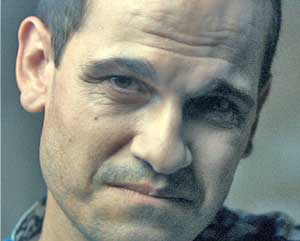
Frédéric Bourdin is an identity thief in “The Imposter.”
(Courtesy photo)
In 1994, Nicholas Barclay, a 13-year-old boy from San Antonio, went missing. Miraculously, three years later, police in Spain found a young boy who claimed to be Barclay. He came home, his family took him in, and life went on.
Except it wasn’t Nicholas Barclay at all. It was a Frenchman, Frédéric Bourdin, a drifting identity thief in his mid-twenties who felt a compulsion to find himself a family where he would be loved, even if it meant stretching the truth to incredible limits.
“The Imposter” is the comprehensive explanation of a lie that turned into a bigger and bigger whopper of a tale, a detailed and logical analysis of how a family could mistake a stranger for one of its own.
Bart Layton, a TV documentary maker, presents a quirky, thrilling, and at times eerie look at Bourdin and the Barclays in his debut film. In a lot of ways it’s a similar documentary to James Marsh’s “Man on Wire,” in that an illustrious figure who committed an infamous act tells us directly how everything happened. Bourdin’s screen time is almost always cheerily tongue-in-cheek, but at the same time a bit sinister, given the harm his actions caused.
He shows no remorse, but at the same time he isn’t a braggart. Bourdin is simply a liar who got away with some pretty hefty ones. Much of it was out of his hands, and for a while he just got incredibly lucky. What parts were under his control–his original identification, his attempts to alter his appearance, his explanations about Nicholas’s whereabouts for those three year–were, however, meticulously thought through. Bourdin is also extremely quick on his feet, much to his advantage.
The Barclays, on the other hand, are a bit slower, and while it’s almost humorous to hear about Bourdin’s utterly conspicuous actions that went unnoticed, those bits of humor are always paired with the embarrassment and shame of a family that, in a moment of blinding hope, acted carelessly. Barclay’s sister and mother provide much of the commentary, as well as an excited federal investigator and an even more excited private detective, and their explanations of what they assumed and thought follow a logical progression, much like Bourdin’s explanations of how he impersonated a total stranger.
While this logic is fascinating to hear straight from the horse’s mouth, it can lock the narrative down too rigidly at times. We get glimpses of Bourdin’s childhood—an unhappy experience that led him to want to be someone else, to constantly move on to places where he’d be appreciated more—but never a whole picture. There is also some speculation as to the true whereabouts of Nicholas Barclay, but of course this goes unresolved. We get no real sense of what the Barclays were like before Nicholas went missing, only that tensions arose after he disappeared.
We get a very clear description of the impersonation, bolstered with heavy doses of reenactment and a creative use of sound, but little discussion of the larger implications. Where a good deal of digging could have been done, Layton seems to have merely asked, “Ok, what happened next?” Which is all well and good, but it loses its ability to fascinate after a while.
Layton is very good at keeping the suspense high in other ways, though. For instance, we don’t learn Bourdin’s identity until we’re near the end of the movie, so for a long time we have no idea who this charismatic and excitable foreigner telling us all about his adventure is. Also, the discussion of Nicholas’s real fate, however brief a discussion that is, has all the same tension of a “Frontline” investigation (and I mean that in a good way).
So it’s clear Layton knows how to put together an engaging documentary. I’m just left wondering why he didn’t get a deeper story out of Bourdin, and because we don’t go further than a chronology of events, “The Imposter” only scratches the surface of what would be a great psychological topic – the psychology of lying.
Of course, it may have been out of Layton’s control; it’s probably difficult to get the whole truth out of someone who never tells it.
Danny Eisenberg is a 2010 graduate of the Bromfield School and is currently a student at the University of Pennsylvania.