Mosquitoes infected with West Nile virus or eastern equine encephalitis have been found in the nearby communities of Acton, Boxborough, Devens, Lunenburg, Fitchburg, and Leominster, Board of Health Chairman Tom Phillipou said this week.
“It would be naïve to think they [infected mosquitoes] are not in our jurisdiction,” Phillipou told the Board of Selectmen Tuesday night. Phillipou said a common mosquito breeding ground is swampland with red maples, which Harvard has in abundance.
Earlier in the day, the Massachusetts Department of Public Health announced one new case of eastern equine encephalitis in Essex and a new case of West Nile virus in the greater Boston area, bringing the total number reported since June to five cases of eastern equine encephalitis and 15 cases of West Nile virus. So far, two patients have died in Massachusetts, one from each of the diseases.
“EEE is the more lethal of the two,” Phillipou said.
Across the state, the Department of Public Health’s assessed threat levels for individual towns remain unchanged. Harvard, along with most of the state, is identified as a moderate risk area until the first hard frost.
Last week, after informal conversations with Phillipou, Harvard Schools sent notices out to students and parents about the mosquito-borne diseases and preventive strategies to avoid infection. A bulletin from Bromfield School sports director Pam Alexander advised, “All athletes should have bug spray in their gym bags and they should put it on for every practice and game. All games and practices must end by 6 p.m. due to the mosquito threat.”
Alexander told the Press that some games have had to start earlier, but so far nothing was rescheduled or canceled.
The Department of Public Health statement listed the initial symptoms of EEE as high fever, stiff neck, headache, and a lack of energy. In severe cases, the disease can progress to confusion, disorientation, and coma, the Department of Public Health said. Most people infected with West Nile virus will have flu-like symptoms or no symptoms at all. The elderly are at higher risk for both diseases.
“The first line of defense is personal protection,” Phillipou said, advising residents to avoid being outside at dusk and dawn, cover skin with clothing, and to use insect repellent. The national Centers for Disease Control and Prevention neatly summarizes the advice as the “five Ds:” dusk, dawn, dress, DEET, and drain.
In a quest for “hard data” on the prevalence of mosquitoes in Harvard, Phillipou said, he contacted the Central Massachusetts Mosquito Control Project, a quasi-public agency that oversees regional mosquito monitoring and control. Harvard is not a member of the project.
Phillipou was told that towns that signed on to the $60,000-a-year program could pick and choose their service locations, but individual services like monitoring were not available. The agency describes its program as surveillance, habitat modification, mosquito larvae and adult eradication, public education, and research.
Phillipou’s inquiries to state agencies had no better luck turning up possibilities for state-funded monitoring in town.
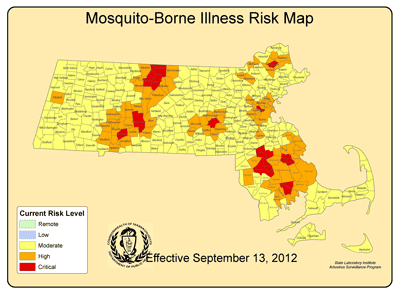
Click image to enlarge
Although Phillipou was not requesting the town immediately spray to kill mosquitoes, as Devens, Boxborough, and Bolton recently did, the possibility of future spraying was a subtext to the discussion. Phillipou acknowledged that there has been opposition in town to using chemicals against mosquitoes. He said he learned that, using GPS technology, the Mosquito Control Project could avoid road spraying along properties where residents don’t want it, as well as go up long driveways of residents who do.
The mosquito control program uses Anvil, an insecticide containing sumithrin—a synthetic pyrethroid—and piperonyl butoxide in a base of 80 percent petroleum distillate.
Phillipou said he is interested in finding out, now, which property owners might want spraying and which might not.
“We should probably start to evaluate where people fall on this [spraying personal property],” he said. “…If the state determines there is an emergency, we could custom tailor services so as not to fall victim to an aerial bombardment of chemicals.”
Although aerial spraying was conducted in southeastern Massachusetts in July, there is no indication that forced spraying is imminent.
Joining the Mosquito Control Project or contracting independently for spraying requires Town Meeting approval, so any chemical action would have to wait until spring and the Annual Town Meeting.