View from Spring Lake trail in the Grand Tetons. (Photos by Nicholas Kouros)
Wanting to see more of our own country and to have an easier, domestic travel experience than going abroad, John and I joined Harvard friends Chuck and Dina Hettes for a five-day trip to the Grand Teton National Park. Established in 1929, the park was greatly expanded through the vision and philanthropy of John D. Rockefeller Jr., creating the present-day park in 1950.
For our lodging within the park, we chose Jenny Lake Lodge, which first was built as a homesteaded small ranch near the turn of the 19th century. It later became popular as a dude ranch in the 1920s, bringing more tourists to the area who needed lodging. The surrounding lakes—Jenny, String (formerly Beaver Dick), and Leigh—were named in honor of Richard “Beaver Dick” Leigh and his Shoshoni wife, Jenny, who guided the Hayden Survey party that first mapped the area in the 1870s.
At an altitude of about 6,000 feet, we took an easy hike on the first day to get used to the thinner air, walking from the lodge after a sumptuous breakfast (included) to the String Lake Trail. Spurred by the beautiful vistas, we continued on to Leigh Lake. All of the trails in the park are nicely maintained and tend to skirt the many lakes and streams in the region, keeping the ever-present view of the three peaks of the Grand Tetons. Depending on the perspective (height of the trail, angle of the view), the view is ever-changing and the mountains always deserving of their title; they are simply grand to behold. With peaks like stiffened egg whites, they seem to be defying gravity and reaching for the heavens.
And then there was the smoke.

A Homestead structure in Mormon Row with smoke haze over the Tetons in the background.
With fires in Wyoming (nearby Jackson and Casper) and as far as Idaho, the ever-present smoke became for us a part of the landscape. Because of the winds, smoke from the fires was driven south and then trapped within the mountain range. Because of an inversion effect in the evening, smoke settled like pollen in the early morning hours. However, by the time we were through with breakfast, it was already clearing, and usually by noon it was just a visual haze in the distance. Seeing the Tetons through this haze was somewhat ethereal.
Hiking in the wilderness is as restorative to the spirit as it is to the appetite. After returning to our cabins after each day’s hikes and refreshing ourselves, we met for dinner in the rustic log cabin dining room for a five-course gourmet dinner (included) to relax, refuel, and discuss the many things we saw along the trails. To help us with our observations, there was a ranger talk each morning after breakfast, when we could ask questions about what to look for depending on our destination.
The next day we took a short hike in the morning, then hit the road to head out for the Mormon Row Historic District, located in Moose, just 12 miles north of Jackson. The Homestead Act of 1862, which promised 160 acres to anyone willing to build a house and cultivate the land, drew many settlers into this area, known as Jackson Hole.
These settlers moved to more populated areas in the mid-1900s as their land was acquired to expand Grand Teton National Park. Being there lets one see the landscape that drew them: the endless ocean of gray-green sagebrush, interrupted only by cottonwood and quaking aspen trees.
Homesteaders who settled here clustered their farms to share labor and community. Structures from six homesteads remain. As we roamed among remnants of the settlements, we stopped to peer out excitedly at sightings of bison and pronghorn roaming the sagebrush flats. We could only imagine the grazing cattle and hayfields that once filled the horizon, and the pioneering spirit of the people who turned this vast landscape into their home.
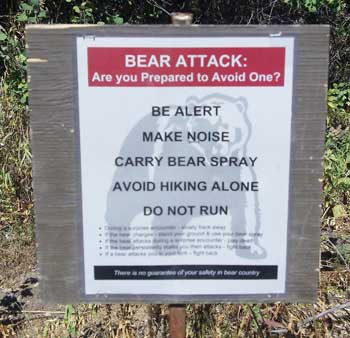
A solemn warning to visitors in Grand Teton National Park.
The next day we headed for the Lawrence L. Rockefeller Preserve, a few miles south of Moose. The draw was the beautiful trails leading to Phelps Lake, providing extraordinary views of the Teton Range. We took an easy three-mile loop to the lake and back and fortunately did not encounter any bears. We did, however, encounter several bear warnings, and I suddenly grew rather fond of hiking as close as possible to John while clapping my hands and saying “hey bear” to let them know I was around the bend. (They really don’t want to encounter you, so just make noise.)
Upon reaching the vista of Phelps Lake, there is a hushed rush of dopamine that rewards you for your effort getting there, all uphill. The small crowd of hikers sharing the space spoke in whispers so as not to disturb other hikers’ experiences, as if in a chapel. It was a very quiet, personal experience. We lingered, soaked it in, and reluctantly began the return hike.
What surprises presented themselves on the return! Carpets of lichen dripping from pine, storybook streams flowing over polished rock, and always those magnificent Tetons. At the base we refilled our water bottles and took in the very impressive Lawrence Rockefeller Preserve Center, with its gorgeous video displays and immersive sound room.
Our final day in the park was a trip to Signal Mountain, an isolated summit providing sweeping views of Jackson Lake and the entire Teton Range as well as the Snake River. Alas, after we drove the five-mile winding road to the summit and popped our ears, the smoke that day was too thick at the higher elevation (about 8,000 feet) to see much of anything. Abandoning our plans to hike even a small portion of the Signal Mountain Trail, we headed back down and drove to the Jackson Lodge for lunch on the patio. The sun broke through, it was warm, the food and drinks were good, and the views were spectacular. As we took turns with Chuck’s binoculars to spot a small herd of elk, we all agreed it was not a bad way to end our beautiful and smoky week in the Tetons.
I have seen many spectacular landscapes in my travels but none as striking and memorable as the Grand Teton National Park. The season is short, and lodging within the park is limited, so plan well in advance if you decide to go.
For information on lodging and camping, visit www.GTLC.com, the website of the Grand Teton Lodge Company.