
Directed by: Len Wiseman
Starring: Colin Farrell, Jessica Biel, Kate Beckinsale
Rated: PG-13
118 minutes
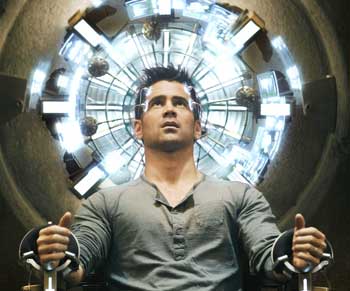
Colin Farrell stars in “Total Recall.” (Courtesy photo)
In case you were wondering: Yes, the original is better. It’s hard to say, though, what makes it better. It sure isn’t Arnold Schwarzenegger’s acting. The subtle changes to the story in this iteration of “Total Recall” are clever and make the original’s futuristic touches even more futuristic (whatever that means), but something about the overall package makes us care less and confuses us more.
It is the gritty, technology-dominated future, and chemical warfare has reduced the planet to two livable territories—England and Australia, now called the United Federation of Britain and the Colony, respectively. Workers travel from one to the other through the Fall, essentially a subway train that runs through the center of the earth. One of those workers is Doug Quaid (Colin Farrell, “In Bruges”), who has been having unsettling dreams lately about being chased. In the dream he’s with a mystery woman, and he always gets caught. His wife, Lori (Kate Beckinsale, “Underworld”), thinks he might be unsatisfied with their marriage, but he swears he isn’t.
But he is, of course—he’s unsatisfied with his whole life. Something’s missing. He goes to Rekall, a company that inserts false memories into patients’ minds—memories of their greatest fantasies. Quaid picks the secret spy fantasy, but before it can be injected into his mind, something goes awry, and the police bust in. Quaid escapes, but when he goes home, he discovers that Lori has been a fake wife, and that the government wiped his memory only weeks before.

Kate Beckinsale in “Total Recall.” (Courtesy photo)
He heads to Britain to sort things out, soon running into the woman from his dreams, Melina (Jessica Biel, “The Illusionist”). Those dreams were not, in fact, dreams at all; they were memories. Realizing what has happened, he and Melina set out to stop Lori and her government superiors and to help the workers of the world stop the UFB from destroying the Colony. Or maybe Quaid just needs to wake up from his Rekall-induced dream?
This last question is the most vexing. “Total Recall” talks about memories and dreams interchangeably, which can be confusing and frustrating. The ambiguous ending—is it all real or is it all in his head?—becomes a lot less ambiguous as a result.
The movie is still a head-scratcher, but visually more than story-wise. Clearly a lot of meticulous planning went into the design of the future world. But we only get glimpses that show everything all at once; you wouldn’t be able to take in the New York skyline in one glimpse, and future Earth is no different. It’s hard to ground yourself in a fictional world when you can’t see how far you are from the ground.
Director Len Wiseman (“Underworld”), to his credit, knows how to construct an action sequence. The original writers devised a clever plot, but in this version, we almost ignore it. There’s a lot of action, a little talking, and then more action. Good action, too, not “Expendables”-level mush (put it this way, I won’t be seeing that sequel). This is action that has been edited and presented well, even if it’s on too small a scale to show us the whole scene.
An assortment of generally generic performances lends itself to that all-we-care-about-is-action feeling, and while it would have been nice to, say, understand motivations and relationships and boring things like that, I don’t feel like I missed much. In a moment of supposedly great feeling, Quaid plays a somber tune on piano, and in doing so remembers key parts of his past. It’s very deep. Then a hologram shows up, then Melina tells him they have to go NOW, then people start shooting—you get the idea. It’s an emblematic scene, in many ways, of the movie’s intentions.
Because what that moment shows, in addition to Quaid’s “sentimental side,” is how “movies of the future” show characters’ sentimental sides. Throw in a musical instrument, that will make him artsy; throw in a girlfriend, that will make him romantic—token character traits, inserted for nobody’s sake. Either “Total Recall” is an example of the schlock that indie film snobs claim the mainstream is going to start feeding us, or it’s a tongue-in-cheek prediction about that schlock.
But which? That’s the real ambiguous question here, and everyone’s likely to think one way or the other. Unfortunately for Wiseman and friends, it’s not like some people will say it’s a great movie and some will say it’s not. It’s a matter of some saying it’s a bad movie and others saying it’s poorly done satire. But at least it’s fun, and that, it would seem, is all that matters.
Danny Eisenberg is a 2010 graduate of the Bromfield School and is currently a student at the University of Pennsylvania.