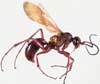

An unknown species of solitary wasp stings a caterpillar to bring back to its larvae. (Photos by Mary Holland)
When we think of a wasp, we usually think of members of the family Vespidae—yellowjackets, hornets, and paper wasps. These wasps build a nest, usually of masticated wood fiber, and live as an extended family in a caste system, with a queen who lays all of the eggs, a few males who fertilize the queen, and a lot of hard-working females who do everything from building and cleaning cells, to raising larvae and collecting food. These are social wasps that live together in colonies of anywhere from 3,000 to 20,000 individuals.
The majority of wasp species, however, are solitary, not social, wasps. This second category of wasps consists of individuals that live alone, with all of the females capable of laying eggs.
Most of the social wasps, both larvae and adults, consume nectar. While this is true of most adult solitary wasps as well, their larvae are meat eaters. Thus, solitary wasps are predators, hunting and capturing prey to provide their larvae with food to eat while they are developing in the nest. In most species, the nest is either a small structure the female constructs out of mud, or a tunnel that the female digs in the ground that leads to individual brood chambers. There are also species of solitary wasps that lay their eggs in the leaves or stems of plants.

A potter wasp (one type of solitary wasp) builds mud pots, fills them with paralyzed living prey, lays an egg on the prey and then seals the pot. The wasp egg hatches, the larval wasp eats the still-fresh prey, and after pupating, the adult potter wasp chews its way out of the pot.
There are many different families of solitary wasps, and their common names often imply something about the nature of their respective nests. Digger wasps and sand wasps dig underground nests. Potter—or mason—wasps make tiny, vase-like pots of mud attached to leaves or twigs. (It is speculated that Native Americans used potter wasp pots as models for their own pottery.) Mud daubers make nests of individual mud cells attached end-to-end, forming long, narrow strips of cells.
Gall wasps lay their eggs in plant tissue, resulting in the abnormal plant growths we call galls. Ichneumon flies, which are actually solitary wasps, lay their eggs in or on the larvae of other insects. Velvet ants (wasps that resemble hairy ants) and cuckoo wasps lay their eggs in the nests of other wasps or bees. A few solitary wasps prefer natural cavities such as holes in wood.
The process of raising young is generally the same for all predatory solitary wasps. A nest site is selected by the female wasp and the nest is constructed. Mud is collected and brought to the site by mud nest makers; sand, often hard-packed, is dug by the underground nesters and cavities are located for non-nest makers. The next task is to collect prey for their larvae. There are many species of prey that these wasps hunt, with each wasp family selecting certain insects and spiders as provision for their larvae (with the exception of wasps, such as gall wasps, whose larvae consume plant material).

A solitary wasp, the organ pipe mud dauber, applies a ball of mud to one of the cells in its tubular nest. Note that the new mud on the nest is darker than the rest because it hasn’t yet dried.
The stingers of many social wasps are used for defense, whereas solitary wasps use them primarily for subduing prey (and laying eggs). Although they can sting, they rarely do. After finding and paralyzing prey, the wasp grasps it in its legs or mandibles or both (and occasionally with its stinger) and carries it back to its nest. It repeats this process over and over until the chamber is stuffed full with paralyzed but living prey. The adult wasp then lays an egg in, on, or next to the prey and seals the chamber. When the egg hatches, the larval wasp proceeds to eat the fresh supply of food that its mother has provided, until it matures enough to pupate. Eventually the adult wasp emerges and exits the chamber by chewing or digging its way out and flying away.
The prey preference for Cerceris fumipennis, a species of solitary wasp, is members of the Buprestidae family of beetles. It so happens that the Emerald Ash Borer (Agrilus planipennis) that is decimating all members of the Ash family in the East and Midwest is a member of this group of beetles, and it turns out that C. fumipennis is much more adept at locating Emerald Ash Borers than humans are. A program of biosurveillance in Canada and the United States has been set up in which volunteers observe and collect prey that these wasps capture for their young, in hopes of monitoring the spread of the Emerald Ash Borer’s range.
The Massachusetts Introduced Pests Outreach Project, a collaboration between the Massachusetts Department of Agricultural Resources and the UMass Extension Agriculture and Landscape Program, is looking for volunteers. If interested, go to http://massnrc.org/pests/blog/tag/emerald-ash-borer/.
Mary Holland is the author of “Naturally Curious: A Photographic Field Guide and Month-by-Month Journey Through the Fields, Woods, and Marshes of New England” and “Milkweed Visitors.” She has a natural history blog which can be found at www.naturallycuriouswithmaryholland.wordpress.com.