
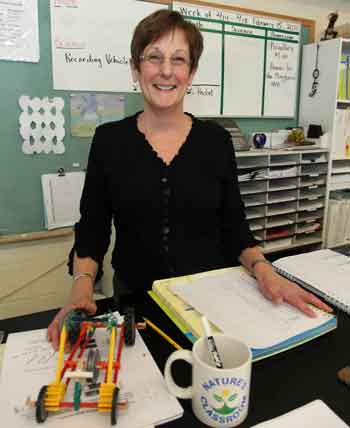
Terry Monette in her fifth-grade classroom at Hildreth Elementary School. (Photo by Lisa Aciukewicz)
Hildreth Elementary science and math teacher Terry Monette, best known for introducing outdoor learning programs to the school, is retiring next week and planning on heading into the great outdoors herself.
After 21 years at the school, Monette decided to bring her teaching career to a close while she and her husband, a retired educator, were still able to enjoy the outdoor adventures they have always loved.
The couple—who met on an Alaskan kayaking expedition and honeymooned in the Wyoming mountains—have placed Iceland and Costa Rica at the top of a long list of travel plans, all of which include some combination of camping, hiking, and kayaking.
The retirement adventures that Monette has planned align with her professional focus: an emphasis on outdoor education. Her first job after graduating from college was as a naturalist at an environmental learning center. She soon earned her master’s degree in experiential learning, and taught elementary school in her home state of Minnesota, leading her students on a variety of skiing, hiking, snowshoeing, and winter camping trips. After moving to Massachusetts, Monette taught in part-time positions until her children Matt and Cassie (now both doctoral students) were in grade school. At that time—following an interview that took place during the watch for Hurricane Bob—she was hired to teach science as part of a fifth-grade teaching team that included Scott Hoffman, Chriss Moeser, and Mitch Grosky.
When that teaching team embraced Monette’s idea for students, their teachers, and parent chaperones to attend a sleep-away environmental education program, a tradition was born. After attending Horizon for Youth in Sharon for some years, the fifth grade settled into a yearly trip to Nature’s Classroom in New Hampshire.
“Nature’s Classroom was the best,” said Bromfield eighth-grader Julia Leblanc this week, looking back on her experience. “You’re in the woods. And you’re with all your friends.” Adding to the trip’s charm, she noted, was the build-up.
“Throughout your whole time at elementary school, you’re always hearing about it and looking forward to it,” Leblanc said.
As for lessons learned through the nature program, Leblanc recalls the story of the slug and the beetle, creatures she found on a woodland ramble.
“It was like real-life predator versus prey when the beetle ate the slug,” she recalled.
Skits performed by the staff at Nature’s Classroom, especially the one about the Underground Railroad, also impressed her.
Another program Monette leaves behind is one that she created with fellow teacher Kathy Kittredge. It is the award-winning Nashua River Watershed Project, where fourth- and fifth-graders learn about the river through inquiry-based learning skills. In fact, the science teacher cites “the excitement the kids share when they find aquatic invertebrates in the Nashua River” as “one of the things she likes best” about teaching.
Among the many other rewarding aspects of the job are witnessing “that ‘aha’ moment when long division suddenly makes sense”; hearing from former students; and watching kids be helpful and kind to each other, Monette said.
The helpful and kind part of teaching, it turns out, is what Monette values most, taking her philosophy in part from the book “Teaching Children to Care,” from the Responsive Classroom program.
“It was a huge influence on me,” Monette said. “For years, I reread that book at the end of every summer, to remind me of the human aspect of teaching. I’d say it helped me create a respectful classroom, which is very important to me.”
Another trait Monette prizes is a habit of mind that emphasizes the positive.
“Frustrations come and go,” she said. One episode she acknowledges as challenging was the time when teachers “worked to rule” during contract negotiations with the town. Being a teacher’s union representative during that period was painful, she said.
As for significant changes over time, Monette says that today’s fifth-grade students are still “sweet and open-hearted,” soaking up information like “little sponges.” It’s the volume of information that has changed, she said.
“Kids are exposed to more, and at an earlier age,” she said.
The technology that makes that happen, she said, also provides her with superb teaching tools.
“I don’t know how I taught before I had the Smartboard,” an interactive, computerized whiteboard, she said.
Two years ago, for instance, using a camera, computer, and Smartboard, Monette was able to create a slideshow for her science class that showed the producers, consumers, and decomposers she encountered on her summer vacation to Vancouver Island. (For more information about producers, consumers, and decomposers, consult your local fifth grader.)
“It’s hard for me to imagine not being a teacher,” Monette said last week, reflecting on her future. “Leaving is a little easier knowing that our principal [Linda Dwight] understands the value of our outdoor programs, and the value of our veteran teachers.”
“She is leaving with the same enthusiasm for teaching she’s had all along,” Dwight said last week, adding that Monette will accompany the school trip to Nature’s Classroom next year and will also substitute teach.
In retirement, Monette says she will relish the “blocks of time” required to pursue travels and hobbies with husband Dave Herbert, visit her nine siblings, and follow her own children’s lives and scholarly careers. Indeed, the teacher who made Nature’s Classroom a rite of passage for Harvard’s fifth-graders may find herself with just enough spare time to return to the childhood passion that she says first ignited her abiding love for the natural world: the contemplation of trees.