Doctors and nutritionists tell us that being more mindful about our eating can help us keep the pounds off. They advise us to chew slowly and savor every bite. Mindful eating in a broader sense—knowing where our food comes from—may change the way we think about what we eat.
Take chickens, for example. Who doesn’t love a plateful of chicken wings at a barbecue on a warm summer’s day? But did you ever stop to think how many chickens it took to provide the 6 to 10 wings you put down in one sitting?
And what about those packages of big, boneless chicken breasts you find in the grocery store? Isn’t it amazing how two of them can feed four people? Have you ever wondered how that’s possible? Seems to me, years ago you needed one chicken breast per person. But not today—thanks to breeding that has brought us what I call frankenbirds.
Commercial chicken breeders call them Cornish Crosses, birds that are the result of a cross between a Cornish Rock and another chicken breed that’s a closely guarded secret in the chicken-breeding industry. (Can’t have everyone running around out there creating frankenbirds, can we?)
These birds are raised to fulfill one fate: filling the grocery store with chicken parts and supplying succulent chicken breasts to the chicken-eating public. These birds can’t lay eggs, and they can’t reproduce. In fact, they must be butchered between 8 and 10 weeks of age, or they’re likely to:
• Have their legs break while they’re just standing there trying to figure out how to get to the feeder
• Die of a heart attack or suffocation
That’s because their breasts are abnormally large—so much so, that they can barely walk by the time they’re 7 weeks old. Some of them are put out of their misery long before then though. Those gourmet-looking little Cornish Rock hens you see at the grocery store?—Frankenbirds that have been dispatched at the tender age of 1 month old.
Cornish Crosses were created to make raising meat birds more profitable for commercial farmers. Heritage birds, such as Rhode Island Reds, Buff Orpingtons, Barred Rocks, and the like, must be fed and fattened for at least 16 weeks before they’re butchered—twice the time, and twice the feed than what’s needed for a Cornish Cross. The heritage birds don’t produce the big, meaty, white breast meat that everyone loves, and have a bit of a different flavor. Not a bad flavor, mind you—just different from the frankenbirds that have become ubiquitous in our food supply.
I first learned about Cornish Crosses two years ago, and encountered them up-close-and-personal at a butchering workshop I took. My most recent encounter was courtesy of a first-grade class’ egg-hatching project.
Back in April my daughter told me my grandson’s first-grade class was going to be incubating and hatching some eggs, and she asked if I wanted any of the hatchlings. I said I might take one or two. Long story short—when it came down to it, I ended up with six: four brown ones and two white ones. The teacher told my daughter the brown ones were Rhode Island Reds, but she didn’t know what the white ones were. They were ready to go the week I was to head to Tennessee to visit my brother and his family, so my daughter and her kids babysat them for me. When I got home, I found that the chicks had been named and had enjoyed chicklet play time outside with my grandkids daily.
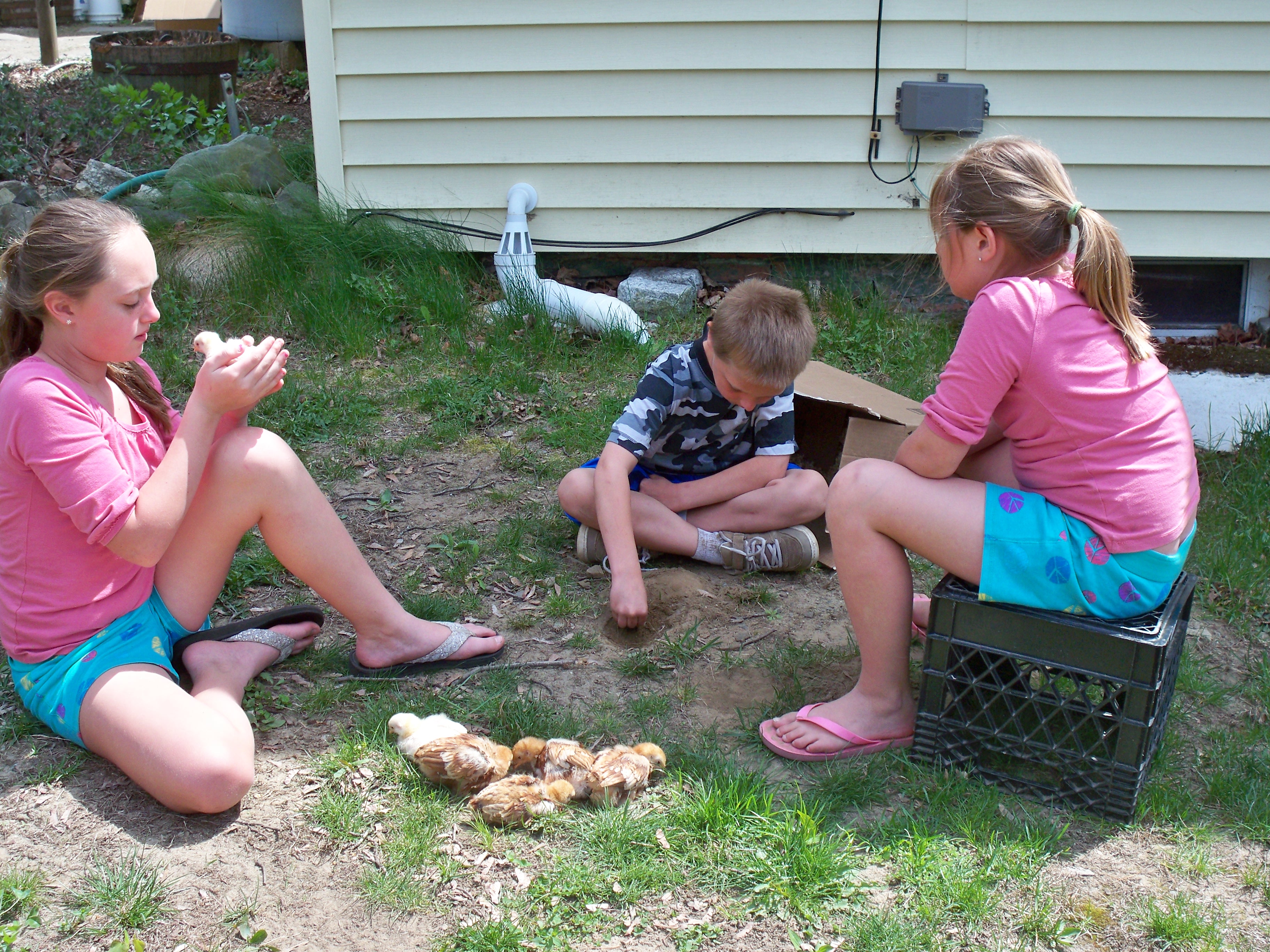
Chicks enjoy some outdoor time with the grandkids
I took them home and set them up in a brooder my husband and I built for the occasion. They grew quickly. In fact, after a couple of weeks, I noticed that the white ones were larger and plumper than the brown ones. Uh oh—I suddenly knew what they were: Cornish Crosses.

Cornish Crosses at about 1 month old
I called my daughter and explained to her what that meant: they would have to be butchered in a few short weeks. I advised her to call my grandson’s teacher to let her know, in case some unsuspecting students had taken home white chicks for pets. The teacher’s only reaction was, “Oh no! I took one of those!” There was no mention of calling students’ families to warn them.
I asked my daughter if I could tell her kids about these birds, and she said yes. I explained to the three—ages 12, 9, and 6—what these birds were raised for, and that they’d have to be butchered soon. They all understood, although they weren’t happy, understandably. My older granddaughter, Lyndsey, said, “Just don’t have it for dinner when I’m over here.” I replied, “You do know that the chicken meat you see in the store comes from these birds, right?” She said, “Yes, but I didn’t hold them on my lap.”
Butchering day came and went, and after some help from a friend, I came home with two plump roasters. One was on my menu for the next night, and I hoped to give the other to my daughter. I decided to give her a heads-up that we’d had a little trouble getting all the pinfeathers out, because I realized that, visually, it could be a shock for her to see them. She told me to keep it. She didn’t want any reminders that this bird had once been one of the cute little white fluff balls her kids had named.
A couple of weeks later I had a discussion with a friend of my daughter’s about the frankenbirds. She said, “Well, that’s what they’re raised for, right? To feed the masses?”
There is that view, I guess, and I have to admit that I’m torn: philosophically, I’m opposed to frankenbirds, but I understand that they are more profitable to raise and that they yield more meat for the buying public. (And they do taste good.) It just seems to me that, as farmer-author Joel Salatin says, chickens should have a chance to enjoy life a bit and “express their chicken-ness” before meeting their fate. Cornish Crosses really can’t enjoy life. All they can do is heft up their bodies, take a couple of steps to the feeder, and plop down with their head in the feed. It seems to me that raising heritage birds for meat is more ethical.
I may soon have a chance to practice what I preach: So far it appears that three of my four remaining first-grade hatchlings are roosters.