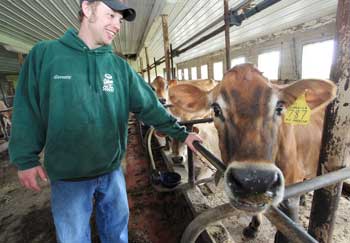
Garret Stillman with one of the Jersey cows in the family’s herd. (Photo by Lisa Aciukewicz)
The milkman is back. Stillman Dairy Farm in Lunenburg, one of only a handful of dairies in Massachusetts that produces, processes, and bottles its own milk, is expanding its home delivery service to Harvard.
In its reincarnation, the Stillman milkman is also the cheese man, the juice man, the meat man…Stillman’s offerings include its own milk, cream, butter, and ground beef; local eggs, Carlson’s cider, Cabot and Smith cheeses, Green Mountain Coffee, orange juice, chicken pot pies, and Stonyfield yogurt. An insulated metal porch delivery box is available to hold doorstep deliveries.
Seven years ago, Garrett Stillman, 30, who runs the fourth-generation family dairy with his father, Garth, and brother, Griffin, believed there were customers for home-delivered milk in glass bottles from grass-fed cows raised without artificial growth hormones, antibiotics, or pesticides, herbicides, or chemical fertilizers. So far, he has been right.
The dairy began home delivery in Lunenburg and gradually expanded to many of the surrounding towns. Stillman milk was available at the Harvard General Store until recently.
“We have a good following in Harvard,” said Stillman, who would like to keep serving Harvard’s “loyal customers.” Home delivery will begin once a minimum number of residents request it.
The Stillman Dairy Farm, which runs along a high ridge on Lancaster Road in Lunenburg, is the picture of a classic New England dairy. A white farm house fronts the road. A milking barn, processing area, and farm store sit behind it. And gently sloping hills of green pasture spread into the valley beyond. The farm raises Jersey cows on its own fields, plus hay and silage.
“Jersey’s are the brown ones,” Stillman said. “Most dairies milk Holsteins, the black and white cows. Jerseys produce less milk, but higher butterfat. They also have more CLA—conjugated linoleic acid, an essential fatty acid.”
The breed, which originally came from Jersey, one of the English Channel islands, is smaller than Holsteins. Jerseys are known for their gentle nature and adaptability to grass feeding. Indeed, with their tan faces and enormous dark eyes, any of the Stillman cows could pass for Borden’s iconic Elsie the Cow.
“In 1950, there were seven Lunenburg dairies delivering milk to the town,” Stillman said. “Now there are only four direct dairies in all of eastern Mass.”
“The wholesale price of milk fluctuates,” he told the Press during a recent tour of the farm. “Each time it goes down another farm is lost.”
Keeping a farm going preserves the rural landscape and its way of life, Stillman said. The Stillmans don’t want to be one of the casualties.
The dairy used to sell its raw milk wholesale, but opened an on-site retail store in 1993 to sell processed milk it bought back from a collective.
“In 2000, my father took a leap of faith and invested in our own processing and bottling,” Stillman said.
Stillman, then 18, wasn’t sure what he wanted to do, but by the time he had graduated from college, he, too, was ready for a leap of faith and committed to the farm.
“We like what we’re doing, the open space,” he said. “More people are interested in local food now.”
The dairy is a family affair. Garth is in charge of the twice-daily milking, and his wife Coleen, a full-time school teacher, makes butter with the extra cream. In the younger generation, Garrett manages the milk processing and bottling, while Griffin rises at 3:30 a.m. to handle the deliveries. Elizabeth runs the farm store, which now includes her baked goods, along with take-out coffee. Julia pitches in, and Garrett says his sister Rachel, who graduates from high school this year, is interested in ice cream.
According to Jeff Harris’s “History of Harvard from 1950 to 2000,” on the town website, Harvard shipped more milk to market in the 1920s than any other Massachusetts town. The last Harvard dairy, the Watts Dairy in Still River, closed in 1987. There are only 130 dairy farms in Massachusetts, a state that once had more than 7,000, said Stillman.
In 2008, Lunenburg had the choice to buy the 50-acre plot that once had been Aro’s Poultry Farm. By four votes, the town decided not to buy the land and it went to a developer. There are still other farms in Lunenburg, but, like most of the state, where a farm once was, houses have cropped up.
“This is a really good place if it all works out,” Stillman said.