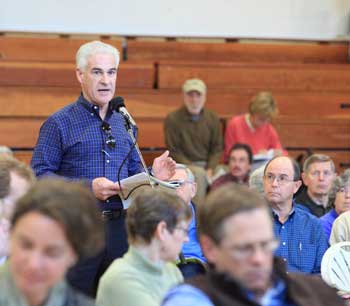
Leo Blair address his concerns about the cost of looming retirement benefits.(Photo by Lisa Aciukewicz)
The reading of the annual town budget is usually uncontroversial, but this year, as Moderator Bob Eubank prepared to call for the vote to approve it, former Selectman Leo Blair tossed what amounted to a rhetorical unexploded bomb into the crowd.
Quoting the most recent audit of the town’s finances, Blair said that the retirement benefits that had been earned but not yet claimed by Harvard’s teachers, police, and other employees currently totaled $29,770,000, “of which we have reserved nothing. Not a cent.”
Moreover, said Blair, those costs, which include payments to those who have already retired, will accrue at a rate of $1.8 million per year and are projected to reach $61 million by 2039. Because Harvard has done a good job of retaining its employees, he said, the average age of the workforce was approaching 50 years and Harvard is facing “a bubble” as the number of retirees grows from the current 84 to 175 in the next 15 years.
“I would challenge,” Blair said, “whether our budget, as presented, is an accurate reflection of our actual needs and our responsibilities going forward.”
The omnibus budget does account for the currently retired employees of the town; Harvard is expected to pay $611,547 into the Worcester Regional Retirement Trust this year. But the budget contains no fund to cover retirements to come.
Finance Committee chair Marie Fagan responded by saying that the Finance Committee is aware of the problem.
“Leo is making a very important point about post-employment benefits,” she said. “We haven’t sorted out how to manage that, but we have started the conversation. It is on our radar screen….It’s something we’re going to have to consider very carefully going forward how to manage it.”
Chris Ashley of Woodside Road, who followed Blair to the microphone, was more critical.
“The thing that I find troubling is that the auditor’s management report speaks to this alarming and potentially unmanageable condition and there’s no mention of it in any published [reports] that have been presented to us,” he said. “It seems to me very curious … [that] we’re presented with good information [such as the town’s recent favorable bond rating] and not the bad and potentially disturbing information, when we are here today to discuss spending a huge amount of capital going forward…The report was in Town Hall from early March. There was plenty of time for people to have received it.”
Lorraine Leonard, the town’s finance director, responded by saying that right now Harvard is only “required by law to figure out every three years what our liability is” and to declare it. But sometime within the next few years, she said, the town will be required by the state to start funding it, at which time it will become a line item in the budget.
“We will not be impacted on our statements until we’re told to do it,” said Leonard, who added that she expected all of the towns in Massachusetts would be given 30 years to build their reserves to the level needed to pay the health and life insurance benefits of their future retirees.
“It sounds like we have a hard reality that we’re facing,” said Steve O’Brien of East Bare Hill Road. “I would urge the town to start a lot sooner, and not wait for the state. The sooner you start it, the more gradual your hit will be.”
“We are basking in the sunshine of great financial management,” Blair said. “I’m telling you that it’s cloudy, with a chance of showers, and perhaps a tornado. I’m not saying it’s raining yet.”
The Finance Committee was scheduled to meet Wednesday this week to review the issue with Leonard and Town Administrator Tim Bragan.