 |
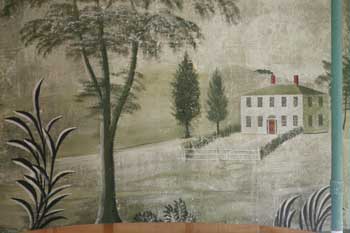
| Section of a Rufus Porter mural in the Rizzo home on Oak Hill Road. (File photo) |
Owners of early 19th- century homes in Harvard should proceed carefully if they decide to remove decades of old wallpaper. A treasure, a wall painted by itinerant folk artist Rufus Porter, may lie beneath it.
Only three buildings in Harvard can boast murals by the now famous but once forgotten artist—Susan and John Rizzo’s house, formerly the Moffa house, on Oak Hill Road; the Trustees Room at Fruitlands Museum; and the old Harvard Inn, which was scheduled to be sold in a foreclosure auction Thursday morning, after the Press was printed. The Fruitlands panel was bought from the Harvard Whitney House by Clara Endicott Sears in 1939. The others were painted in place on dry plaster.
The Harvard panels, which are believed to have been painted in the 1830s, were forgotten once wallpaper became mass-produced, cheaper, and fashionable.
“When we tell people where we live, they often ask, ‘Isn’t that the house with the murals?'” said Susan Rizzo in a phone interview with the Press. “Then they ask if we’re going to paint them or leave them. We’d probably be run out of town if we painted over them,” she said with a laugh.
The Rizzo’s paintings have a few colored elements added by an earlier owner.
Porter expert Linda Carter Lefko documented the Harvard Inn murals in 2009 for “Folk Murals of the Rufus Porter School,” which she co-authored with Jane Radcliffe. In a recent email exchange with the Press, Lefko confirmed that the plum-colored monochromatic murals on the first floor are Porter originals, but said, “The upstairs hallway walls in green monochromatic are repainted modern—in the style of what was presumably said to have been there or evidenced by what was there, when the repaint was done.”
Renaissance man
Rufus Porter is often described in popular shorthand as an “itinerant folk artist who painted tavern walls for room and board.” That portrayal may conjure the image of an indigent, perhaps uneducated, wandering man who traded his possibly unrealized and untrained talent for day-to-day survival.
 |
| Drawing of 800-foot steam-powered airship designed by Porter. |
The image evaporates when we learn that in addition to painting walls, Porter filed over 100 patents for inventions, bought and published the New York-based New York Mechanic, which he moved to Boston and renamed the American Mechanic, and founded the still-thriving Scientific American magazine.
Being ahead of his time, but more interested in his next idea than capitalizing on an old one, was a recurring theme for Porter. Porter designed and had made a rifle with a revolving cylinder in 1826, ten years before Samuel Colt patented the Colt revolver. Fearing that Porter could challenge his patent, Colt bought Porter’s rifles and designs for $100 in 1836.
Porter pursued plans for an 800-foot steam-powered airship, a hydrogen-filled “aerial navigator” that he thought could speed miners to the 1849 California gold rush. Porter gave talks on working models to sell shares in his Aerial Navigation Company until he gave the effort up in 1856 after his three prototypes were destroyed by a tornado, vandalism, and technical problems.
So mult-talented was the self-taught Porter that a 1970 Time Magazine article called him a “Yankee da Vinci” with a “grasshopperish interest.” He may even have been the model for the title character in Mark Twain’s “A Connecticut Yankee in King Arthur’s Court,” as folk art historian Jean Lipman suggested in “Rufus Porter: Yankee Pioneer,” from which most of what is written about Porter is drawn, including this article.
Porter was largely forgotten until Lipman published a monograph about him in 1950. He is now acknowledged to be a seminal influence in 19th-century wall paintings.
Porter was born in 1792 to a multi-generational farming family in West Boxford that moved to Maine at the turn of the century. Porter began at an early age his life-long pattern of traveling, evolving professions, and teaching what he learned. He gave up an early apprenticeship to a shoemaker to play fiddle and fife for the dances and in the militia companies in Portland, Maine.
In 1810 he was apprenticed to a house and sign painter, drafted as a private two years later, and in 1813, at 21, was playing drums, teaching drumming, and painting drums and sleighs.
By the end of 1815, at the age of 23, Porter was married, had been a private and musician in the Maine state militia, taught school n two Maine towns, built wind-driven grist mills in Portland, and had written “The Martial Musicians Companion.”
A year later he was running a dancing school in New Haven, Conn., where he also practiced portrait painting and the first of his 16 children was born. A two-year trading voyage took him to the Pacific coast and the Hawaiian Islands, followed by a year traveling as far south as Virginia to paint portraits.
As Lipman and others point out, Porter epitomized the expansive dynamism of 19th-century America. He was on the go, always developing time-, labor-, or space-saving ways to accomplish activities in tune with his time.
There was popular demand for the silhouette cuts, portrait painting, and wall stenciling Porter produced early in his career with his characteristic eye toward improvement and efficiency. Porter built his own camera obscura to focus on an image on paper, allowing him to create a good portrait likeness quickly.
Decorating interior walls with stencils and paint was an available alternative to expensive European wallpaper. Porter used stencils and other decorating techniques to create an efficient way to offer rural landscapes and imaginary seascapes.
Porter shared his ideas freely. “A Select Collection of Valuable and Curious Arts,” published in 1825, was an early how-to for decorative arts. In later writing he explained in great detail how to create murals, even claiming a room of scenes could be painted in five hours from start to finish.
According to Lipman, the painted walls executed in the first half of the 1800s are often found in inns, taverns, and public meeting places along established stagecoach routes. The Union Turnpike passed through Harvard center and may have accounted for Porter’s presence in Harvard.
Artists often came to a town by foot or coach, stayed at a local inn, and gained customers for their work from advertising handouts. Trading tavern wall painting for room and board would have been as much a good business practice as a necessity. It cut down on expenses and offered free advertising.
Lipman reproduced an advertisement from the early days of Porter’s painting journeys:
“Painting. The Subscriber respectfully informs the Ladies and Gentlemen of Haverhill and its vicinity, that he continues to paint correct Likenesses in full Colours for two Dollars at his room at Mr. Brown’s Tavern, where he will remain two to three Days longer. (No Likeness, No Pay.) Those who request it will be waited on at their respective places of abode. Rufus Porter Haverhill, March 31, 1821.”
As time passed and fashions changed, most of Porter’s original paintings were papered, plastered, or painted over, or destroyed in alterations. His unsigned silhouettes and portraits hung unrecognized. The same 19th-century inventive mindset that led him to find cost-effective ways of creating substitutes for expensive wallpaper and portraits, led others to create less expensive, mass-produced wallpaper and to invent Daguerreotype portraits that pushed Porter’s work out of fashion and demand.
By the 1840s Porter had turned his peripatetic eye to his inventions and publishing.
Today, it would not be surprising if careful removal of a century and a half of layered wallpaper revealed more of Porter’s work in Harvard. Even more likely is the possibility that a family silhouette or portrait on one of those walls might be Porter’s work or that of the several New England traveling artists who learned from him and his writings.