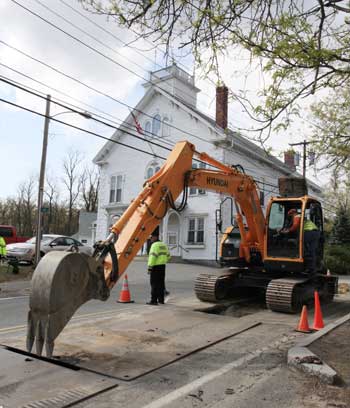
Work on the sewer system continues in front of Town Hall. (Photo by Lisa Aciukewicz)
As they continued their last-minute preparations for Town Meeting, the Municipal Building Committee and its architect, LLB Architects, met with the Sewer Commission for the first time this week to discuss the potential impact of an expanded Town Hall on the capacity of the town center sewer system now under construction.
The centerpiece of the discussion was a study commissioned by LLB to estimate the increased flow of effluent to be expected if the additional meeting space and large assembly hall planned for the building dramatically increases the number of people who use it.
The report’s conclusions were good news for both the Sewer Commission and proponents of the renovation project.
“While Title V computations show an increase in flow…through the renovation of Town Hall,” the report said, “on most days, flow from the Town Hall will be similar to the flow used by the existing Town Hall.”
“Even when a nightly or weekend function results in additional flow,” the report continued, “it is unlikely to be as severe as Title V computations [predict].”
The Sewer Commission and members of other town committees have worried that if the renovated Town Hall is used to host large assemblies, performances, or other events such as dances in its restored second floor great hall, the increased use of restrooms could create a “surge” and push the system over the 20,000 gallons per day limit set by the state Department of Environmental Protection when it approved the project. Under regulations that are now being written by the Sewer Commission, any increase in flow beyond the amount allocated by a building must be approved by the Board of Selectmen and the commission, and only if it creates a “demonstrable benefit to the town.”
The study presented Wednesday was done by GPR, Inc., an engineering firm that the town has used to assess past projects. It concludes that normal daily and evening use of Town Hall is not likely to increase the daily flow of wastewater much above the estimated historical rate of 111 gallons per day (GPD), which is only a third of the maximum amount allocated to the building by the Town Center Sewer Action Group in its plans for the sewer district.
A large event that draws 115 or more people, however, could cause a temporary increase beyond the maximum 314 GPD “design flow,” the report says, thus causing a surge in the system. But any event that includes 70 or fewer people could be held without exceeding capacity. Unfortunately, the report concludes, there is no way of knowing how frequently such events are likely to occur until the building is finished and actual use numbers can be collected.
Cal Goldsmith, one of the GPR presenters, observed that Town Hall would not be the only source of surges during the week. A Town Meeting typically packs 300 or more residents into the school gym, he noted. Some events might otherwise have been held elsewhere at another town facility on the system, effectively shifting the “surge” from one part of the town to another.
“To my mind,” he said, “the ‘perfect storm’ is most likely to occur on a weekday morning when everyone in the district is showering for school or work.”
Drayton Fair, the Town’s architect, said the project would use low-flow toilets, waterless urinals and other water conservation measures to further reduce flows from the building. And he also noted that the commission will have the power to limit the size of events in upper Town Hall to a number that keeps flow where it needs to be. Average gallons per day are computed over monthly periods.
“I think you can say we’re positively responsive,” Commission Chair Cindy Russo said, summarizing the opinions of her two colleagues, Rick Maiore and Kyle Hedrick.
If the question comes up at Town Meeting “would you like to say that,” asked Municipal Building Committee Co-Chair Pete Jackson, who was present at the meeting?
“I would not like to say that,” answered Russo, to laughter.
“The pitfall we want to avoid is getting into details, specific measurements, because none of us know what they are right now,” said Maiore.
If the Town Hall renovation is approved Saturday and once detailed designs are complete, the building committee will most likely be required to return to the commission next year and apply for permission to connect to the system. It’s at that point that terms of Town Hall use will be set.