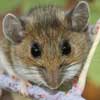

A white-footed mouse, a breed known to transmit Lyme disease. (Photos by Mary Holland)
No longer can we roam the woods and fields with careless abandon as we did several decades ago, for many small but potentially harmful creatures are waiting to hitch a ride and get a meal from any warm-blooded animal that passes by. The black-legged tick, Ixodes scapularis, also known as a deer tick, is alarmingly common in Massachusetts, and along with it, the illness it often carries, Lyme disease. This spring, in particular, promises a profusion of black-legged ticks lurking on shrubs and tall grasses.
We can’t solely blame the ticks, as they are just the middlemen.Ticks aren’t born with Lyme disease; they acquire it from warm-blooded animals, mammals and birds. And not every species of tick carries this disease–of the 12 species of ticks in the Northeast, only the black-legged tick can give you Lyme disease.
It is helpful to be familiar with the black-legged tick’s life cycle in order to understand what we, as warm-blooded mammals, are up against. Dave Mance, of Northern Woodlands magazine, explains it very succinctly. “The deer tick’s life cycle usually requires at least two years to complete. Sometime during late spring and summer, tick eggs hatch into larvae. The larvae feed throughout summer and early autumn, then molt into nymphs. The nymphs lie dormant during the winter, then re-emerge the following spring. After finding a blood meal, the nymphs molt into adults that fall. The adult ticks feed and mate on larger animals, particularly deer, then lay their eggs and die.”
Black-legged ticks can transmit Lyme disease to humans in the larval, nymphal, and adult stages.
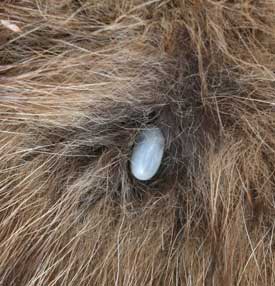
An engorged tick, species unknown.
From a human’s viewpoint, the larva’s first meals are the key to its potential for causing us harm. If it bites an animal that has Lyme disease, from then on the tick will carry the bacteria causing Lyme disease, Borrelia burgdorferi, in its gut, where it eventually will be transmitted into the blood of any and every warm-blooded animal the tick feeds on.
For years white-tailed deer were blamed for being the primary host of Lyme disease. According to a study by the University of Pennsylvania, deer actually play a rather minor role in transmitting the bacteria to feeding ticks, although they are a major cause of the increasing tick density that influences the spread of the disease to humans. Research reveals that smaller animals are more likely to be bitten by larval ticks, and chief among these smaller mammals are white-footed mice (host of 25 percent of infected ticks), short-tailed shrews (25 percent), masked shrews (25 percent), and eastern chipmunks (13 percent).
Dr. Richard Ostfeld, of the Cary Institute of Ecosystem Studies, is of the opinion that white-footed mice play a key role in perpetuating Lyme disease, due in part to the fact that they don’t groom off or kill larval ticks at the rate that shrews and chipmunks do. Ostfeld correlates the prediction of a spring population explosion of larval black-legged ticks this year with the white-footed mouse population, which, in turn, he correlates with the irregular acorn crop.
In 2010 there was a bumper crop of acorns, a favorite food of white-footed mice, which resulted in a bumper crop of white-footed mice in 2011 and plenty of warm, little bodies for black-legged ticks to feed from. Oaks don’t produce massive amounts of acorns every year, and there was not a large crop in 2011; thus, the white-footed mouse population crashed. This means that a tremendous number of tick nymphs and larvae will be looking for a meal this spring, and if white-footed mice are in short supply, that means humans have an even greater chance of finding tiny, black hitchhikers the size of a period on them at the end of a spring or summer day.
Lyme disease now afflicts more than 20,000 Americans, most of which are in the Northeast. It has been recorded in every city and town in Massachusetts. Efforts are being made to come up with a preventative, as well as something safe and effective to treat people who have found ticks imbedded in themselves. There is a promising jell which, if applied shortly after a tick bites you, can destroy the Lyme disease bacteria at the bite site. However, it is not available yet. Until it, or something equally effective, can be purchased, rolling your socks up over your pant cuffs is one harmless precaution easily taken.
A second practice I heartily recommend is a daily tick check – supposedly it takes 24 to 48 hours of feeding before a black-legged tick can pass Lyme disease on to a human. I can’t verify that, but I can tell you that one hour of bush-whacking in Vermont several weeks ago during a warm spell resulted in a total of 19 ticks crawling around the upper half of my body, two of which had already latched onto and into me.
Mary Holland is the author of “Naturally Curious: A Photographic Field Guide and Month-by-Month Journey Through the Fields, Woods, and Marshes of New England.” She has a natural history blog which can be found at www.naturallycuriouswithmaryholland.wordpress.com.