For a second time, the Planning Board wrestled into the night with how to regulate community solar garden-type arrays whose electricity and costs would be shared among participants. Pivotal questions are whether it is a residential use and should be allowed in the agricultural/residential zones that make up 90 percent of Harvard (not including Devens), or if it is a commercial enterprise that should be restricted to the commercial district.
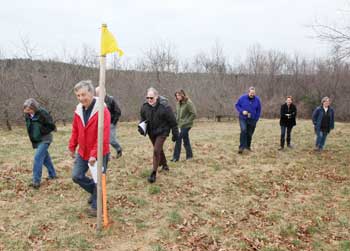
Worth Robbins (next to marker) leads a site walk of the proposed solar garden site off of Woodchuck Hill Road, March 17. (Photo by Lisa Aciukewicz)
After considerable discussion, the board decided to consider a three-tiered approach: residential, commercial, and a-yet-to-be-named category for aggregated systems, which Planning Board members Michelle Catalina and Tim Schmoyer will draft.
Although the prospect of very large-scale, corporate-built arrays spurred the Planning Board to action to create a solar photovoltaic bylaw, the board had no problem agreeing those systems were commercial and restricted to the commercial district. It is the actuality of the Community Solar Garden project proposal that has driven most of the debate and comments at the Planning Board’s informal and formal hearings.
The commercial question
More than 30 residents attended Monday night’s Planning Board hearing, the majority of them affiliated with Harvard Community Solar Garden, LLC. Several people submitted written letters to the board.
In one letter, Woodchuck Hill residents Bill Calderwood and Robin Carlaw, whose property is in front of the proposed site for the Community Solar Garden, laid out several arguments why ground-mounted solar arrays with the capacity to generate more than 20 kilowatts should not belong in an agricultural/residential district.
“If a precedent is set that allows a 249.9Kw ground-mounted solar array in an A/R district, then what private land elsewhere in Harvard’s A/R district will have the next 249.9Kw ground mounted solar array?” they wrote. They argued that “solar ‘farms’ or ‘gardens’ are widely defined, by the industry and others, as for-profit, commercial ventures.”
“Open space will be sacrificed…some open space properties which have ledge or other impediments to housing development could become developable for large solar arrays,” they said.
Eric Broadbent from Oak Hill made the point that without a collective option, residents who wanted solar might be inclined to cut more trees and change more views than carefully sited solar gardens would.
Are solar gardens commercial?
Not exactly, said Community Solar Garden organizer Worth Robbins, who explained that the Community Solar Garden was created specifically to offer a solar-energy alternative to residents who could not participate in the Solarize program, because of siting or structural obstacles, or, in some cases, a reluctance to extensively cut trees.
According to Robbins [who is also a part-owner of the Harvard Press], the Massachusetts Clean Energy Center will offer the same incentives to shared community solar garden participants as to individual Solarize program residents and small businesses. However, to qualify for the tax-based incentives, a group cannot incorporate as a nonprofit, charitable organization, because those organizations, like municipalities, don’t pay taxes and would be ineligible for the incentives. Robbins characterized the solar garden option as a way to offer solar photovoltaic energy to residents who might otherwise be unable to have it, not as a commercial venture.
Investors and abutters
“Investor, abutter, other?” Planning Board Chair Kara McGuire Minar asked as speakers identified themselves.
“I certainly don’t think of myself as an ‘investor’,” Still River resident David Fay told the Press.
Fay said that he had been an enthusiastic participant in the Solarize program, even willing to commit to significant structural modifications to his 1834 Greek revival home in order to gain the energy savings over time and to avoid fossil fuel-generated electricity for climate reasons. When one more structural requirement was found, that project became too expensive. He considers himself a participant in the Community Solar Garden for the same money-saving and environmental reasons, though with less financial benefit.
Underlying policy decisions illustrate the task of balancing traditional Harvard values with emerging clean energy and environment stewardship values and desires.
“Harvard has a long history of land stewardship,” said Margaret Nestler of Cruft Lane, who opposes allowing community solar gardens in residential areas.
Steve and Stella Matson, in their letter to the Planning Board, wrote that they agree with conserving land and viewshed, “but we also perceive beauty in cleaner energy technology. We respect our nearby neighbors on Withington Lane. But we also count as neighbors those who reside beyond the hills of Harvard—e.g., in the Appalachians and in Great Plains, where mountaintops are removed and the earth is scoured to obtain the coal that powers most of the U.S. electrical grid. And it’s not just about the views. Our current energy mix has many other economic and social externalities that are largely (and conveniently) hidden from our view.”
The Matsons urged the board to consider a bylaw that “differentiates between strictly for-profit commercial [photovoltaic] … and community solar that benefits Harvard residents directly.”
“The sticking point for me, personally, is that it [the Community Solar Garden] implies an overall community benefit, but I think it is commercial,” Minar said.
In a letter to the board, Lyn and Adam Horowitz, who have offered the Community Solar Garden use of 1.3 acres of their 16-acre property on Woodchuck Hill where they eventually hope to build a retirement home, said, “We understand that the building permit application for the Community Solar Garden on our Woodchuck Hill Road property has been denied on the basis of being considered a commercial business operation not allowed in the AR zoning district. The reason cited was an understanding that electricity would be sold to the grid, which is incorrect. The electricity produced will be credited to the individual accounts of the share owners of the Community Solar Garden, all community residents, in the same way it would if it were installed on their property.”
“We support a goal of making it as difficult as possible to convert tracts of Harvard land into large-scale commercial solar (or any other commercial venture) but draw a distinction between a for-profit venture and a carefully considered community project where each participant is treated as if the solar panel were installed on their property for a finite period with strict land restoration and preservation criteria.”
The fish-or-fowl logjam was broken by environmental lawyer Ruth Silman, who identified herself as providing pro bono legal advice to the Community Solar Garden.
“This one is different. And it feels different, and it’s hard to talk about because it is different,” she said. “I do a lot of work for commercial developers. They are from other places. They see a large tract of land, they get something permitted, they have a power-purchase agreement with somebody to provide electrical power, they find out how to get connected to the grid. That is a for-profit entity…This community solar garden is an aggregated residential use… The electricity that’s generated is not directly net metered because the line isn’t directly connected. It is virtually net metered across town, but it is still serving a residential property…. I think you’re confusing things to say that it’s commercial.”
“The economics of it are no different than if you had a lot of houses close together. I’m not saying you shouldn’t regulate it because of size, but to say you’re regulating it because it is commercial rather than residential, I think is a fallacy. … It is somewhat in the middle. It is different,” she said.
Minar invited people to send comments to the board before it reconvenes April 2.