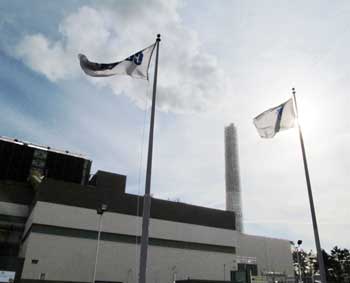
Trash goes up in smoke at Covanta’s Energy from Waste facility in Haverhill. (Courtesy photo)
The next time you travel north on 495 through Haverhill, when you get to exit 48, look across the highway to your left. There you can see our trash going up in smoke (way up). The tall smokestack is part of Covanta Energy Corporation’s Energy from Waste facility, one of 35 such facilities they operate in the United States.
I took a trip to Haverhill and met with Dan Harty, who is their materials separation plan coordinator. He graciously showed me around and explained the process of turning trash into electricity.
Incineration
The process begins as trucks arrive at the facility and line up to be weighed before depositing their loads of trash in a giant hall (more than 1,600 tons a day). Trucks from 23 communities take their turns entering the building, dumping on the “tipping floor,” and leaving by another door. Overseers constantly monitor what gets dumped. If a truck were full of wood or paper, it would have to be turned away, because those are waste-banned items. The truckers know that, and if they tried to dump such things it would end up costing them a lot of money. Televisions and computers are not allowed either, and a floor man walks around looking for them and pulling them to the side.
Part of Dan Harty’s job is to keep track of these items and to arrange for them to be picked up and brought elsewhere.
A payloader shoves the trash into a pit at the back of the building, where a huge grapple hand comes down and picks it up. The “hand” then travels into another section of the building, drops the material into a burner chute, and comes back for more. The trash is burned at a temperature of more than 1,800 degrees Fahrenheit, turning water into steam. The steam spins turbines to create electricity, which is sold to National Grid. A complicated array of equipment is used to make the smoke as clean as possible (they say 99 percent free of particulates) and, in fact, much of the facility that you see is devoted to taking care of emissions.
At the other end of the process there is ash: 10 percent of the material originally brought in. Trucks periodically take the ash out of the building and dump it onto the landfill that is part of Covanta’s 147-acre property. The company currently has a permit to continue adding to the landfill until 2020.
The mercury story
Remember the Mad Hatter? Lewis Carroll’s character in “Alice in Wonderland” showed the effects of a common industrial hazard for hatters at the time: the use of mercuric nitrate to shape felt hats. They did not know it then, but this is dangerous stuff, and the phrase “mad as a hatter” refers to neurological symptoms resulting from chronic exposure.
Incineration is currently a significant source of mercury in the environment. In 1998 the Department of Environmental Protection issued regulations governing facilities like Covanta and requiring development of a Materials Separation Plan to describe actions that will be taken to remove products containing mercury and other toxic components prior to incineration.
A wealth of information about the Mercury Recovery Program is available at a website devoted to the project, www.keepmercuryfromrising.org, and raising awareness of the hazards of mercury contamination is part of Mr. Harty’s role as MSP coordinator.
At the transfer station in Harvard, we collect fluorescent tubes, compact fluorescent bulbs, thermometers, and thermostats—all mercury-laden items. They are stored in a locked shed behind the trash receptacles, and Mr. Harty comes to collect them from time to time. Our mercury is then taken to a recycling company, and is in turn sent to China for manufacture of new light bulbs.
Collecting these items, while helpful, does not compare in scope to the challenge of addressing mercury pollution caused by burning coal. Controlling emissions from coal-burning power plants is very expensive and, of course, politically interesting.
There is some hopeful news. A report prepared for the Massachusetts Department of Environmental Protection by NESCAUM (Northeast States for Coordinated Air Use Management) in December of 2011 estimated that as of 2008, anthropogenic (resulting from human activity) mercury air emissions in Massachusetts had been reduced by over 90 percent since 1996. Emissions from municipal waste combustors decreased by 96 percent.
We still have a long way to go toward meeting our collective needs in an eco-friendly way. So please, “Reuse, Reduce, and Recycle.”
Glenn Williams is a Bolton Road resident and a proud transfer station volunteer. He may be contacted at gwilliams024@gmail.com.