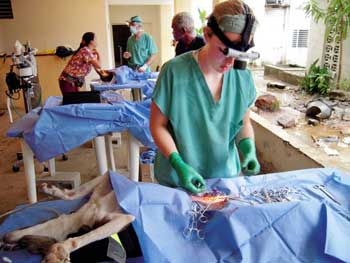
A member of Project Samana operates on a dog in the Dominican Republic. (Courtesy photo)
Named after a rural town on the Samana Peninsula in the Dominican Republic, Project Samana is an outreach program of the Massachusetts Veterinary Medical Association. Begun in 1993, its goal is to help the people and animals of the Dominican Republic, which is the second poorest country in the western hemisphere.
In a remote area where veterinary medical resources are scarce, Project Samana provides surgical and medical services to the animals of Samana and surrounding villages. A team of volunteer veterinarians and technicians make the trip twice yearly.
The main goal of the project is neutering dogs and cats. Some have owners, but many are street dogs and cats. In addition, large animal vets make the trip to treat equines (mostly horses and mules). Sick and injured animals are also seen and cared for.
The team makes a great effort to educate animal owners in animal husbandry with the focus on nutrition as many of the animals are grossly underweight, subsisting on table scraps and/or scavenging. Basic first aid and parasite control are also stressed.
The project provides training to students attending Dominican veterinary schools, and the group mentors two or three Tufts veterinary students on each trip as well. They are able to gain first-hand experience with problems plaguing animals in third world countries.
This November, a team of 19, traveling from various places in the United States, met at the airport in Santo Domingo and loaded up 4 SUVs for the 2½-hour ride to Samana. The team was made up of six veterinarians, two Tufts students, and 11 veterinary technicians. After a meet-and-greet dinner, everyone got their station assignments for the next day (anesthesia and prep, surgery, and recovery).
The next morning, the equine team headed off into the countryside and the small animal team drove a short distance where a large number of barking dogs and an equal number of animated children were already waiting. The team organized itself very quickly and set about the task at hand. Some locals and two Peace Corps volunteers also pitched in. Improvised surgery tables were set up, supplies laid out, and animals were soon anesthetized and prepped for surgery.
The team works from 8:30 in the morning until around 7 each night, sometimes necessitating the use of flashlights and head lamps as the sun sets, the sun being the only source of light.
The work area, in past years, has been a large outdoor concrete slab which was an extension of an abandoned building. Surrounding the work area were piles of empty beer bottles, abandoned heavy road equipment, and a rusting hearse. This year, a covered patio of an oceanfront restaurant served as the work site.
Everyone quickly settles into their assignments. As is always the case, the technicians are the most vital part of the team. They keep things flowing and are very alert to the vital signs of each patient. Veterinarians quickly realize that many of the cases can be quite challenging (many dogs are older and have had multiple litters making the uterus and ovaries more apt to tear as well as increasing the blood supply), and a quiet earnest concentration settles in at the tables.
At week’s end, the team has operated on 160 patients. Among the spays and neuters, there are also trauma cases, sick animals, tumor removals, and a few cases of transmissible venereal tumors which are less common in the U.S. These are treated with the intravenous chemotherapeutic agent vincristine. A dog with a machete wound and some hit-by-car cases were also treated.
Another part of the experience is interacting with the people of Samana, especially the children. Often members of the team bring down little gifts for the kids (usually makeup items, candy, and bandannas). The kids often bring in their own pets on rope leashes or carried in their arms. There are always children circling the tables, fascinated and/or repulsed by the surgeries. Some of them show up every day and by the end of the week are fast friends with the veterinarians and technicians.
East Bare Hill Road resident Fred Karotkin is a veterinarian.