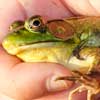

One of the many citizen science projects is FrogWatch, a program that requires participants to listen for frog calls and log them. (Photos by Ellen Harasimowicz)
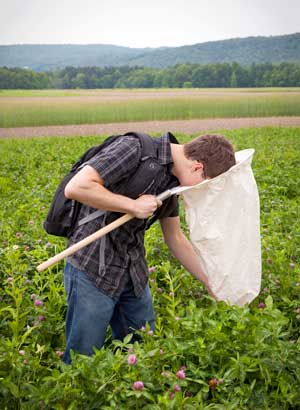
A graduate assistant at Cornell University participating in the Lost Ladybug Project buries his head in a net looking for ladybugs.

Loree Griffin Burns at the Wachusett Wildlife Sanctuary.
Young people are the perfect scientists, says local author Loree Burns; they see the world differently than older people do.
Burns writes about looking for a monarch butterfly chrysalis with her daughter in an area near their West Boylston home. She found it was especially hard to spot any of them, she wrote, and she was walking back to her car when her young daughter announced she had spotted one. Young people have a few advantages, Burns said: they are smaller and more in touch with the activity of smaller creatures, they have heightened senses, and they have the ability to focus more on what they are searching for.
Burns and Harvard photographer Ellen Harasimowicz are asking citizens everywhere to be more observant of the world around them in their newest book, “Citizen Scientists.”
Harasimowicz and Burns first teamed up in February 2008 when Harasimowicz did the photography for Burns’s second book, “The Hive Detectives.” The two wasted no time after its completion to begin work on “Citizen Scientists.”
The project kicked off in September 2008 with “Fall Butterflying,” a project that involved tagging monarch butterflies at the Wachusett Wildlife Sanctuary in Princeton, Mass. In her book, Burns walks the citizen scientist through the tagging process, which requires patience and the right equipment, while Harasimowicz shows the citizen scientist, through a series of striking photos, how to tag the monarchs.
The pair also traveled to central Mexico in February and March 2009 to witness the annual monarch migration.
Among the many photographs depicting the monarchs at the end of their migration is one of a sea of butterflies in a government-protected sanctuary at Cerro Pelon.
Harasimowicz said this was her favorite trip of the whole project.
“I remember riding on a horse up the Transvolcanic Mountains on a beautiful cool sunny day late one February and thinking, ‘How lucky am I?'” she said. “To be in this place, about to see millions of monarch butterflies, and getting paid for this experience? Pinch me, and hopefully I won’t wake up.”
Their second venture, “Winter Birding,” took Harasimowicz and Burns to New York City for the annual Christmas Bird Count in Central Park. There they participated in tracking the various bird populations located around Central Park. Citizen scientists need not wait until Christmas or travel very far to count birds, however.
“We’ve been counting birds in our backyard for years,” said Burns, who encourages citizen scientists to explore the immediate world around them.
“Spring Frogging” took the team to Rhode Island to research the mating calls of frogs. They learned about the various organizations dedicated to protecting and researching frogs. The North American Amphibian Monitoring Program, which was formed in 1997, and FrogWatch USA, formed in 1998, are simply citizen scientists doing exactly what anyone with access to wetlands can do.
This project was the most difficult to photograph, Harasimowicz said, as the field work was done at night. However, depicted in the book are some up-close-and-personal pictures of a variety of frog species.

Loree Burns took this snapshot of Ellen Harasimowicz photographing hundreds of flying monarch butterflies during the start of the monarch migration in central Mexico. (Courtesy photo)
The research for “Summer Ladybugging” was conducted in Ithaca, New York. There the duo caught up with Cornell University’s John Losey, whose Lost Ladybug Project has citizen scientists wondering where to find ladybugs in New York and North America. Losey encourages citizen scientists to search their local communities for ladybugs, photograph them and upload the photos to his website, www.lostladybug.org.
Included in the chapter are photographs of the “lost ladybugs” and the research laboratory at Cornell where researchers studied the specimens.
At the end of each chapter, Burns provides a checklist of the materials a citizen scientist might need when embarking on experiments. For any experiment, she writes, a notebook and pencil, as well as open ears, eyes, and mind are a must.
“It’s all about the experience,” Harasimowicz said about her time spent on the project. “It’s about slowing down and focusing on the sights and sounds around you, and it’s about getting outside.”
The Harvard Public library will host a book launch for “Citizen Scientists” on Feb. 29 at 1:30 p.m. Burns and Harasimowicz will share their favorite experiences, adventures, and misadventures; and pictures in additon to those in the books will be shown.