 |
| Selectman Ron Ricci presents the BOS recommendation to cap the betterment fees for the town center sewer project at the Special Town Meeting on Aug, 18. (Photo by Lisa Aciukewicz) |
 |
| Elm Street resident Jared Wollaston presents photos showing the impact of a “no” vote. |
Voters at a rare summer Town Meeting last week approved a request by the town to borrow an additional $540,385 so work can begin this fall on a sewer system that will serve the businesses, homes, churches, and municipal buildings in the center of Harvard. The affirmative vote clears the way for contracts to be signed and for the town to draw money from a state revolving fund to pay for construction and other costs.
This week, Selectmen appointed a three-person Sewer Commission to manage the new wastewater district once it is complete.
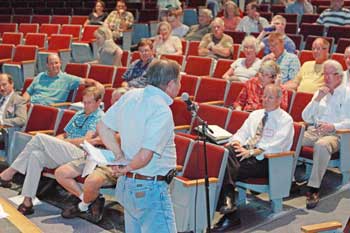
More than 200 residents turned out to cast their votes last Thursday evening. Outside, a thunderhead took shape, but inside Bromfield’s Cronin Auditorium, where the meeting was held, there was little drama. Following a detailed presentation by Town Administrator Tim Bragan, attendees were ready to vote after less than an hour of discussion. Once moderator Bob Eubanks had scanned the sea of blue cards raised in favor of the measure, with none opposed, he declared the vote unanimous.
Next steps: contracts and a Sewer Commission
With the additional borrowing authority in hand, the town can start construction as soon as a contract with the winning bidder, Ricciardi Brothers of Worcester, is prepared and signed, a process that will take three to four weeks, Bragan told the Press after the vote. Engineering management will be provided by Norfolk Ram of Plymouth, the firm that designed the system.
The project has two components: a network of pipes and pumps that will collect wastewater from 74 privately-owned and five town-owned buildings in Harvard’s town center, and an upgraded plant to treat it. Chris Ashley, who chairs the sewer building committee, says he wants to complete work on the collection system—which requires the opening of streets and the removal of rock ledge—by first snowfall. Work on the wastewater treatment plant, Ashley said, can proceed through the snow and slush of winter without disrupting traffic.
The vote of Town Meeting resulted in a flurry of applications for the all-volunteer Sewer Commission. Eight candidates volunteered for the three open positions, a job that had previously drawn only a single applicant. Selectman Ron Ricci had jokingly suggested the board purchase a truck for use by the commissioners to attract wider interest.
But by Tuesday this week, Selectmen had a pool of qualified applicants. Cindy Russo, a member of the Capital Planning and Investment Committee, was appointed to a one-year term; Kyle Hedrick, a town center resident and former member of the now-disbanded sewer policy planning committee, was appointed to a two-year term; and Rick Maiore, a member of the Board of Assessors, was appointed to a three year term.
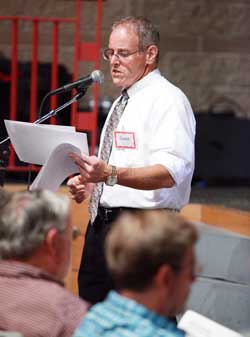 |
| Town Admininstrator Tim Bragan reads the Finance Committee’s statement. |
Among the first tasks of the commission is the assignment of betterment units to each of the 64 private properties within the sewer district and the adoption of rules and regulations to govern use of the system.
As reported in previous issues of the Press, the town needs the additional half million dollars to pay for the higher-than-expected cost of designing the system to meet state Department of Environmental Protection requirements, to cover the removal of larger-than-expected amounts of ledge, and to add a 5 percent contingency to the budget, as required by law. According to estimates released by Bragan and finance director Lorraine Leonard for Town Meeting, the additional borrowing will raise the taxes on an average home in Harvard by $6 to $8 per year for the next 20 years.
For town center property owners, who are responsible for 62 percent of the added cost, the impact is greater because their portion must be allocated among far fewer properties. For them, the additional borrowing will raise the cost of a single betterment unit (the amount the owner of two or three bedroom single family home will pay) from $17,000 to $18,530, assuming there are 85 betterment units across which to spread the additional cost.
In 2009 Selectmen promised that if the betterment fee ever exceeded $18,700, they would call a Town Meeting to get approval for the higher amount. The current betterment estimate is $170 shy of that number.
To deal with these and other concerns, Selectmen met briefly before Thursday’s Town Meeting and voted to recommend to the incoming Sewer Commission that the betterment unit fee not exceed $18,700, regardless of the final cost of the project. Tim Clark and Ricci voted in favor of the resolution, while Peter Warren, who owns property in the center, abstained. Selectmen Marie Sobalvarro and Bill Johnson were absent.
Ricci read the statement to Town Meeting attendees before discussion on the merits of the article began:
“In accordance with the home rule petition approved by the 2009 ATM that created the Harvard Wastewater Management Service area for the town center of Harvard, the BOS recommends that the future Wastewater Commission set the maximum fee for a single betterment unit as defined at the 2009 ATM at $18,700.”
Town center resident Billy Salter of Elm Street noted that the cost of a betterment unit can also be driven higher if the total number of betterment units decreases. That can happen, for example, if assessors find that a home thought to include a rental apartment has none, thus reducing the total number of betterment units in the neighborhood by one unit.
“Are you saying,” he asked the Board of Selectmen, “that under any such circumstance, you would instruct [the Sewer Commission] to keep the betterment at $18,700?”
“The short answer to that is ‘yes’,” Ricci said. “The Board of Selectmen will instruct the sewer commissioners that we appoint to hold the betterment at $18,700.”
The newly appointed commission is not legally obligated to follow the recommendation of the Board of Selectmen, but the Selectmen’s statement of intent appeared to satisfy residents of town center who had asked that their contribution to the system be capped. If the project goes further over budget and the cap remains in place, the burden would be shifted to taxpayers, who will pay an estimated average of $74 over 20 years for every $100,000 increase in project costs, according to Town Hall estimates.
The request for additional borrowing authority had the support of the both the capital and finance committees, whose members were presented with estimates earlier in the week by Bragan and Leonard that showed that the cost of a “no” vote would be more than $821,000 higher than that of a vote in favor of the project. That’s because the town’s current wastewater treatment plant, which serves schools and the library, is not in compliance with state Department of Environmental Protection standards. Fixing it, Bragan told Town Meeting, could cost $1,989,420 at 4 percent interest or more over 20 years, and taxpayers would have to fund the entire amount.
“It doesn’t take a lot to understand that we’re actually saving money by a ‘yes’ vote on this article,” said George McKenna, speaking for the Finance Committee. Town Meeting agreed unanimously.’
 |
| More than 200 voters attended the Special Town Meeting on Thursday, Aug. 18. (Photo by Lisa Aciukewicz) |