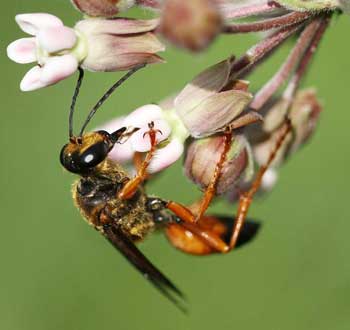
Although great golden digger wasps prey on insects for their young to eat, they themselves are nectarivores, consuming the nectar of a variety of flowers. (Photo by Mary Holland)
Generally speaking, wasps are to be avoided. Many species are quite aggressive, and their sting can be very painful. Digger wasps, however, are wary of creatures much larger than themselves, and thus usually avoid humans, and rarely sting them. However, they are very active and have ground nests that are out in the open, so observing these wasps as they hunt prey or enter and exit their nests is not only possible, but quite fascinating.
The great golden digger wasp, Sphex ichneumoneus, is commonly seen during July and August in Harvard, as it patrols over lawns looking for insects to feed its young. Both its scientific and common names are very apt; the species name, “ichneumoneus,” is Greek for tracker (it spends much of its time tracking prey) and when not actively looking for insects to sting, it does a great deal of digging.
The great golden digger wasp is a solitary wasp and lives independently—no cooperative social colonies for this species—although several females may build nests in the same general area. A female wasp may build up to six nests in a summer, each containing several eggs.
She begins by cutting the earth with her mandibles. Carrying the soil between her forelegs and head, she walks backwards about an inch away from the nesting site. She then flips the soil with her forelegs beneath her body, scattering it to the sides with her hind legs. She also uses her front legs to dig the tunnel, as they have a special structure called a rake, with which the female wasp whisks the soil. In this manner she excavates a vertical tunnel about half an inch in diameter down into the ground as far as four to six inches. Off of this tunnel she digs out several horizontal chambers, or cells.
After constructing her nest, the female digger wasp goes above ground and searches for insects, zigzagging low over lawns and fields as she flies looking for crickets, katydids and their relatives to sting and paralyze. When she finds suitable prey, she curls her abdomen underneath herself, aims her stinger at the targeted insect, and inserts her stinger into it, secreting toxins which paralyze but don’t kill it. Her next task is to transport the paralyzed insect back to her nest. If the insect is relatively small, she flies it directly to the nest; if the prey is too large to carry in flight, she will walk with it across the ground. The digger wasp grasps the insect’s antennae with her mandibles, or mouth parts, and clasps it beneath her body as she returns to her nest.
Once back at the nest, the wasp deposits the paralyzed prey near the opening, and she goes down to inspect the nest. After a brief time, she emerges above ground and drags the insect down into a cell. She then lays an egg on the insect’s thorax, or middle section, and repeats this entire process until every cell is filled. The wasp’s eggs are yellow, less than a quarter of an inch long and have a slightly curved cylindrical shape. Because the prey is alive, it remains fresh until the wasp egg hatches in two or three days and the larva begins to feed on it.
Although adult great golden digger wasps are nectarivores, living off the nectar of a variety of flowering plants, they spend a good part of their life preying upon insects for their offspring. They are well equipped to protect themselves with their stinger, but they do have to guard their booty. American robins and house sparrows have been observed chasing great golden digger wasps carrying prey to their nests, causing the wasps to drop the insect they were carrying, which the birds then ate.
After their eggs have been laid, adult great golden digger wasps die. There is only one generation per year; next year’s adults spend the winter in their nests and emerge in the summer. Now is the time to look for these industrious insects and observe their nesting behavior, for they will soon disappear.
Mary Holland is the author of “Naturally Curious: A Photographic Field Guide and Month-by-Month Journey Through the Fields, Woods, and Marshes of New England.” She has a natural history blog which can be found at www.naturallycuriouswithmaryholland.wordpress.com .