A project initiated by the Cemetery Commission to restore the metal, lollipop-shaped grave markers in the Shaker Cemetery on South Shaker Road has inflamed tensions between that commission and the Harvard Historical Commission, raising questions about jurisdiction over the historic burial ground and posing a challenge as to how two divergent boards can work together for the betterment of the town.
In May, Harvard resident and Shaker scholar Roben Campbell noticed several of the antique markers missing, during one of her frequent visits to the old cemetery as part of work she was doing on an independent research project. In place of the missing markers were numbered stakes. Curious, she contacted Roseanne Saalfield, chairwoman of the Historical Commission, who told her the HHC did not know anything about the missing markers.
—Roseanne Saafield,
Historical Commissioner
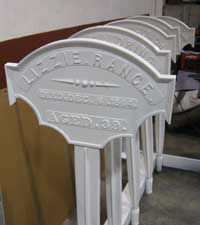
Saalfield went to the cemetery and was so alarmed at what she saw that she thought it was vandalism and contacted the Harvard police. It turns out that the 20 missing markers had been sent out for powder-coating by Central Mass Powder Coating in Clinton, owned by former longtime Harvard resident Jeff Gould, as part of a restoration project initiated by the Cemetery Commission. No one on the Cemetery Commission had notified the Historical Commission about the decision to remove the markers and go ahead with the powder-coating.
The preservation methodology to be used in restoring the markers has been a source of longstanding disagreement between the two town commissions. Cemetery commissioners believe they alone have responsibility for maintaining all of Harvard’s cemeteries, including this one. However, because the Shaker Cemetery is located in a designated historic district in town, members of the Historical Commission believe the restoration falls under their jurisdiction as well.
The Press first reported on the dispute in May 2010. The Cemetery Commission had initially pitched the restoration project to the Community Preservation Committee (CPC) in 2007, with a proposal to sandblast and powder-coat the old markers. According to CPC Chairman Donald Boyce, the commission later withdrew the application because Historical Commission approval was required. (Boyce said that any group applying for CPC funds for historical preservation projects has to obtain approval from the Historical Commission.)
—Whit Sprague,
Cemetery Commissioner
Concerned about the fragility of the aged and deteriorating metal, then-Historical Commission chairman Jonathan Feist consulted with several antique metals conservators, all of whom advised against the approach recommended by then-Cemetery Commission chairman Bruce Dolimount. Among the many concerns were the effect sandblasting would have on the fragile and decayed metal and the effect of extreme high heat on the metal from powder-coating. In addition, samples Dolimount produced of markers restored using the controversial technique “looked like plastic,” according to Feist.
In 2009 the Historical Commission applied for CPC funds to hire a preservationist to advise both commissions on the restoration project. At the May 2010 Annual Town Meeting (ATM), there was a near-unanimous vote to spend $5,655 of CPC funds for a consultant to advise and set up a preservation plan, as proposed in the warrant article put forward by the Historical Commission and CPC.
After the ATM vote, Dolimount suddenly changed his mind and said his commission no longer supported the project. In an angry e-mail sent to Feist, Dolimount complained that the Cemetery Commission had been left out of the warrant article as a cosponsor and said that the HCC felt “sold out” by the Historical Commission. He said the Cemetery Commission had voted to “table spending the money appropriated at Town Meeting,” adding that the cemetery commissioners objected to “the spending of money to tell us something we already know.” The omission in the warrant article amounted to a clerical error, according to Saalfield, and was corrected by an amendment to the article that was approved at ATM.
Since last year, little progress has been made by the two commissions in coming to an agreement, but, according to Saalfield, Sprague had accepted her offer of last year to work together on a subcommittee to explore the issue. However, in February of this year Sprague notified Saalfield that he would not have any involvement in the subcommittee. When asked by the Press why he changed his mind, Sprague replied in an e-mail, “It became apparent to me that this was going to take a whole lot more time to meet … talk … meet … talk … vet the numbers … meet … talk … than I wanted to spend.”
According to Saalfield, Cemetery Commission members have been unresponsive to invitations to Historical Commission meetings to discuss the situation, and have not returned her phone calls.
Is it the right process?
Over the past year, Saalfield says, she has continued to consult with conservators “with terrific credentials and lots of very strong experience” who have said, “Powder-coating is wrong for those objects, especially if ‘wrong’ includes historical accuracy.”
Sprague, in an e-mail to the Press, said, “There are a lot of consultants and differing opinions out there on how to preserve antique metal … there’s probably hundreds of pages written by so-called ‘experts’ in the field. At some point, somebody has to make a decision, or nothing gets done.”
Gould explained in a recent phone call that being in a business that does antique restoration, he is quite experienced at working with old and fragile metal. He has done work for the Smithsonian and recently restored a 150-year-old wrought iron railing for the town of Orange, which was funded by a historical grant. “We have powder-coated many historical projects, including the railings on the front of the town of Concord Town Hall,” he said. “We are the go-to guys for antique metals restoration.”
When asked what he knows about the markers, Gould said, “The markers were sand-casted over a 25-year period from around 1875, the height of the Victorian era, and are beautifully designed. The markers themselves are made from a higher grade of metal than the posts.”
He said that in 2003 members of the Cemetery Commission approached him about restoring the markers. He made three samples and placed them in the cemetery to see how they would hold up over time. Eight years later they “look great, while the rest of the markers have continued to deteriorate,” he said. Gould went on to say that he grew up near the cemetery and had been “appalled at the deteriorating condition of the markers over the years. They are just rotting away.”
Gould said he is excited to do this project, and has offered to do it at cost, because of his personal interest in saving these markers and preserving them. He has done about 20 out of approximately 200, and has photographed and documented the process, including cataloguing the individually unique markings on the markers. He said that Campbell had called him, and he invited her to observe and assist with the documentation. She has made several visits.
Saalfield does not question Gouldʼs professionalism and acknowledges that he has worked with museums. “The fact remains,” she said, “that he is not a conservator.” She reiterated that powder-coating is risky, and not a historically sensitive treatment. Conservators she has spoken with have cautioned that when sandblasting, a very fine medium must be used, among other precautions.
Gould sent the Press an overview of the entire process used to clean and coat the markers. After an ultrasonic cleansing, the parts are blasted with “ultra-fine, 100-grit aluminum oxide (almost like powder) at only 90 psi.” The many steps in the process include a micro-etch and decontamination, then a protective layer is left and the castings “are pure and stable again,” according to Gould. He added, “We inspect each piece for cracks or damage and determine if the markers need any repairs. It was at this point that Shaker expert Roben Campell came to our facility and photographed and inspected each marker and made notes about the markings that had been added over the years.”
Campbell, who observed the markers after cleaning, said, “Their very light grayish color after the cleaning process revealed that an alloy of nickel, or something like it, was used to enhance the durability of the iron. The use of an alloy confirms what we know of the Shakers, who were committed to high quality materials for construction.”
Gouldʼs notes about the coating say that the bright finish—which can seem harsh in bright sunlight—was chosen “because of the excellent weatherability performance and the highly UV stable gloss level. It is also a ‘neutral’ white——similar in color to the original milk-based paint used 100 years ago.”
Gould said, “Every step of the way, these markers are handled with kid gloves.”
When asked about the paint color, Campbell said, “We do not know for sure whether the markers were painted in the 1879 restoration project, but they have been painted multiple times. The Shakers were savvy about the nature of metal, and probably did paint them. We know from photos that go back to the mid-20th century that the markers are very light looking.” She mentioned other painted metal objects in Shaker village, such as hinges for attaching wooden fencing to granite posts. “Given the constant exposure to the elements, the markers, too, were probably painted.”
‘Structure’ determines jurisdiction
In a phone conversation with Harvard Town Administrator Tim Bragan, the Press asked if he thought any bylaws were violated by the Cemetery Commission’s actions, and what his thoughts were about the unfortunate situation between these two commissions.
Bragan said he didnʼt know why the decision to go ahead with the restoration was made in an abrupt manner without any communication to the Historical Commission, or whether there was any animosity involved due to lingering conflicts, but he felt the Cemetery Commission would probably rely on the fact that they are an elected board and so, legally, they are not bound to communicate with anybody about their decisions.
“They donʼt answer to the Board of Selectmen, the Historical Commission— they donʼt answer to anybody,” he said.
Bragan said that the Historical Commission has jurisdiction when “structures” are involved, and acknowledged that is where the center of the issue is. He said, “Town counsel [Mark Lanza] has come back and said that under the Massachusetts law, and under our bylaws, the markers themselves are not structures.”
Given that the Historical Commission disagrees with town counselʼs interpretation of the law within the confines of the defined historic district of Shaker Village, Bragan was asked if he thought there might be any gray areas in the interpretation of the law. He replied that “historic” is one piece, “structure” is another, and under Massachusetts guidelines, markers are not structures. Bragan noted that the Historical Commission could have attempted to amend the town bylaws to include the markers as structures, and the time to have done that would have been in 2003 when the Cemetery Commission presented the powder-coated samples.
“There simply would not be an issue today if they had done that,” he said.
What about the will of the people?
In an e-mail to Board of Selectmen Chairwoman Marie Sobalvarro, the Press asked if there would be any consequence to the Cemetery Commission’s going against the apparent will of Town Meeting, which set aside money to hire a consultant to develop a plan for the restoration. In her reply, Sobalvarro said, “This issue was brought to the Board of Selectmen during our last meeting via public comment. At that time, we asked Roseanne, of the Historical Commission, some questions, but did not deliberate. As the BOS only has authority via its votes, and we neither deliberated nor were there any motions made, I canʼt comment regarding possible consequences.”
The Press asked Sobalvarro, “Even if the Cemetery Commission is within the letter of the law, are they really off the hook for willfully ignoring the advice of an expert paid with CPC funds to advise them?”
Sobalvarro again deferred comment, saying that the Historical Commission was on the agenda for the June 7 BOS meeting to discuss the Shaker marker restoration. However, the item was subsequently removed from the agenda, after the Historical Commission announced that two of its members would attend the June 6 Cemetery Commission meeting to discuss the subject.
Sobalvarro said, “Carrying an optimistic view of the world, Iʼm hopeful that the efforts of these two committees to resolve this jurisdictional issue can occur at their meeting on Monday.”
When asked about last yearʼs ATM vote, Bragan pointed out that the Historical Commission had gone to the CPC on its own first, without communication with the Cemetery Commission, to seek money to do the study of how to best preserve the markers. “It was initiated by one party; it was not jointly initiated,” he said. “They did not get buy-in from the Cemetery Commission up front.” He also said that there was an expectation created by the town vote to go ahead with spending the money, but “an expectation is not a legal requirement.”
Toward a more collegial working relationship
Historical Commission members Ken Swanton and Rhonda Sprague attended the June 6 Cemetery Commission meeting, along with Gould, Sobalvarro, and Selectman Peter Warren, who is the BOS liaison to the Cemetery Commission. The purpose of the joint meeting was to revisit the process that was performed on the 20 markers, and determine what will be done with the remaining 175 plus.
Cemetery commissioners defended their decision to proceed with the restoration project and argued that more study is not needed, citing their own technical expertise: Whit Sprague and Chairman Jack Spero are engineers; commission member Dolimount has extensive experience in various aspects of metal coating. Gould recounted his own experience and asserted that his company is fully qualified to perform this kind of historical preservation.
Gould said he had done the first three markers at no charge and had done the recent batch at cost. He said he would probably want a bit more for future work. Spero spoke in favor of immediate treatment of another batch of markers, to take advantage of unspent funds in the current year’s Cemetery Commission budget. The group discussed funding sources for the remainder of the project; one idea was to go back to the CPC for money. Ironically, that would require approval from the Historical Commission. Spero said that the Cemetery Commission could probably come up with the money, if not from its own budget, perhaps from a grant or an “adopt-a-marker” fundraising approach.
Warren asked the Cemetery Commission for a more deliberative process, taking more time to gain agreement with the Historical Commission, even if they do not have jurisdiction. Gould offered to attend a meeting of the Historical Commission to review his proposal for the rest of the work, along with his qualifications.
In the end, no firm decision was made on how or when the remaining restoration work would proceed.
Next steps
In his phone conversation with the Press last week, Bragan expressed disappointment at the lack of decorum that is normally expected on the part of elected or appointed commissioners to communicate with each other and to work in a collaborative manner. When asked if the town could try to stop the Cemetery Commission from doing further work on the markers, he said there was no legal way for selectmen to stop them from doing the work because the BOS doesn’t have jurisdiction over an elected board. He said the only way to do that would be “to call a special town meeting to amend that bylaw, so that this couldnʼt happen.”
Campbell expressed frustration with the two commissions, saying,”Neither the HCC nor the HHC is concerned with the overall care of the cemetery. One specializes in straightforward maintenance and the other in historic preservation.”
She also pointed out, “The cemetery is on our watch as citizens of Harvard. We all love the Shaker cemetery and should prioritize the dangers that threaten the stability and longevity of the site as a whole.”