Just over a dozen parents and community members took the opportunity to meet and talk with two of the three finalists for principal at the Hildreth Elementary School (HES) at evening meetings on Jan. 5 and 6. (A meeting with the third finalist was scheduled to take place Jan. 13, after press time.) Despite the comparatively low attendance, however, questions covered a variety of topics ranging from parental involvement to crisis management.
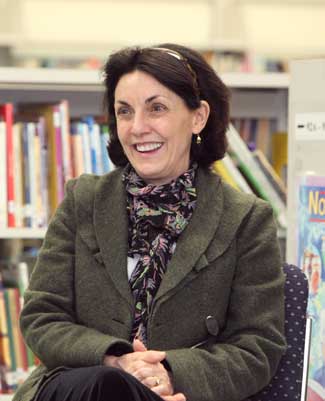
Dr. Mary Lou DiBella. (Photos by Lisa Aciukewicz)
First to visit was Dr. Mary Lou DiBella, currently principal of the Holland Elementary School in Holland, Mass. DiBella is in her third year at that school, having previously served as principal of an elementary school in Greenfield, Mass., and assistant principal in Springfield, Mass.
DiBella spent the day of Jan. 5 visiting classrooms and meeting teachers, students, and members of the School Council and the School Committee. Commenting on the classrooms she had visited, DiBella said, “I was very impressed with what I saw. All the children were on task, responsive, and respectful with each other. There was lots of partner work, more than I’ve ever seen.” DiBella explained that she was interested in Harvard because she was looking for a school with a lot of community involvement as well as a seasoned staff.
Asked about the class she most likes to teach, DiBella responded that she loves to teach reading and writing. She explained, however, that her background is primarily in special education, particularly autism, rather than as a classroom teacher. Before she moved into school administration, she worked with programs in Springfield, South Hadley, and Chatham on early intervention and language development. She also spent many years as a private practitioner, consulting with families and public school systems for children with developmental delays and disabilities.
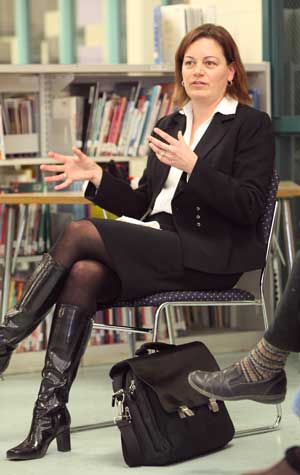
Dr. Linda Dwight.
The second candidate to visit HES, Dr. Linda Dwight, followed a similar schedule of meetings on Jan. 6. For the past nine years, Dwight has been the principal of an elementary school in the Pequea Valley School District near Lancaster, Penn. Earlier in her career, she taught in grades 1, 2, 4, and 5. She joked about the variety, saying that as a beginning teacher she had been moved around a lot.
Describing her day at HES, Dwight remarked that all students appeared engaged and on task. “Teachers and students were so proud of what they were doing, it was hard for me to leave,” she said.
She noted that her Pennsylvania district is similar to Harvard, in that both are in rural settings but have large cities not far away. One unique feature of Dwight’s school district is that more than half the children in the area are Amish and therefore attend their own one-room schools, rather than the public schools.
The third candidate, Carl E. Mock, has most recently served as director/superintendent of the River Valley Technical Center School District in Springfield, Vt. His prior career included serving as a superintendent in White River Junction, Vt., and as principal/superintendent in Little Compton, R.I. Before moving into administration, he taught at both the elementary and secondary levels. He noted in his letter of application that he has had 35 years of experience in public education.
Parents, teachers, and tests
Several common concerns emerged from parents’ questions at the first two meetings. Questioners asked the candidates about their attitude toward parental involvement in the schools; about the balance between a teacher’s autonomy in the classroom and the need for consistency across a grade level; and about the tension between teaching to state standards and fostering a love of learning.
Asked about parental involvement, DiBella described the types of schoolwide events with parents that she has encouraged in her present position, ranging from math night to sky-watching and “bingo for books.” She noted, “It’s a high-paced world in school, more than it used to be,” which sometimes limits the time that can be set aside for volunteer-led projects during the day.
Also on the topic of parental involvement, Dwight noted that most of the part-time employees and aides in her school were parents, and she encouraged teachers to invite parents into the classroom, especially during writing time, to work with students. She described a DVD of reading sessions that one teacher had done for parents, so that they could use some of the same approaches at home.
Dwight suggested that the HES website could be improved and expanded so that every teacher had a page where they could post items of interest to the class. The web connection would help parents keep up to date on topics their children were studying in school.
Contacted by the Press, the third candidate—Carl Mock—also expressed support for parental involvement. He noted the current concerns about “helicopter parents” but emphasized, “Parents are absolutely the first and most important teachers for every young child.”
Both Dwight and DiBella were asked about balancing teachers’ autonomy and creativity against the need to meet state standards for a uniform curriculum. Dwight said the solution lay in building strong grade-level teams of teachers and giving them plenty of time to meet together each day to allow for both consistency and special projects.
DiBella noted that consistency across grade levels was important. “There’s not much make-up time in middle school,” she explained, so students need a firm foundation in all areas. She emphasized that teachers should communicate across grade levels as well as within them, to be sure that skills and content were coordinated as students moved from grade to grade.
Speaking about the role of state standards and tests, Dwight noted, “Assessments should be a byproduct of learning, not the main point or focus … But you must meet the state standards and align your curriculum to them, or you set kids up for failure.”
In a telephone conversation with the Press, Mock asserted that it is important for teachers to “have the latitude to follow up on their special talents and skills.” He noted that doing so may inspire students to develop their own interests. Those special projects, he said, must be balanced with “the obligation to provide common preparation for the curriculum requirements.”
Responding to crisis
Both Dwight and DiBella were asked whether they had ever needed to lead their school during a time of crisis. DiBella recalled a disastrous flood in Greenfield, when many homes were swept away in a neighborhood across the river. The children in her school had collected supplies and household goods for the people who had lost everything, she said. The worst event that had directly affected her school, she said, was an auto accident in which a teacher’s child had died and the teacher herself was seriously injured.
Dwight recalled that she had been a young principal at the time of the 9/11 attacks in 2001 and had to deal with the children’s reactions. And in October 2006, when a gunman shot several girls at a nearby Amish school in Lancaster County, police helicopters had gone directly over her school and all the children had been taken inside for safety.
While Mock said he had not dealt with a school that was actually “in crisis,” he recalled that two schools had faced problems of low morale when he first arrived, creating a school-wide problem that he had to tackle.