At the upcoming Special Town Meeting on Nov. 9, residents will be asked to do something they have not done since before 1974—vote on possible changes to the building code.
Generally, updates to the state building code occur every few years with nary a ripple of awareness in the general population. But, since May 2009, communities have had an opportunity to adopt a modification to the general building code that is intended to increase energy efficiency in new and substantially renovated buildings. Commonly called the “stretch energy code,” or more simply the “stretch code,” the officially titled Appendix 780 CMR 120.AA replaces the requirements to the energy section of the base building code. These changes are expected to increase energy efficiency, and thus lower energy costs, by 20 percent from the current base code and 30 to 35 percent over the 2006 state code.
reduces energy use and saves money, benefits that are primarily realized by residents and owners.
Opponents object to
increases in building costs that are largely borne by builders and developers.
In response to requests for improved building energy efficiency, the Board of Building Regulations and Standards (BBRS) developed optional building standards to those in the base code. Rather than repeat the past confusion of multiple building requirements across the state, the BBRS, in collaboration with the state’s energy and environmental departments, introduced the Appendix 780 CMR 120.AA, based on the energy sections of the International Energy Conservation Code (IIECC) 2009. The optional appendix strengthens the energy section of the base building code, while not expanding its scope.
According to the New Buildings Institute, which contributes to building code development, a stretch code, referred to as a “reach code” in some states, lets builders and businesses know what to expect in the next base energy code as energy codes evolve to meet new practices, materials, and energy standards. By signaling what to expect, builders have time to develop new skills, and businesses can anticipate new demand for goods and services.
This is particularly relevant to the Massachusetts stretch code. The Green Communities Act of 2008 requires the state building code be updated every three years, following developments in the IECC. The 2012 state building code update is expected to incorporate the current stretch code, including its requirement for higher-rate insulation and performance ratings by certified Home Energy Star raters. Rather than an abrupt requirement for which there might be insufficient skills or materials, the stretch code encourages a gradual increase in both the skill and material supplies. According to Mass DOER, roughly 30 percent of new buildings built in 2009 met the Energy Star standards of the stretch code.
The stretch code is all about increasing energy conservation in new construction, including additions and some residential renovations, through design, building practices, and measurements. There are no requirements to replace conventional energy sources with renewable ones such as geothermal, solar, or wind, although very large commercial buildings have the option of meeting energy conservation requirements by generating a small percentage of their energy needs with onsite renewable energy generation. There are also no requirements to modify existing buildings.
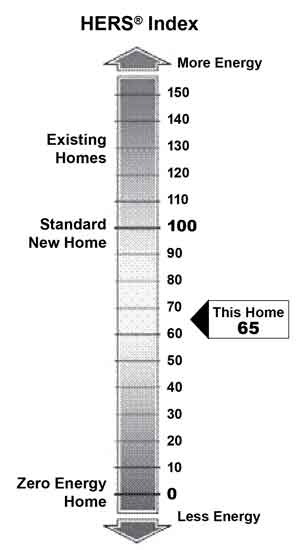
An example of a HERS index for a new house with better-than-average energy use. (Source: RESNET)
The new performance rating system
Most of the energy efficiency specifications and building practices in the original appendix code are now part of the new comprehensive state building code that went into effect last July. There are a few notable exceptions; the significant difference is a performance component. The energy portions of the current base code cover what to do—specific building techniques and material requirements. The stretch code offers a way to ensure that the base code is correctly implemented through performance measurements. The base code encourages performance testing, but the stretch code requires it on new residential construction and commercial construction of more than 100,000 square feet.
This means that energy use in new residential buildings will be estimated using the Home Energy Rating System (HERS), the same system used to qualify for energy-efficient mortgages and many Federal IRS tax credits. An independent certified HERS rater, working with the builder, assesses a new house for energy efficiency by several means that include an initial design review, a blower-door test for air leaks, duct testing for heat and air-conditioning, a thermal bypass checklist, and optional infrared camera readers to further test for air leaks in the building envelope. Usually, the builder works simultaneously with the HERS rater to correct any air leakage discovered in the performance testing. A final HERS index rating on the building is reported to the town building inspector. (See sample HERS rating chart in sidebar.) Houses more than 3,000 square feet in size are required to be 35 percent more efficient than the 2006 base code, which is the baseline for HERS index ratings.
Impact on home renovations
While the stretch code requires performance testing on new homes and very large commercial buildings, there is flexibility in other construction. Home renovations and additions have different requirements and energy-savings expectations. If a renovation does not involve anything covered by the base energy code, for example, reconfiguring a bedroom, there are no added requirements from the stretch code. If an exterior wall is opened, the insulation in that part of the wall must be replaced to meet new insulation requirements. If a window is added or replaced, it must meet the Energy Star requirements, which are slightly higher than those in the current base code. No performance testing is required.
An extensive residential renovation or addition falls under the stretch code, but the builder or renovator is given the flexibility of offering two possible ways to meet the code’s efficiency requirements: a prescriptive path of construction practices and materials, like the base building code, or by a performance measurement requirement. Energy efficiency requirements in the stretch code for additions are much lower than for new construction.
The stretch code and commercial buildings
The stretch code also applies to new commercial buildings larger than 5,000 square feet. Commercial renovations, as well as new buildings with special energy requirements like supermarkets, laboratories, and warehouses smaller than 4,000 square feet, are exempt. Non-exempt buildings under 100,000 square feet may meet stretch code requirement by either a prescriptive or performance path. Buildings larger than 100,000 square feet are expected to meet performance standards demonstrated through BBRS-approved modeling.
Historic buildings are exempt from the stretch code.
Arguments for and against; costs
Proponents of the new stretch code claim it reduces energy use and saves money, benefits that are primarily realized by residents and owners. Opponents object to increases in building costs that are largely borne by builders and developers. Some oppose the stretch code on philosophical grounds that the building practices should be by choice, not regulations. Proponents suggest that not increasing energy efficiency regulations may leave builders with choices to make, but not consumers.
So how much does implementing the stretch code cost? Analyses commissioned by the state Department of Energy Resources estimated net costs for a new 2,762 square-foot house at $1,755 and $5,176 for 4,462 square feet. Respective energy costs reductions were estimated at $516 and $1,455 a year.
Details of these analyses, as well as more information about the stretch code, can be found at www.mass.gov/doer/.