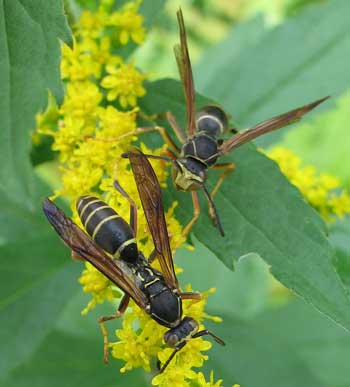
Yellow jackets (shown here gathering nectar from goldenrod) seek sources of sugar, such as nectar and decayed fruit, especially in the fall. (Photo by Mary Holland)
Yellow jackets—yellow- and black-banded members of the wasp family—make their presence known most dramatically in the fall. This is because their search for sugar intensifies, and who more than humans can provide an ample supply of sweets? Decaying and crushed fruit, sweetened fruit juices, and soda are abundant and accessible sources of sugar—anyone who consumes a sweet drink outside in the fall is a sitting target for yellow jackets.
The insect family Vespidae consists of yellow jackets, hornets, and their relatives. There are four subfamilies within this family: Polistinae (paper wasps); Vespinae (yellow jackets, hornets); Eumeninae (potter wasps and mason wasps); and Masarinae (pollen wasps). The social wasps in this family (those that form colonies) include the paper wasps, yellow jackets, and hornets. Often these groups can be distinguished by the design and location of their nests. Paper wasp nests (consisting of cells in which the queen lays eggs and larvae reside) are composed of horizontal layers of paper cells (wood fiber is masticated by worker wasps until it forms a pulp from which the nest is made) suspended by a stalk. The nest is exposed to the elements (the cells open on the underside, so they are protected from rain). Hornets and yellow jackets have multi-tiered nests of cells as well, but their nests are surrounded by a paper envelope consisting of several layers. The nests of both hornets and yellow jackets can approach the size of a soccer ball. Most hornet species build their nests in trees and shrubs, well off the ground, whereas most, but not all, yellow jackets conceal their nests underground in a deserted rodent burrow or in a cavity. (There are some aerial yellow jackets that build their nests several feet off the ground.)
Paper wasps, hornets, and yellow jackets all raise their young on insects or other high-protein food, which they capture and chew up into small bits. In addition, yellow jackets also consume significant amounts of sugar.
The falling temperatures in autumn are a signal to the yellow jacket queen to alter her egg-laying routine. Through the summer she has been laying primarily fertilized eggs, which develop into females (workers) that raise the developing larvae. As the weather cools, the queen begins cutting back on the number of fertilized eggs and begins to lay unfertilized eggs, which will develop into males (drones). A few fertilized eggs are put into larger cells than normal, which promotes their development into queens. The old queen dies in the fall, but the new queens mate with the recently-hatched males, and overwinter in sheltered areas, such as rotting logs.
There is an introduced species of yellow jacket, Vespula germanica, which is most apt to be the species that comes around and pesters you in the fall. As the queen’s egg-laying diminishes and she eventually dies, there are no more developing larvae, so the workers stop gathering the high-protein food they’ve been feeding them (insects, etc.) and begin searching for sources of sugar for themselves.
Come fall, when yellow jackets become sluggish in the cool weather, it is not uncommon to come upon an underground nest that has been dug up and torn apart by a hungry raccoon, striped skunk, or black bear. The papery remains of the nest usually lie scattered on the forest floor.
If seeing the inside of a yellow jacket (or hornet) nest sounds intriguing, be sure to wait until several hard frosts to take a look. These insects are surprisingly hardy, and if the nest is brought into a warm house after a light frost, signs of life may surprise you.
Naturalist and writer Mary Holland lived in Harvard for many years before moving to Vermont. She can be contacted at mholland@vermontel.net.