As the town takes up the question of what to do with some of the historic buildings in town center, we feel it’s appropriate to revisit the histories of these grand places. This week we take a look at the history of the old library.
A library has long been an important part of Harvard’s town center, but for close to 100 years a library existed without a building of its own. In the late 1800s a tradition of generosity enabled the old library building to come into being and later supported its growth and changes.
The origin of a library in Harvard goes back to 1793, at which time Reverend William Emerson, father of Ralph Waldo, formed a social library club, of which he served as custodian of the books. He had about 100 volumes at his home. After Emerson’s departure from Harvard in 1799 there is no record of a library until 1808, when Edmund Foster, a merchant on the Common, organized the Social Library of Harvard. Ten men, as promoters of the library, attended the first meeting at the center schoolhouse. Thereafter, annual meetings were held at the inns of Merriam, on Elm Street, and Wetherbee, where the old library stands now. There was no restriction as to the residence of members, but the books themselves were required to be kept within a half mile of the meetinghouse. The librarian/custodian was chosen yearly, the honor going to the lowest bidder at auction. Only one volume could be borrowed at a time by any family and kept for 60 days. There were 150 volumes at the end of the first year, when the library was moved from Foster’s store, on the Common, to Ezra Wetherbee’s tavern. The following year Jonas Merriam obtained the office of librarian and the library became one of the attractions of his tavern.
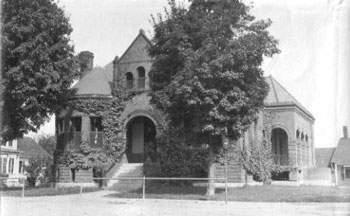
A photo (above) and a postcard (below) of the library in 1902, just after the Hapgood addition was added to the east side of the building to house the children’s room and a large meeting room. (Photos courtesy of the Harvard Historical Society)

Legislation of 1851 empowered towns to support free public libraries by taxation. In 1856 Harvard’s Social Library voted to offer its books for the founding of a free public library, provided the town would raise $100 for the purpose. A year later the library opened with 429 volumes on its shelves. It was open to the public once a week and each family could borrow two volumes at a time for one month. But while the town now had a public library, that library still had no permanent home. During the first six years the books were kept at the building which housed Gale and Dickson’s store, on the site of today’s General Store. For the next 20 years Mrs. George Harrod served as librarian and kept the books in a room of her house on Fairbank Street.
Through a series of generous bequests, the town was able to build a public library three decades after receiving the books for one. In 1880 the Honorable Edward Lawrence of Charlestown, who had grown up in Harvard, remembered the town in his will. He left the library $5,000 for the purchase of new books, contingent on the town’s erecting a building specifically to house those volumes. A year later Augustus Sawyer, a prominent citizen and longtime friend of the library, died. It had been his intention to remember the library, and his widow did so in her will the following year, leaving the remainder of her estate for the purchase of land and the erecting of a permanent home for the library. In 1886 Town Meeting appropriated money to add to the bequest of Mrs. Sawyer; the town purchased the lot made vacant when fire destroyed the Wetherbee Inn; and a building was under way. The architect, William Channing Whitney of Minneapolis, was another Harvard native, the nephew of Lawrence; he donated his plans to the town. Mr. Warren Hapgood, a retired Boston merchant originally from Harvard, donated money for certain improvements to the building project. The building committee (Warren Fairbank, William Harrod, Elijah Myrick, Andrew Fairbank, Edwin Hildreth, and Selah Howell) gave unsparingly of their time to the construction of the library, the total cost of which was $10,472.
The building, a brick structure in the then-popular Victorian style, was dedicated on June 22, 1887. A reporter of the time recorded the event in language to match the ornateness of the structure itself: “A Gala Day—The long-expected day of jubilee came along last Wednesday. An institution that more than any other unites together townspeople of every political shade, religious belief, nation, and sex had its bridal day, and after having been tenderly cared for under the Harrod roof, was formally joined in wedlock to one of the most handsome edifices of its proportions in this section of the state.” The occasion was marked by speeches and music, after which residents were fed in the upper Town Hall, while guests of the town ate in the lower hall. The same observer goes on: “The afternoon was spent in the inspection of the new library building and in a free and easy social gathering about the Common, which to many was not the least delightful feature of the day. As the afternoon waned, Harrod’s coaches came on the scene and dispersed what can be truthfully said to be a golden day of rare delights, which has had scarcely a precedent in Harvard’s history.”
On the walls to either side of the library entrance, which faced the Common, stone tablets were installed, commemorating Harvard’s Civil War participants. In its early years two first-floor rooms were allotted to the postmaster of Harvard, who acted as janitor of the library. There were no changes to the library until 1902, when a bequest from Warren Hapgood made possible a large addition to the east side of the building. The Hapgood Memorial, dedicated in February of 1904, housed the children’s room and a large meeting room.
In 1956 the post office moved to 9 Mass. Ave., freeing up two front rooms for use by the library. By the late 1970s it was clear that expansion or replacement of the library was crucial, and Town Meeting of 1982 voted funds for expansion and remodeling. The front entrance to the building was removed, an elevator was installed for handicapped accessibility, and usable space was increased by 30 percent. At this time the Civil War tablets were relocated in the lower level of the Hapgood addition.
A Library Facility Needs Committee determined in 1995 that further expansion of the library, necessary to meet the needs of a growing population, would require a new site, and the next year the committee settled on Old Bromfield. April of 2007 marked the official closing of the old library. As part of the dedication ceremony of the new Harvard Public Library, a parade of children carrying books in yellow plastic bags wended its way through the town center from the old library to the new.