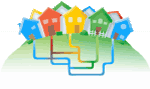
On Wednesday, Feb. 10, Google announced plans to launch an experiment aimed at making Internet access better and faster for everyone. They will build ultra-high-speed broadband networks in one or more trial locations, delivering speeds more than 100 times faster than what most Americans have access to today, more than 1 gigabit per second on fiber-to-the-home connections. Google said the service would be offered at a competitive price to at least 50,000 and potentially up to 500,000 people.Ten years ago, in June 2000, several Harvard residents banded together in a Yahoo discussion group, HarvardDSL, to try to bring high-speed Internet service to town. Before Charter Communications offered high-speed Internet, and before Verizon offered DSL, Harvard residents had only dial-up connections, Integrated Services Digital Network (ISDN) service, or T-1 (frame relay) service. The latter two were prohibitively expensive for residential or small business use. The group was successful in bringing DSL service to Harvard, delivered by Vitts Networks. Vitts only lasted a few months before declaring bankruptcy, but the group continued to communicate as first Charter, and then Verizon, brought high-speed Internet service to Harvard.
When the Google announcement hit, chatter in HarvardDSL picked up, and it was quickly decided to hold a meeting to begin organizing a Harvard response. Some 20 people gathered at the General Store Tuesday afternoon, and while it snowed outside, ideas were kicked around for how Harvard should respond. Google’s process allows either a formal government response by a municipality, or a community group response. The group decided to go for a formal government response, and also decided it would be best if multiple towns could work together to make a regional response.
The opportunity was to be reviewed at this morning’s (Friday’s) Harvard Board of Selectmen meeting (rescheduled after Tuesday’s meeting was cancelled because of weather), and at next week’s Joint Boards of Selectmen meeting, to enlist formal participation by Harvard government, to alert other towns to the opportunity, and to enlist their participation.