A girl balances a bucket of water on her head as she crosses the street in Port-au-Prince before the earthquake. (Photos by Libby Levison)
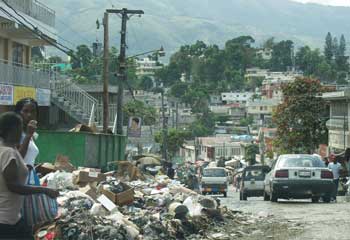
A typical scene in Port-au-Prince prior to the earthquake.

A water tanker travels down a road in Port-au-Prince.
The first weeks I was in Haiti, in October 2008, the noise woke me up by 5:30 every morning. The MSF (Médecins Sans Frontières) or Doctors without Borders house I shared with eight other aid workers was located in Bourdon, near Pétionville. Port-au-Prince is flat near the sea, but the city extends up the hills that encircle the port, with houses seeming to cling to the hillsides. The roads were bad—narrow, steep, some paved, some dirt, and some cobbled with interlocking pavers laid down on a bed of sand, which shift after a rainy season, resulting in missing tiles and potholes. Outside my bedroom window on our side street, tires spun, burning rubber, especially on wet pavers, as trucks tried to get up the narrow, steep street.
Getting anywhere in Port-au-Prince involved bouncing down a series of side roads that were often just wide enough for a Land Rover. The main road near the house, which ran from the center to Pétionville, was one lane in each direction. It took 45 to 60 minutes to get to the MSF hospital where we worked—and often twice that. One accident could gridlock huge parts of town. Avenue Delmas, which ran from Pétionville to the port, was two lanes in each direction, but except for Sundays and the middle of the night, Delmas was too congested to use. Instead, we took single-lane, back roads, past piles of garbage with only inches of clearance on either side of the car. The MSF team dealt with the morning trip pragmatically—we held meetings in the back of the Land Rover, while trying not to fall off the benches as the car bounced along.
The other noise outside my bedroom window came from the neighbors’ generators. Electricity—in those parts of town that had electricity—was never on 24/7. Our hospital sometimes had power 8 to 10 hours a day, the house from 7 a.m. to 6 p.m. To supplement this there was a generator and backup battery system. The house generator ran from 6 to 10 p.m., and then the batteries powered the lights. Sundays, when there was no electricity, we ran the generator to charge the batteries, to cool the ice-lined refrigerators used to store perishable medicines and vaccines, and to charge cell phones, radios, and computers. While the MSF house generator was a new, “quiet” model, the neighbors’ generators weren’t. The neighbor to the left had added a car muffler to the generator exhaust. When it started at 5:30 a.m., it sounded like there was a truck in the room next door. The generator of the house in front of us had an exhaust pipe that extended above their compound wall—which meant that the fumes were released at exactly the height of my bedroom window. Every surface in my room was always covered with a mixture of road dust and exhaust debris. The generators at the hospital were not quiet models, either, and we often searched for a quiet corner to have a discussion.
The water supply was unreliable. Both the house and hospital were allegedly on city water, and we had underground cisterns from which water was pumped to tanks on the roof that then gravity-fed the building. When the city water was off, MSF bought water, brought in by tankers to fill the cisterns for washing and in stacks of 5-gallon carboys for drinking water. A water tanker parked in front of the hospital blocked traffic, patients, and pedestrians. Few private homes were on the city-water system: little tankers delivered water to the narrow roads of Port-au-Prince, again blocking traffic. For the many homes perched on steep hillsides or the virtual lean-tos near the port, reachable only by foot, water was carried in by hand. These homes had little or no services at all.
And then there was the lack of health infrastructure, the reason that MSF and scores of other nongovernmental organizations (NGOs) are in Haiti. There are government hospitals in Haiti that are supposed to offer free services, and there are private clinics and hospitals, which charge for services. The government hospitals were on strike for two of the five months I was in Haiti, and were always short (or out) of supplies. Patients had to bring or buy the medicines and medical supplies needed for their treatment, be it antibiotics, syringes, or IV fluid.
Until the earthquake on Jan. 12, MSF ran three projects in Port-au-Prince: the only free trauma hospital in Port-au-Prince, an emergency obstetrics hospital, and an emergency room in a slum, which treated victims of violence. The 65-bed obstetrics hospital where I worked was mandated to handle only emergencies or complicated cases, but with no hospitals available for nonpaying patients (because of frequent strikes), our hospital delivered 800 to 1,200 babies per month—30 to 40 a day—with only half of the cases being complicated. For a normal delivery, women lined up outside waiting for an available bed; afterward they rested on a cot for a few hours before heading home. The cries of 20 or so women in labor constantly filled the hospital courtyard.
In 2008, Haiti was the recipient of an international grant that guaranteed free obstetric care for all normal births, including free medical supplies. But somehow the funds were exhausted, supplies were unavailable, and the system didn’t work—and the NGOs were delivering the babies and providing a significant part of all health care.
After the earthquake
I heard one Haitian explain on the news this week that Port-au-Prince is a town built for 200,000 that has 3 million people shoe-horned into it. This describes the city well. But now even the infrastructure for the town of 200,000, already overloaded, is gone. Any long-term relief effort cannot be focused on reestablishing services. Instead it will require trying to retrofit services into an overcrowded setting that never had adequate electricity, water, roads, schools, or health care. Getting Haiti “back to normal” should not be the goal.
The part of the infrastructure that does work is the Haitian people. I remember the staff I was lucky enough to work with—from the doctors to the cleaners to the accountant. They were strong, determined, hard-working people who are trying to make things better: the doctor who refused to let office politics get in the way of treating patients; the drivers who got us safely through Port-au-Prince every day; the hospital engineer who worked 15-hour days keeping the hospital running; and our tireless 75-year old cook, a tiny woman who ran around the hospital with a huge tray of food making everyone smile. Given the time and resources, it is people like these who will rebuild Port-au-Prince.
Libby Levison grew up in Harvard and has recently moved back to town. She works in the field of international public health and was in Port-au-Prince with MSF from October 2008 to February 2009.
Haiti relief: How to help from close to home
Locally, churches, residents, relief agencies, and corporations are mobilizing to support efforts to provide aid for the victims of last week’s earthquake in Haiti.
——————————
Bromfield student Eve Karon of Granite View Lane started an initiative at Bromfield to raise money for Haitian relief. This week, during lunch period, Karon gave away rope friendship bracelets, for a donation of any size. She planned to forward the donations to the American Red Cross by the end of this week.
Karon has also been monitoring news accounts of Haiti, and is updating a display board at Bromfield daily on conditions there in order to encourage awareness and inspire action among the student body.
——————————
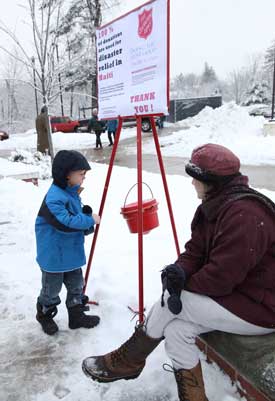
Four-year-old Austin Backer-Verbits puts his donation for Haiti relief into a Salvation Army bucket as volunteer Melissa Marteney looks on. (Photo by Lisa Aciukewicz)
Ayer Road resident Bill Cory reports that the Salvation Army, which has had a presence in Haiti since 1950, has initiated a disaster relief fund for Haiti. Members and friends of the Salvation Army’s Harvard Service Unit have collected funds at the transfer station, the post office, and election polls, and have placed a collection bucket at the General Store. Cory said that 100 percent of the money collected will go directly toward the relief effort. Overhead, he said, is covered by the Salvation Army’s Christmas kettle donations and the infrastructure the organization has in place for responding to international disasters.
Cory reports that the Salvation Army is operating a staging area in south Florida and a logistics and supply line in Port au Prince and has several 15,000-gallon-per-day water purification units headed to Haiti. To learn more or to donate, visit the Salvation Army website.
——————————
Holy Trinity Parish will be taking a collection for Haiti Jan. 23 and 24. Donations received will be sent to Catholic Relief Services, a nonprofit organization that helps those in need in times of crisis.
——————————
The Congregational Church of Harvard began taking offerings for Haiti relief last Sunday and will continue for the next couple of weeks, according to the church’s pastor, Greg Schmidt.
——————————
The Harvard Unitarian Church raised $1,845 in donations Jan. 18 and will send it to the Unitarian Universalist Service Committee’s earthquake relief fund.
——————————
Rollstone Bank & Trust, headquartered in Fitchburg, with a branch office at 283 Ayer Road in Harvard, has agreed to be an official collection site for the American Red Cross’ Haitian earthquake relief efforts. The bank will accept donations on behalf of the Red Cross, and will match up to the first $5,000 in donations.
——————————
The North Central Massachusetts office of Habitat for Humanity reports that an assessment team from Habitat for Humanity International’s Disaster Response department is on its way to Port-au-Prince. They plan to coordinate relief efforts with other organizations such as World Vision, World Concern, and CARE. The office reports that the Habitat for Humanity office in Haiti was destroyed and at least 40 of the 50 Habitat staff members based there are currently unaccounted for. For information on donating toward Habitat for Humanity’s relief effort, visit the North Central Massachusetts website.