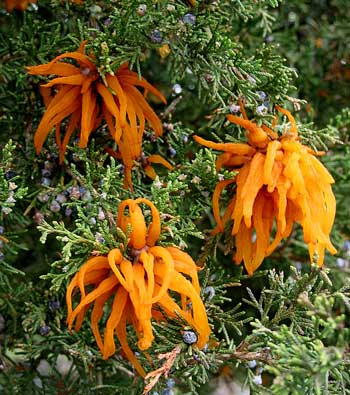
Cedar apple gall: The majority of galls are caused by insects, but fungi are responsible for some, including the cedar-apple gall. Fungi permeate cedar trees and form reddish balls, or “cedar apples,” which disperse their spores from gelatinous spikes that develop in the spring, often after a rain. In completing their life cycles, these spores infect nearby apple trees (cedar-apple rust), causing rust-colored spots on apple leaves as well as the fruit. (Photo by Mary Holland)
Imagine not having to provide a home for your offspring, much less produce three meals a day for them, because it is all taken care of for you. There are many insects, bacteria, mites, fungi, and nematodes (roundworms) that are in this enviable position. The plants on which they lay their eggs, or where their spores germinate, produce abnormal growths, called galls, which serve as edible “houses” for the next generation.
Most of the agents responsible for this type of plant reaction are insects. Of 2,000 gall-producing insects in the United States, 1,500 of them are wasps or gnats. Certain plant families are more attractive to gall insects than others; the oak (more than 800 species of insects), daisy (nearly 200 species of insects), rose (more than 100 species of insects), and willow (more than 100 species of insects) families top the list.
A species of gall-making insect always chooses the same species of plant as host, and the resulting gall has a certain size, shape, size, and color. Thus, all galls associated with a species of insect look the same. A naturalist can note the species of plant as well as the appearance of the gall and often immediately know what insect resides within the gall.
As a rule, galls are formed by a plant in reaction to an insect laying its eggs on or in it. This usually occurs in the spring, during the plant’s growing season, as mature plants appear to not react to gall-making insects. Different insects lay their eggs in different parts of their host plant—on buds, leaves, stems, or roots. Scientists are still trying to understand what stimulates a plant to form an insect gall. Mechanical irritation (of the larva boring into the plant) and chemical substances secreted by the egg-laying insect both appear to be involved. In defensive reaction to the presence of the egg-laying insect and/or her eggs and larvae, the plant grows specialized cells to contain them. These cells form a mass of tissue that we refer to as a gall.
Having hatched and bored their way into the host plant, most larval insects spend this stage of their lives inside the gall that has formed around them. Most, if not all, of the eating they will do in their lifetimes occurs while they are larvae and have chewing mouth parts. The host plants are very accommodating, as the tissues that form the gall are very nutritious, and provide the larvae with food, sometimes for as long as an entire winter. Some galls house a single larva, while others are colonial in nature. After pupating, often in the spring, the adult insect emerges from the gall, leaving a tiny exit hole.
Predators such as downy woodpeckers and black-capped chickadees have learned that they can obtain a high-protein morsel in the middle of winter inside these growths. Often you can detect when they’ve dined on the resident larva by the presence of a fairly large hole drilled into the gall.
Galls are actually a win-win proposition. The larval insect derives both food and shelter (from wind, storms, and temperature extremes) from the gall. While the host plant appears not to benefit from the presence of galls on its leaves, buds, or branches, it usually doesn’t suffer severe damage from them either, and humans have found a number of ways to utilize galls, including the making of medicines, insecticides, and permanent inks, due to the large amount of tannic acid they contain.
Naturalist and writer Mary Holland lived in Harvard for many years before moving to Vermont. She can be contacted at mholland@vermontel.net.