The solution to the staggering tick problem is simple, said Board of Health (BOH) member Lorin Johnson at the Aug. 11 board meeting. Cut back dramatically on the deer population—to the level in 1970—and the problem will go away. However, success depends on political will, and would require town health boards to work together.
Follow the lead of Nantucket, Johnson said, where the island culled the deer herds and saw an 80 percent reduction in ticks. A similar hunt was effective in the Quabbin area.
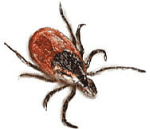
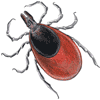
Illustration of a female deer tick, from the Centers for Disease Control and Prevention (CDC) website.
At the request of the Board of Selectmen, Johnson attended a two-hour presentation sponsored by the Boxborough Deer Control Study Committee (DCSC) on Aug. 6. Johnson told the BOH that, after hearing the presentation by Tufts University epidemiologist and tick specialist Dr. Sam Telford, he came away convinced that the solution is not only in the hands of homeowners, but in those of town governments, as well. Apparently, others agree. Johnson said that members of health boards from surrounding towns, including Acton and Littleton, attended the meeting.
BOH Chairman Tom Philippou plans to contact Telford, who is with the Department of Biomedical Sciences, Infectious Diseases Section, at Tufts’ Cummings School of Veterinary Medicine. Telford will be invited to speak in Harvard.
Johnson expects the Boxborough selectmen to petition the state Division of Fisheries and Wildlife to extend the hunting season, and allow both doe hunting and the widespread application of pesticide. Grants exist to cull the deer population, said Johnson, but the financial resources that are needed to do the job sufficiently are “beyond the resources of most towns.”
Resident Deborah Skauen-Hinchliffe questioned whether farmers would accept widespread pesticide spraying, and said that the Food and Drug Administration had put out a major warning on topical treatments for farm animals. Johnson answered that the guidelines had been updated, and that this is no longer the case.
“My suggestion?” said Ira Grossman, consulting sanitarian from the Nashoba Associated Boards of Health. “Open up hunting on private land, and combine efforts with Lymelite.”
An organization founded by former state representative candidate Kurt Hayes, Lymelite (www.lymelite.org) is seeking to inform the public as well as lobby for support for Massachusetts House Bills H. 1148 and 1038, which would grant greater leeway to doctors in the disease’s treatment, as well as increase insurance coverage for treatment.
With grassroots movements beginning to take hold, even Governor Duval Patrick is getting an earful these days about the Lyme disease problem. Hayes lobbied the governor at a Groton townwide meeting on Aug. 4 to support the bills.
First detected in Lyme, Conn., in 1962, the disease continued to spread, until it became the subject of a study in 1984. Ticks are the largest means of spreading disease to humans, resulting not only in Lyme disease, but Tularemia and Babesiosis, among other afflictions. Lyme disease symptoms may include the well-known bull’s-eye-shaped rash, chills, fever, fatigue, headache, and muscle and joint pain. Left untreated, it can lead to chronic arthritis as well as heart and nervous system problems.
The town of Boxborough’s website (www.town.boxborough.ma.us/) has resources on the topic. Viewers can download 7-MB Tick Management Handbook; scroll down under the “News” heading to get to its link. It is described as “an integrated guide for homeowners, pest control operators, and public health officials for the prevention of tick-associated diseases.”
Persons who have Lyme disease can visit www.TickedOffMass.com for an online Lyme disease support group.
The Board of Health plans to hold a Lyme disease forum in the future.