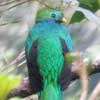
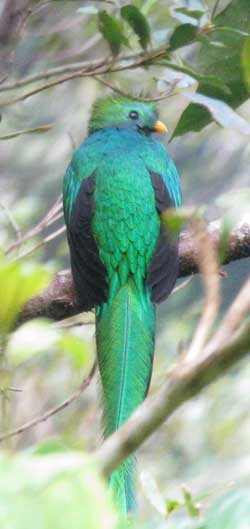
Resplendent quetzal. (Photos by Pam Durrant)
A couple of years ago a friend, Jane, suggested getting a small group together sometime for a trip to Costa Rica. Jane has a relative who is considered one of the best native birders in Costa Rica, so when trip plans solidified at the end of last year, my wife, Pam, and I signed on. It was planned more as a trip for a group of friends to get together and experience the country rather than as a serious birding trip. Of the people in the group, Pam and I were probably the most experienced birders, with the others ranging in experience from little to none. We had previously gone on a serious birding trip to some of the same areas with Mass. Audubon.
As it turned out, the timing for this new adventure could not have been better. We planned to leave Harvard by airport limo at 5:30 a.m. on Dec. 12. Just after midnight we got a frantic call from our driver saying that he could not reach our house because of the ice storm. Since we were now wide awake and had packed the night before, we convinced him to try to get to us, not fully understanding the conditions outside. Thirty minutes later our Prius “limo” arrived and, to the frightening sound of trees cracking and falling around us, we made our escape, arriving at Logan at 2 a.m. Our plane was scheduled to take off at 8 a.m., but we decided to take one scheduled for a 5 a.m. departure instead, not knowing how the storm might impact the airport by the time of our originally scheduled flight.
At the airport in Costa Rica we were met by our guide, Paco, and Carlos, the driver of our small bus, who took us to a hotel just outside San Jose. The hotel had extensive ornamental gardens, which created a wonderful habitat that attracted a wide variety of birds—the most spectacular being the blue-crowned motmot.
The next day we headed to Selva Verde, a lodge in the rain forest on the Caribbean slope. One morning before breakfast during our stay there we sat on the terrace overlooking the Sarapaqui River and watched a couple of fasciated tiger herons courting. While watching a sandpiper feeding at the edge of the river, I noticed a bird that I did not recognize and pointed it out to Paco. He excitedly told me that I had found a sun bittern.
Later, while our group was en route to the Organization of Tropical Studies La Selva Research Station, Paco asked the driver to stop the bus, having spotted a green ibis feeding in a field alongside the road. We all filed out, and Paco set up his spotting scope so the group could get a better view. While there, we saw two great green macaws fly over. Later on, while walking in La Selva, we saw three more of them. Since there are only about 300 of these birds in the wild, it was exciting to realize that in the space of one hour we had seen five of them.

Slaty-tailed trogon.
As we entered the forest at La Selva, Paco heard a great tinamou calling from the dense forest about 100 yards away. The chicken-sized great tinamou is rarely seen because it forages on the ground, is well-camouflaged, and moves constantly. We walked slowly in the direction of the call and, unbelievably, Paco managed to spot the bird nestled in the ground cover. We all got a good look at it, though it was extremely hard to see. Farther down the trail we actually heard, and then found, another one. About 40 minutes later, while Paco was checking out some banana leaves for roosting bats, he almost stepped on yet another great tinamou. This one did not budge, which allowed us to get some good photos. We were amazed that in the space of 90 minutes, we had seen three great tinamous, birds that people can go a lifetime without seeing.
The next day took us to Arenal Observatory Lodge, located on the site of the observatory that the Smithsonian built to study the Arenal volcano after the last major eruption in 1968. Our room had an unimpeded view of the volcano. It was humbling to lie in bed at night and hear the volcano rumble and see car-sized molten boulders rolling down the side of the mountain.
During the daytime we saw a number of incredibly colorful birds—like the emerald, crimson-collared, and blue-gray tanagers and green honeycreepers—by just standing on the deck of the lodge and observing the feeders stocked with various fruits.
While walking one of the trails by the lodge, we saw what was probably the most exciting bird of the trip for me—an ornate hawk eagle, which is more than two feet high, with a distinctive black, spikey crest. We were at a clearing in the forest created where a huge tree had fallen. Most of us were trying to find a bird that was flitting around in the understory when one of the women in our group happened to see a hawk eagle land high up in a tree. She alerted Paco, who viewed it through his scope. We all were able to get a good look at it, and even got a few photos through the scope.
The following day a long bus ride took us around Lake Arenal and down to the Pacific coast to Hotel Villa Lapa. A late afternoon boat ride on the Tarcoles River yielded closeup views of many birds and a fabulous sunset over the Pacific. We saw stilts, yellow-headed caracaras, a prothonotary warbler, boat-billed herons, black-crowned night herons, and several other birds, including an osprey with its catch and a peregrine falcon.
The next day we spent the morning in Carara Biological Reserve, located in a unique climatological zone where the ecosystem of the humid southern coastal region joins the dry climate of the northern Pacific area. This forest has trees that are more than 500 years old and grow to a height of more than 100 feet. Here we saw a black-throated trogon, the seventh trogon species (out of nine) we had seen. Walking back to the bus we flushed out a forest falcon, a raptor that is usually hard to find.
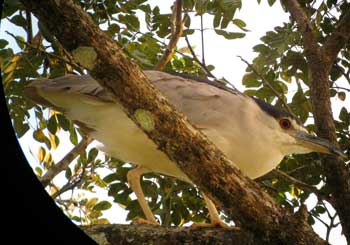
Black-crowned night heron.
Back at the lodge in the late afternoon we saw eight species of tanagers and several Baltimore orioles, which winter there after breeding up north. After dinner, we went on an owl prowl but did not hear any. However, on the way back we saw several pauraques crouched on the side of the road, illuminated by the bus headlights. These nighthawks are insect-eaters and hang around streetlights and other light sources, picking off the bugs attracted by the light.
The following day we left the Pacific coast and drove inland to Bosque de Paz Cloud Forest Reserve, which has a lodge in a 1,200-acre privately owned biological reserve. The lodge was originally a farm, surrounded by a lot of open land. Twenty years ago the present owners bought the property with the intent of making it into a wildlife preserve. Now the lodge is surrounded by forest created by native species that the owner planted. We heard that the resplendent quetzal is commonly seen around the preserve. This is one of the most magnificent birds to be found anywhere, and we were all hoping to be lucky enough to see one. As we sat down to lunch, one of the guides said there was a quetzal not 100 feet away. After lunch we crept through the brush and found the bird sitting about 15 feet up in a tree, affording us all a good look at it, an exciting experience for those in the group who had never seen one before. We were able to get a few closeup photographs of it by aiming our camera through the scope. The next day another quetzal flew into a fig tree to feed. We knew it was a different bird because the tail feathers were much longer than those on the bird we had seen the day before.
As we left the lodge the following day for our trip to the airport and home, we noticed the distinct odor of sulfur in the air. We were told that Poas Volcano, maybe 30 miles away, was spewing gas. This turned out to have been the precursor to an earthquake that followed about 10 days later, killing people and devastating areas we had just visited.
In the space of two weeks we were exposed to two natural phenomena poles apart—an ice storm and an erupting volcano. What a memorable trip. We saw a total of 190 species of birds, 34 of which were new to me. That number was far fewer than the 300 species we had seen several years ago on our “serious” birding trip, but this trip wasn’t about the numbers—it was about the camaraderie of the group and the enjoyment of an interesting and beautiful country.
David Durrant lives with his wife, Pamela, on East Bare Hill Road at Micheldever Farm, where they run their business, Durrant Design, and watch birds—their own peacocks, chickens, and wild birds.