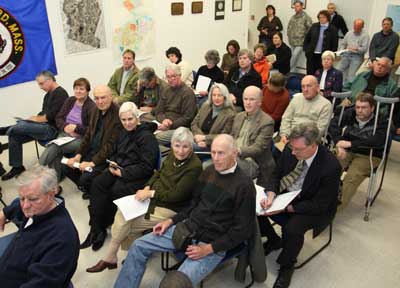
A crowd turned out at the public hearing on the proposal to redevelop Vicksburg Square. (Photo by Lisa Aciukewicz)
Harvard residents, at a public hearing Monday evening in Town Hall, had a chance to weigh in on the proposal to redevelop Vicksburg Square at Devens. Nearly 40 people listened as Harvard Selectman Ron Ricci and MassDevlopment’s Ed Starzek outlined the proposal. Then it was the public’s first opportunity to comment on the plan to rezone Vicksburg Square to include up to 400 units of residential housing
The presentation described the property at Vicksburg Square, showed several overhead visuals of the buildings there, and summarized the proposed amendments to Chapter 498, the 1993 legislation that created the Devens Regional Enterprise Zone when Fort Devens closed. It also listed MassDevelopment’s rationale for the proposed changes to current law: preservation of the historic buildings, enhancement of Devens regional identity, development of the regional economy, and “blight prevention.”
In the question-and-answer session following the presentation, Elm Street resident Jared Wollaston, a Freedom’s Way Heritage Association official, offered a letter of support from that organization. The mission of Freedom’s Way is to help preserve, protect, and promote the shared history of nationally significant resources.
Harvard Selectwoman Lucy Wallace requested clarification of the meaning of “accessory retail” in the zoning article. Peter Lowitt of the Devens Enterprise Commission explained that accessory retail means that a building must be less than 51 percent retail. He said further that “small-scale retail would be less than 40,000 square feet” based on the principle that retail in Vicksburg Square should not compete with retail in downtown Ayer.
Marty Green of Old Littleton Road pointed out that 40 percent of Vicksburg Square is in Harvard and 60 percent is in Ayer, but there is no language in the article guaranteeing that affordable housing units will be distributed fairly across the towns. Starzek confirmed that there is nothing in the proposed amendments that evenly distributes affordable housing across the towns.
Bill Ashe of Myrick Lane asked for assurance that nothing would change Rogers Field, the former parade ground facing Revere Hall; he was assured by Starzek that Rogers Field would remain protected. Ashe also commended the subcommittee and those associated with the preservation of Vicksburg Square for their work and asked when work would begin. Starzek replied that if the zoning changed quickly enough, remediation of the buildings could begin this summer.
Stu Sklar of Scott Road asked, “What are the benefits to the town in approving or not approving this redevelopment proposal?” Starzek replied that the buildings would “eventually return to the jurisdiction of the towns.” Starzek added that Bristol-Myers Squibb and Evergreen Solar are staffing up and need appropriate housing for that staffing. He said further that “the military is expanding considerably and they need housing as well.”
In a preview of the same presentation at the March 12 Joint Boards of Selectmen meeting, Frank Maxant of Ayer said that MassDevelopment should be prepared for questions that address its level of effort in preserving Vicksburg Square over the years. He posed a series of possible questions: “How much money did MassDevelopment invest in the infrastructure for these buildings? How much money is MassDevelopment receiving in rent from these buildings? Had MassDevelopment kept its offices in Vicksburg Square and used some of its money to maintain its responsibility in upkeep of a National Registry property, would it not now be a jewel-like property that anyone would want to bring their innovative technology business to?”
At the same JBOS meeting, Ayer Selectman Rick Gilles made the point that, until now, the communities have not been involved in the proposal process and suggested a charrette as a method for communities to have input. He said that “it is a mistake to not have public comment as part of the process.” Peter Lowitt responded that the selected developer would meet with selectmen from each community and present its concept to each community as a way for the communities to participate in the process.