Throughout the glaciated Northeast there are wetlands referred to as bogs—where acidic peat, or dead plant material (often mosses), accumulates. Many of these bogs were originally glacial kettle holes, where huge chunks of ice broke off a glacier and were buried by sediment. When the ice melted, it left a depression containing water, with no inlet or outlet. If this water becomes acidic due to decomposing plant material, it is called a bog.
The stagnancy of a bog has a significant impact on the plants that live there. It contributes to oxygen deficiency and a relative lack of nutrients (that would be carried in by a stream) as well as an accumulation of acids (no means of flushing them out). This type of bog is a closed ecosystem. The plants in these bogs are totally dependent upon precipitation—rain, fog, and snow—for their limited supply of nutrients. Few plants that require substantial nutrients thrive in these bogs. Those plants that do manage to survive under these acidic, nutrient- and oxygen-poor conditions have adapted to them, some in very unique ways. One such group, carnivorous plants, has evolved ways in which to actually supplement the limited amount of nutrients available to them.
Carnivorous plants
There are more than 20 species of plants in New England that trap insects, mites, and spiders to supplement their nutrient intake. Some of these carnivorous plants have evolved a passive means of entrapment; others more actively catch their prey. The three groups, or genera, of plants that illustrate the range of these different trapping techniques are also the most common carnivorous plants in northeastern bogs; they are pitcher plants (passive), sundews (semi-active), and hornworts (active).
Pitcher plants—passive persuasion
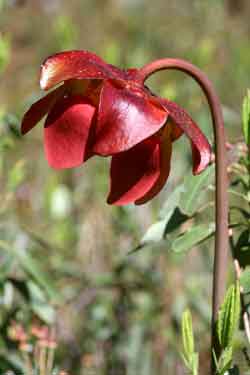
After the single flower of a pitcher plant blooms and is pollinated, a rosette of pitcher-shaped leaves starts to appear. (Photos by Mary Holland)
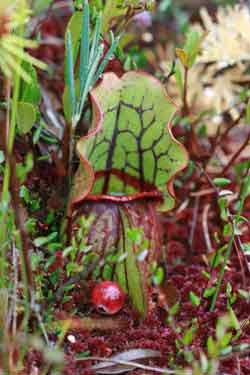
The bright colors and sweet nectar of the pitcher plant’s modified leaf lure unsuspecting insects to its rim.
Many plants have flowers that use fragrance, nectar, and coloration to attract pollinators, and the pitcher plant is no different. However, the modified leaves of pitcher plant found in the northeast, Sarracenia purpurea, mimic flowers in that they use these same techniques to attract insects. Pitcher plants aren’t luring visitors solely for the purpose of pollination; they are attracting potential meals which, if caught and ingested by the plant, will allow it to flourish.
The pitcher plant’s common name derives from its modified, pitcher-shaped leaves which are not only photosynthesis factories, but also serve as very efficient traps. Prior to the 19th century, botanists had no idea that the leaves served this function. Linnaeus believed the leaves might possibly be designed to hold water that sustained the plant during droughts. But closer examination revealed that these liquid-holding vessels serve as traps. Because the majority of sugar-exuding nectaries are located near the mouth of the pitcher, insects and other visitors occasionally fall in.
The chances of escaping from this pitcher are minimal, thanks to a number of clever adaptations on the part of the plant. Tiny downward-pointing hairs grow on the upper portion of the interior of the leaf, preventing all but the most determined insects from getting out. Below the hairs the vertical walls of the leaf are smooth and quite slippery, causing insects to slide down into the rainwater that collects at the bottom of the pitcher, where they usually drown. (Those insects that attempt to fly out of the narrow confines of the pitcher also rarely succeed.) Glands along the lower walls secrete digestive enzymes that break down and digest the dead insects. When it rains and dilutes the water, or if there is an abundance of prey to be broken down, the plant injects extra amounts of acidic digestive fluids into the water. Bacteria living in the water also help to decompose the prey organisms.
The pitcher plant’s leaf is not a death trap to all who enter it. The larva of one mosquito actually thrives in the water and even hibernates through the winter in the leaf-trapped ice. The larva of a species of fly takes advantage of leftovers and lives off of the insect remains left in the pitcher plant. It is not unusual, especially in the fall, to find the mouth of the leaf covered with the silk web of a spider that is capitalizing on the ability of the pitcher plant to attract insects.
Sundews—semi-active seizure

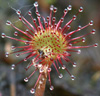
Many insects and other small organisms find the glistening drops of adhesive liquid on the hairs of the round-leaved sundew both irresistible and inescapable.
Sundews, the second group of carnivorous plants in the Northeast, are more active than pitcher plants in catching their prey. The leaves of this “fly paper” plant have hairs, often referred to as tentacles, which are tipped with a lethal, sticky fluid that is very effective at capturing small insects that come in contact with it. The aroma, color, and attractive glistening of the droplets of fluid on the tips of the longest hairs lure creatures to the sundew’s leaves. The struggle that ensues when the insect gets mired in the adhesive fluid stimulates the leaf to produce more fluid, thereby sealing the organism’s fate. Nearby hairs grow toward the prey and hold it firmly in place. Glands on the tips of the shorter hairs then secrete an anesthetic to debilitate the prey, and within just a few hours enzymes will have done their work and the plant will ingest its meal.
There are 100 species of known sundews, five of which are found in New England. The two species we’re most likely to encounter in bogs and other acid environments are named for the shape of their leaves: round-leaved sundew (Drosera rotundifolia) and spatulate-leaved sundew (Drosera intermedia).
Bladderworts—sudden suction

The beauty of the horned bladderwort flower belies the lethal nature of the traps that lie beneath it.
Of the 14 species of bladderworts in New England, the two most common bog species are horned bladderwort (Utricularia cornuta) and common bladderwort (Utricularia vulgaris.). This unique group of plants is rootless; their flowers are supported by a stem and finely-divided leaves that are located under or floating on the water. If you look closely at their leaves, you will notice tiny sacs interspersed throughout them, which were once thought to be flotation devices. We now know that they are, in fact, highly specialized traps.
The bladders, a mere 1/5 to 1/100 of an inch in diameter, capture, hold, and digest food for the plant. Picture miniature oval balloons that have a double-sealed, airtight door on one end. When this door is closed, the balloon, or bladder, expels water through its wall, creating a partial vacuum inside. A leafy, feather-like structure hangs down adjacent to the door and the instant an organism bumps against this feathery trigger, it twists and breaks the seal of the door. The vacuum inside causes water to rush in, pulling the victim along with it. As the bladder fills with water (and prey), the pressure is equalized inside and out and the door automatically closes, caging the organism. This entire process takes 2/1000ths of a second. As enzymes digest the prey, special cells in the bladder’s wall pump out the water and reestablish a partial vacuum inside, preparing the trap to spring again.
The survival of carnivorous plants isn’t dependent upon their ability to trap and ingest animal matter. They will live and, if pollinated, produce seeds, but their vigor, as well as their flower and fruit development, is greatly enhanced when their diet is supplemented with nutritious little bodies. As impressive as our New England carnivorous plants are, they are tame in comparison to one tropical pitcher plant that is capable of holding several quarts of water in its leaf and has been known to capture and digest giant tropical rats.
Naturalist and writer Mary Holland lived in Harvard for many years before moving to Vermont. She can be contacted at mholland@vermontel.net.