My recent trip to the Galapagos Islands with my wife, Pam, was certainly one of our most memorable birding adventures which, in addition to birds, included sea lions, fur seals, land and marine iguanas, turtles and tortoises, and a spectacular variety of volcanic landscapes.
The islands, located in the Pacific, 600 miles east off the coast of Ecuador, are volcanic and of different ages, giving each one a unique fauna and flora. On the seven islands we visited we saw 38 species of birds, 28 of which are endemic—indigenous to, and confined to, that region. We even saw some we are familiar with in New England, like the yellow warbler, the oyster catcher, and assorted other sea birds. Most of the islands are teeming with birds that have evolved with no fear of humans, which gave us the opportunity to observe them at close range.
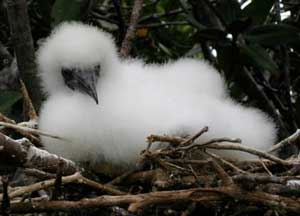
A blue-footed booby chick sits in a nest. (Photos by David Durrant)
On Seymour, the first island we visited, we were thrilled to encounter blue-footed boobies. These birds nest in a scrape on the ground, some of them right beside the trail. We had to step around the nest we came across, but we were able observe them close-up and get great photos of the fluffy white chicks. Magnificent and great frigate birds wheeled overhead, with some of them nesting in precarious twig nests set in the low bushes. Under low bushes we saw Galapagos doves, which are similar to our mourning doves but far more colorful, with a distinctive blue eye ring and boldly patterned wing feathers. Closer to the beach we saw lava gulls, swallow-tailed gulls and wandering tattlers. (I just love that name!)
On the island of Plaza we saw the first of several finches made famous by Darwin’s theory of evolution, which was inspired by the variety of flora and fauna he found on his voyage along the South American coast and through the Galapagos Islands in the early 1800s. We found the common cactus finch, aptly named because of its preference for the flowers and fruit of cacti which grow enormous here, and the small ground finch flitting around in the underbrush, while overhead we saw our first tropic birds.
Moving on to Santa Fe island, we saw a Galapagos mockingbird. (It wasn’t until Darwin got back to England from the Galapagos and had a chance to study the skins he had collected that he realized the Galapagos mockingbird was its own species.)
We observed a couple of Hood mockingbirds, another endemic species, on Española, the most southerly island. This island hosts the Nazca booby, warbler finch, and large cactus finch. While hiking on Española I noticed a hawk sitting on a snag, and although it was a little too far away to get a good look at it, it was obvious that it was a Galapagos hawk—that is the only hawk seen on the islands.
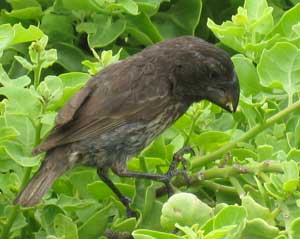
A large ground finch on Santa Cruz island.
We saw the large ground finch on Santa Cruz. This species of finch is distinctive, with its overly large beak. After a while we were able to differentiate between the three ground finches by their beak sizes, going from a normal-looking one on the small ground finch and getting progressively bigger. On Santa Cruz we also saw cattle egrets, which are world-wide in distribution, and a common noddy, an all-dark-brown tern-like bird endemic to the islands.
The big hit on the next island, Floreana, was a group of probably 50 flamingos feeding in a brackish lagoon, just inland from the beach. These vibrant-looking birds get their pink coloration from the small shrimp they eat. As we stood on a cliff overlooking the lagoon, we observed the way they walk around in circles herding the shrimp into their submerged beaks. Sharing the bounty of the lagoon was a pair of white-cheeked pintail ducks, a resident endemic sub-species.
The bird I was most excited to see was the Galapagos penguin, which we found on Santiago. Pam even got to swim in the ocean with the penguins, as well as sea lions, sharks, stingrays, and other exotic fish. A bird that is perfectly camouflaged in its charcoal grey plumage is the lava heron, which we were able to find despite the fact that it blends in so well with the volcanic landscape.
The short-eared owl was one bird I had really hoped to see. I have seen this bird on Plum Island in Massachusetts and was told it could be found on Tower or Genovesa Island in the Galapagos. After a long walk along the cliffs we found ample evidence of its being around—bits and pieces of Galapagos petrels, on which the owls had been feeding. We saw thousands of the petrels wheeling above the cliffs. However, despite constant searching, we were unable to find a short-eared owl. We also saw many red-footed boobies, which nest in bushes.
Our visit to the islands came to an end all too soon, and we headed for the Ecuadorean mainland, where we continued our adventure in the cloud forest and Andes mountains.
David Durrant lives with his wife, Pamela, on East Bare Hill Road at Micheldever Farm, where they run their business, Durrant Design, and watch birds—their own peacocks, chickens, and wild birds.