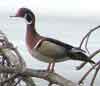
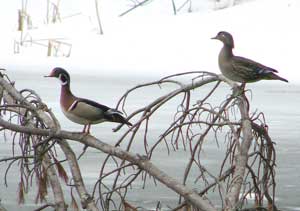
March arrival of wood ducks: male, left, and female, right. (Photo by Mary Holland)
As March progresses there is much to anticipate seeing that has been either under snow or absent from Harvard during the winter months. Male red-winged blackbirds are appearing in marshes to stake out their territory. Skunk cabbage is poking up through wetland snow that is melting from the heat generated by this plant. Mourning cloak butterflies are emerging from behind bark, where they spent the winter as adults. Male American woodcocks are spiraling upward in the sky in an attempt to impress potential mates. Male woodchucks are waking up and leaving their burrows in search of females still sleeping in theirs. For most creatures spring is a time for finding a mate, but there is at least one species of bird that has already taken care of this task by the time it returns to Massachusetts in the early spring. Most wood ducks (Aix spansa) form pairs in the fall or on their wintering grounds. They return as pairs to our forested wetlands in the spring, eliminating the need to spend time and energy on courtship once they arrive on their breeding grounds.
Plumage
Listen for the loud “oo-eek, oo-eek” call of the female wood duck when she takes flight after being disturbed. You may not see her, as she is so well camouflaged. It is typical in the bird world for the male to have much more colorful plumage than the female, and wood ducks could well be the poster birds for this rule. If you’ve seen a male wood duck, or drake, it is not a sight you are likely to soon forget. Feathers in metallic shades of red, orange, yellow, green, and blue cover his entire body—Roger Tory Peterson aptly refers to its “rainbow iridescence” in his Field Guide to the Birds. Even the drake’s bill is multi-colored. The female? She is drab brown with a slight hint of blue on her wings. Of course, this makes perfect sense, for it is the female alone that will incubate the eggs for the month that it takes them to hatch. She generally leaves the nest twice a day to feed, and she will be far less conspicuous going in and out of her nest with this coloration.
Wood ducks (other than some hardy souls that overwinter in Nantucket) leave their winter habitats (which are hundreds of miles farther south) and arrive back in Massachusetts beginning in early March. Look for them near streams, marshes, swamps, and beaver ponds. Wood ducks may, in fact, have beavers to thank for bringing them back from a sharply declining population in the late 1800s. Wood ducks were overhunted and forested wetlands were disappearing rapidly. Fortunately, as the beaver population rebounded, more and more beaver ponds were created, providing wood ducks with ample habitat in which to nest.
Cavity Nester
The wood duck’s common name reflects the location of its nest, for wood ducks are one of only seven North American waterfowl species that regularly nest in tree cavities. (They will also nest readily in man-made wood duck houses, if available). The hooded merganser, another cavity-nesting duck, has been known to share a cavity with a female wood duck, with the two females taking turns incubating the eggs. Often when a limb breaks off a tree, a hollow cavity is formed, and it is here where the female wood duck frequently decides to lay her eggs. Her slim body allows her to also take advantage of old pileated woodpecker holes as well as the smaller northern flicker holes. Wood ducks are known to re-use nesting cavities in successive years; in 1840 John J. Audubon found a wood duck nesting in the same abandoned ivory-billed woodpecker nest for the third year in a row. After investigating several potential nesting sites, the female wood duck chooses one (often over or close to water) and proceeds to pluck feathers from her breast to provide her eggs with a soft, insulating bed. She then lays her eggs and incubates them for the next 30 days or so.
Fledging
One of the things that sets wood ducks apart from all other North American ducks is their ability to produce two broods (sets of offspring) in one breeding season. However, this commonly occurs only in the southern part of its range, not in Massachusetts where the breeding season is too short. There is something else that every wood duck does once in its life that few other birds do so dramatically, and it has to do with fledging, or leaving, its nest.
The cavities in which the young, precocial (born covered with down and fully active) ducklings are born are an average of 24 feet high in trees. Within 24 hours of birth the young are ready to hit the water, but how do they manage to do this when they are this far off the ground? There are eyewitness accounts that describe the mother wood duck ferrying her ducklings one by one from the cavity to water with the young ducklings perched on her back. There are also eyewitnesses who have said that they’ve seen her carrying her young one by one with her bill and between her feet. However, most observers of this dramatic moment in the life of every young wood duck say that the mother does not assist her ducklings in any way, other than to encourage them vocally.
The mother is on the ground or in the water directly below the nesting tree. From this spot she softly calls to her young—“kuk, kuk, kuk.” The ducklings eventually emerge from the entrance of the cavity, having clawed their way up from the nest at the bottom of the cavity (a distance of up to eight feet) with the help of their sharp nails. They then hurl themselves out of the tree, down into the water. That is, if there is water below the tree. Wood ducks can nest more than a mile from water, and when this is the case, the young are said to hit the ground and bounce much like a tennis ball. According to Cornell’s North American Birds, ducklings have been known to leap as far as 291 feet to the ground and escape injury. Not only are they none the worse for wear, but the ducklings follow this daredevil act with a lengthy (average of a little more than a mile) and dangerous hike over land to a suitable watery rearing spot.
Imagine starting out life by jumping, at the tender age of one day, off the roof of a two-story building, landing on the ground and then hiking more than a mile to reach the spot where you will be reared. It sounds more than a little daunting, but this is a close approximation to what every wood duck duckling experiences. To witness some of this excitement, watch “Leap of Faith from 35 Feet” —one of Cornell’s videos of wood ducks taking the plunge. http://www.birds.cornell.edu/birdhouse/nestboxcam/movies_home/movies_home/wodu_movies.
It’s hard to believe that life isn’t a bit anti-climactic after an entrance like this.
Naturalist and writer Mary Holland lived in Harvard for many years before moving to Vermont. She can be contacted at mholland@vermontel.net.