Illustrations by Chiho Kaneko.
(CLICK IMAGE TO ENLARGE)
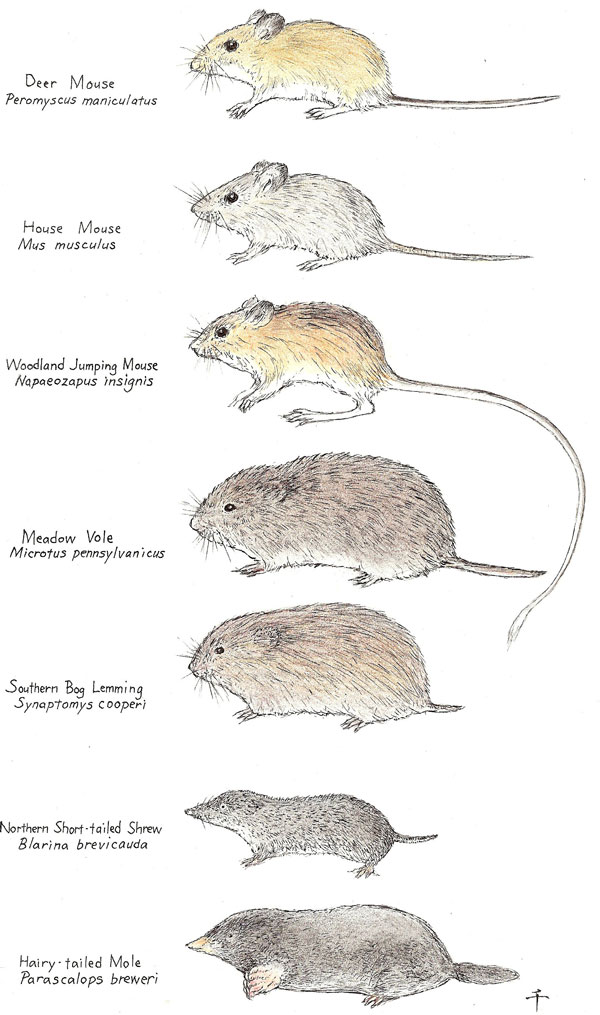
Mice, voles, lemmings, moles, and shrews—we tend to lump these small, furry creatures together. While these small mammals resemble one another, they have significant physical and behavioral differences—enough so that they belong to two different groups: Rodentia (rodents—mice, voles, and lemmings) and Insectivora (invertebrate-eating animals, or insectivores—shrews and moles). Mice, voles, and lemmings comprise 11 of the 21 species of rodents in New England; all 10 species of insectivores in New England are shrews or moles, the subjects of the next “It’s Only Natural” column.
Rodents
Rodents—beavers, porcupines, woodchucks, squirrels, chipmunks, rats, mice, and lemmings—come in all sizes and shapes. Some live on the ground, others live in trees; some live most of their lives underground, and there are even semi-aquatic species. As different as their habits and appearances may be, the features they all share are a pair of prominent incisors in the front of both upper and lower jaws and a lack of canine teeth.
Mice, voles, and lemmings have some pretty obvious distinguishing features. Mice generally have a relatively slender build, prominent ears, large eyes, and well-developed whiskers. Voles and lemmings are relatively thick-bodied, small-eared, snub-nosed, short-tailed, and beady-eyed. Mice are omnivorous, eating both animal and plant material; voles and lemmings are primarily plant eaters, or herbivores. Voles and moles are more likely to construct burrows and tunnels under the ground as well as under grass and snow. Together, mice, voles, and lemmings make up a large percentage of many predators’ diets, including those of birds of prey, coyotes, foxes, and bobcats.
Mice
New England’s mouse population consists of deer mice, white-footed mice, house mice, and meadow and woodland jumping mice. The deer mouse (Peromyscus maniculatus) and white-footed mouse (Peromyscus leucopus), while technically two different species, for all intents and purposes are one and the same animal. Field guides will tell you that the tail of the white-footed mouse is slightly shorter, less than one-half the length of its body, while the tail of the deer mouse is slightly longer than the length of its body. This is not only a challenging call to make in the field, but there are many exceptions to this rule—so many that it isn’t really applicable. The similarities are so great that mammalogists have to take a look at enzymes in the saliva of these mice in order to positively tell one from the other. Both of these species have pointed noses, live in both woods and fields, are active year-round, cache food, are capable of swimming and climbing and often inhabit buildings in the winter. Both white-footed mice and deer mice tend to travel quite extensively on top of the snow, although they also use tunnels beneath the surface of the snow. When they travel on top of the snow, they sometimes hold their tails vertically, in which case their tails don’t leave a drag mark.
House mice (Mus musculus) share many physical characteristics with deer and white-footed mice, though their tails are far less hairy and their coat is more of a gray color than the brown of white-footed and deer mice. Unlike deer and white-footed mice, they are not native to North America. Because house mice seek out human habitations in which to live year-round, we are more familiar with them. Unfortunately, they can do a lot of damage inside houses, chewing almost everything they come across including soap, glue, books, paper, leather, wood, cardboard, and most plastics, in addition to grains and other foods. Another point not in their favor is that house mice carry a number of diseases, such as salmonella.
The physical differences between jumping mice and the previous three species of mice are easy to spot. Both meadow (Zapus hudsonius) and woodland jumping mice (Napaeozapus insignis) have greatly elongated hind legs and very long tails, which enable them to take long jumps. Normally they travel by walking, but when alarmed, jumping mice live up to their name. Meadow jumping mice can leap as far as three feet, while woodland jumping mice can leap up to six. Their powerful hind legs propel them, and their long tail provides balance. Because our two species of jumping mice look so much alike and can occupy the same habitat, the best way to tell them apart is to get a look at their tails. Only the woodland jumping mouse’s tail has a white tip. In the fall jumping mice do not store food, but eat voraciously and acquire a layer of fat to sustain them through the winter. They hibernate longer than most mammals in North America, curling up in a ball underground for roughly six months. Research shows that only about one-third of jumping mice survive hibernation and emerge in the spring.
Voles
Three species of voles can be found in or near Harvard: the meadow vole (Microtus pennsylvanicus), southern red-backed vole (Clethrionomys gapperi) and the woodland vole (Microtus pinetorum). Even though we may not see them with regularity, meadow voles, also known as field mice or meadow mice, are one of the most abundant small mammals in North America. Their population is cyclical, peaking every four years or so. Signs of this small rodent are noticeable year-round. Even more than the white-footed and deer mice, meadow voles tend to seek cover under the snow, where they dig an extensive network of tunnels just under the surface as well as down next to the ground. Sometimes these tunnels are so close to the surface of the snow they can be seen as raised ridges. (In the spring when the snow thaws, vole tunnels, about the width of a garden hose, on the surface of the ground are very obvious in fields.) Every now and then you may see a hole in the snow about ¾ inch in diameter, with no tracks leading to or away from it. These holes are often the work of meadow voles and are thought to be a means of releasing carbon dioxide from the tunnels. Voles occasionally leave tail marks in the snow, but more often do not. In the summer you need look no further than your vegetable garden to see signs of meadow voles. Their voracious appetite for vegetables is well known to most gardeners, as is their preference for the bark of fruit trees in winter.
Lemmings
Last, but not the least of our diminutive rodents are the lemmings. We tend to hear about lemmings when the Canadian population crashes, as it does periodically, sending northern hawks and owls such as snowy owls farther south into New England in search of prey. Lemmings are less common than mice and voles. There are, however, two species of lemmings found in New England, the southern (Synaptomys cooperi) and northern (Synaptomys borealis) bog lemmings, one of which, the southern bog lemming, can be found in eastern Massachusetts.
Lemmings strongly resemble voles, the major differences being that lemmings have shorter tails than voles and have grooves running down the front of their incisors, which voles lack. Another distinguishing characteristic is that lemming scat is bright green, as opposed to the brown and black pellets of voles. Southern bog lemmings occur in colonies that range in size from a handful of individuals to several dozen. Although their name indicates otherwise, they can be found in a variety of habitats including hillsides, fields, and mixed woods. Grasses and sedges appear to be a staple food, which is why bogs are often their chief habitat.
Many people tend to take a dim view of these small rodents. If you are a farmer, they are a serious adversary due to their fondness for vegetation, particularly grains. If you are in the health field, you may view these small mammals primarily as disease carriers. If you are the owner of a cat that is allowed outdoors, you may have grown used to rodent carcasses being deposited on your doorstep, but for most of us the mere sight of a mouse is unsettling. Are these feelings warranted? We have rodents to thank for much of the valuable research that has been conducted in laboratories, to say nothing of the fact that hawks, owls, and other predators owe their very survival to these furry little creatures—the food chain would collapse without them. Perhaps it’s hard to live with them, but harder without.