If you don’t have a bird feeder, you may well want to set one up, as this winter promises to bring many unusual seed-seeking visitors from the north to Harvard feeders. From the number of common redpolls sighted in Massachusetts in the past month, one can see that we are already beginning to experience an influx of birds that normally do not stray this far south. When species of birds that normally winter in the boreal forests of Canada appear in large numbers south of their normal wintering grounds, this phenomenon is referred to as an irruption. While a migration consists of a seasonal, predictable movement that is repeated each year, an irruption is defined as an unpredictable sudden change in the population density of a species. Ornithologists feel that these mass movements are in response to food shortages, such as coniferous cone crops, in the wintering grounds of seed-eating birds.

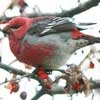
Male pine grosbeak (Pinicola enucleator) eating crab apples. (Photos by Mary Holland)
The reason for high expectations in our location this winter is that Canada is experiencing the largest tree-seed crop failure in a decade across more than 2,000 miles of boreal forest from Saskatchewan into Quebec. Apparently, there is sometimes a synchronization of seed crop failures in some high-latitude tree species and when this happens, states as far south as southern New England can expect to have unusual birds at feeders and fruit trees. Southern Canada is already reporting unusually high numbers of boreal finches, which are the primary seed-eating birds affected by these synchronizations. They include pine grosbeaks, red crossbills, white-winged crossbills, common redpolls, pine siskins, and evening grosbeaks. When you consider the appetite of these birds (the daily intake of a white-winged crossbill is 3,000 seeds) it is not surprising that they are forced to look further afield when the Canadian crops fail. Not only is there a dearth of seeds, especially coniferous, in the north this fall, but there are also large numbers of seed-eating birds, due to last winter’s bumper seed crop. Years of good seed crops are often followed by years with poor crops. This combination of a shortage of essential winter seeds and a successful breeding season resulting in large populations of birds almost guarantees an irruption of at least some of these species this winter.
According to the National Audubon Society, it is a rare winter when no species of bird is irrupting somewhere in North America. Sometimes it is very localized; at other times, there are simultaneous irruptions of several species into one area. The last major winter finch irruption, or “superflight,” occurred during the winter of 1997-98, when the Northeast was inundated with northern birds. Earlier this fall Canadian ornithologists predicted that New England would see especially large numbers of pine grosbeaks, evening grosbeaks, purple finches and common redpolls this winter. In fact, the number of sightings of these birds in Massachusetts (as well as throughout the Northeast) is already noticeably higher than usual.
Specifically, common redpolls top the list in Massachusetts this fall, but pine and evening grosbeaks as well as red crossbills and common redpolls are not that far behind. If you have a crab apple tree on your property, your chances of seeing a pine grosbeak are very high. Once they discover a tree laden with fruit, they are apt to eat every apple on it and then move on to the next tree, so you need to keep a vigilant eye on your food supply if you wish to catch sight of these large, beautiful birds. Similarly, if you have a birch tree, white or yellow, you may very well be treated to the sight of a flock of common redpolls, and if you’re very fortunate, maybe even a rare hoary redpoll in the midst of them.
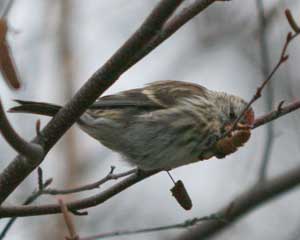
Female common redpoll (Carduelis flammea) eating birch seeds.
We may also see more rodent-eating northern owls than usual this winter. In 2006 there were big seed and berry crops in Canada, but this year was very poor, due to cold weather and snow in late spring that froze the buds and flowers of many plants. If a significant crash in the small rodent population, particularly deer mice, occurs as a result of the poor fruit crop this year, great gray owls, northern hawk owls, and snowy owls may move southward. Red-backed vole numbers often decline when the deer mice population declines and because saw-whet owl numbers are linked to red-backed vole numbers, there could conceivably be a large influx of saw-whet owls as well.
There are many opportunities to learn about and contribute to sightings of irruptive bird species. The National Audubon Society and Cornell Laboratory of Ornithology sponsor Birdsource (www.birdsource.org), a database for bird information which records bird sightings throughout North America. It coordinates and publishes results from Project FeederWatch, Christmas bird counts, and the Great Backyard Bird Count, programs which use volunteer sightings. Another excellent program that collects and provides information on dates and numbers of irruptive as well as other bird species in many states, including Massachusetts, is eBird, found at www.ebird.org.
Unusual species you may encounter this winter:
White-Winged Crossbill
Main food source: smaller-coned spruce and larch seeds in boreal forest; eastern hemlock and cedar seeds during Northeast irruptions
Winter 2007-2008 prediction: probable irruption. So dependent on conifer seeds, they feed them to their young, which allows them to breed and raise young in winter.
Red Crossbill
Main food source: conifer seeds, primarily those of eastern hemlock and white pine during Northeast irruptions
Winter 2007-2008 prediction: poor Eastern hemlock seed crop in Canada, may see increased numbers.
Pine Grosbeak
Main food source: crab apples, European mountain-ash berries, conifer and maple seeds
Winter, 2007-2008 prediction: irruption in progress.
Evening Grosbeak
Main food source: conifer seeds, box elder seeds
Winter 2007-2008 prediction: tree-seed crops very poor in Canada; probable irruption.
Common Redpoll
Main food source: seeds of birches and alders
Winter 2007-2008 prediction: very poor white birch, yellow birch and alder seed crops in Canada; irruption in progress.
Pine Siskin
Main food source: seeds of birches and alder
Winter 2007-2008 prediction: poor Canadian seed crop; probable irruption.
Non-finch family species:
Bohemian Waxwing
Main food source: European mountain-ash berries, crab apples, buckthorn berries
Winter 2007-2008 prediction: irruption in progress.
Naturalist and writer Mary Holland lived in Harvard for many years before moving to Vermont. She can be contacted at mholland@vermontel.net.