Are you finding your home inundated with tiny, colorful, uninvited six-legged guests? Fear not, for as far as company goes, these beetles are fairly unobjectionable. They are very small, they don’t take up much room, they don’t eat nor do they reproduce while under our roofs. What more could you ask of any guest? These tiny visitors come in a variety of colors and bear the appropriate common name of “multicolored Asian lady beetles.” We know them as ladybugs, but because they are technically beetles, entomologists refer to them as lady beetles. This particular species is sometimes called the Halloween lady beetle because some adults are a pumpkin yellow-orange color and large populations often occur in late October or early November. For the most part, lady beetles are beneficial predators that consume aphids, scale insects, and many other pests that injure plants. While humans have historically had a fondness for these diminutive insects, the current infestations are testing even the most ardent lady beetle admirer.
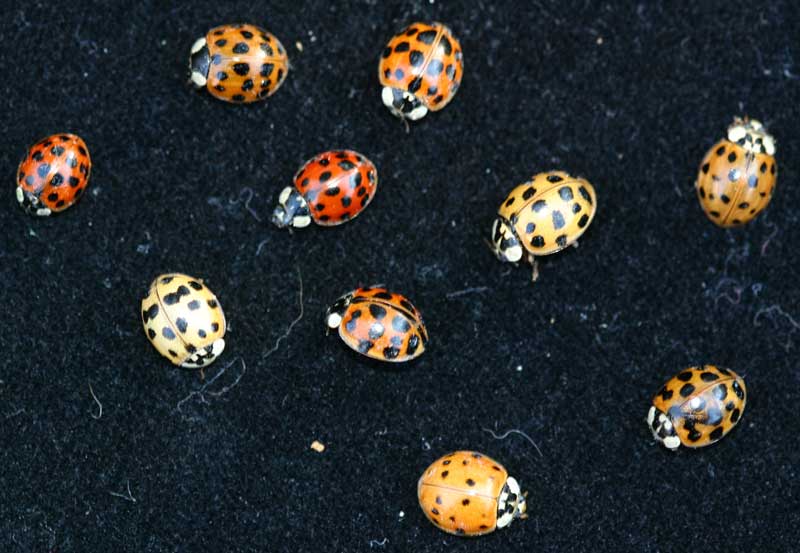
Multicolored Asian lady beetles come in all shades of yellow, tan, and orange, with many, or no, spots. Females tend to be heavily spotted; males often with fewer, if any, spots. (Photo by Mary Holland)
Why, in the past decade, have our houses started becoming infested with these lady beetles in the fall and again in the spring? Have they suddenly discovered the protection a house can provide during the cold winter months? The answer lies in the exact type of lady beetle we’re seeing; it is an entirely different species from the one we’ve grown up with. While there are more than 350 kinds of lady beetles in North America, only the multicolored Asian lady beetle has chosen to cohabit so conspicuously with humans. As is often the case, it is humans themselves who are responsible for this phenomenon.
Through both accidental and planned releases, the multicolored Asian lady beetle has firmly established itself throughout North America. Originating in China, Russia, Korea, and Japan, this tiny predator was very effective in controlling aphids and soft-bodied insects that inhabited Asian trees. As a result, the U.S. Dept. of Agriculture imported tens of thousands of them during the late 1960s through the 1990s in an effort to control insect pests that injure North American trees, particularly apple and pecan. Only recently have the beetles become established in the Northeast, so much so that they are commonly referred to as “seasonal nuisance pests.”
Our native species of lady beetles tend to hibernate under logs, leaf litter, and other outdoor sites, whereas the multicolored Asian lady beetles, in their native habitat, congregate in cracks and crevices within cliff faces. Apparently, the south- and southwest-facing sides of light-colored houses are the next best thing to cliffs, as that is where they most often appear in the Northeast. After a beetle has found a suitable site, it emits a “come hither” pheromone—a chemical that attracts other beetles. Once the signal is sent, hundreds of beetles may gather in this spot. Cracks around windows, doors, and siding allow them access to the insides of houses, which offer even more protection. As far as humans are concerned, there really is very little objectionable about these little creatures which the French call “les betes du bon Dieu” or “creatures of the good God.” They are beautiful to look at. Once hibernating, they won’t move unless disturbed. They do not eat wood, building materials, or human food. In fact, as mentioned previously, they neither eat nor mate during the winter months. Come spring, they voluntarily move back outside, where they will consume quantities of injurious insects. Consider that the convergent lady beetle, one of our common native species, consumes up to 350 aphids per day during its month-long larval or immature stage. The adult female consumes up to 75 aphids per day, while the smaller male may consume 40. With a life span of up to three years, any species of lady beetle takes quite a toll on the aphid population and makes a highly desirable neighbor. There is such a demand by gardeners that you can even mail order certain species of this voracious aphid-eater.
The only word of warning one might heed is that to disturb a multicolored Asian lady beetle is to ask for trouble. It is not by chance that they have few natural enemies, for as a defense mechanism they exude a liquid (actually blood) from their joints. This behavior is referred to as reflex bleeding. Unfortunately, lady beetle blood has a distinctly unpleasant odor. In addition to its smell, their blood also permanently stains whatever surface it is on. All in all, it pays to be hospitable to these pint-size boarders. They are harmless if left alone and will vacate the premises come next spring.