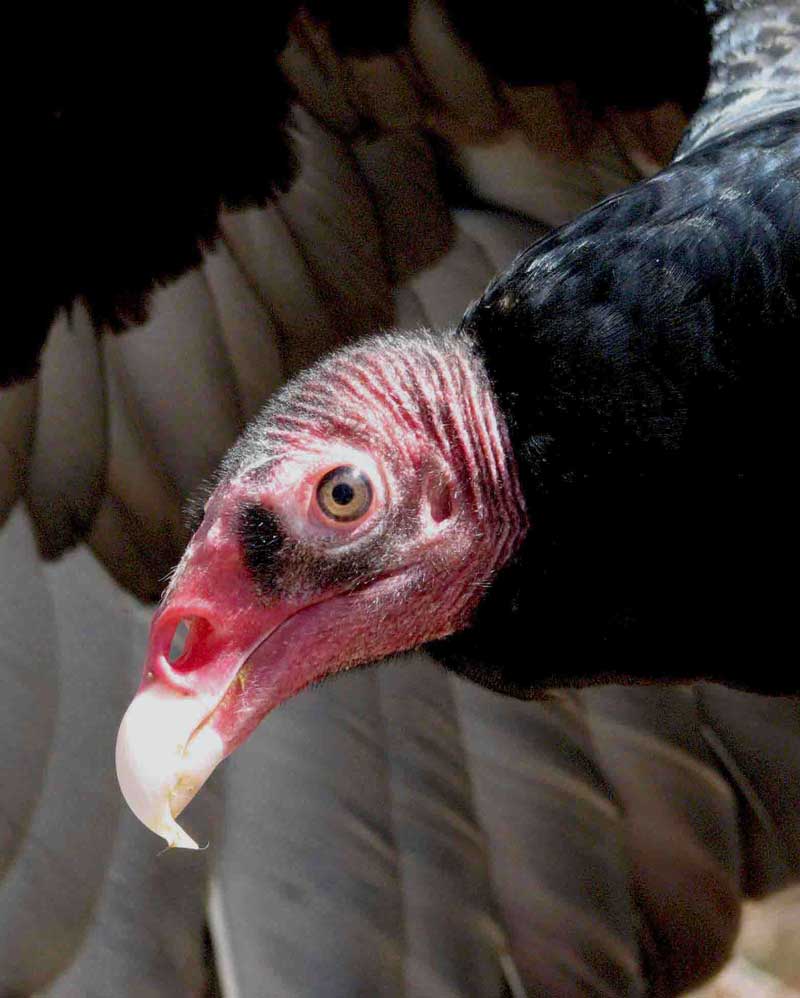
A relative of storks, the turkey vulture is a familiar sight in the October skies of the Upper Valley. Look for a large, black soaring bird with its wings in a “V” dihedral. (Photo by Mary Holland)
Awkward on land and not much to look at, the turkey vulture probably isn’t on anyone’s list of top 10 birds. However, if you can get beyond the featherless head and a taste for carrion, you may find a great deal to admire about this gentle scavenger.
Most people associate the turkey vulture with rotting carcasses, and rightly so. It has an uncanny ability to find both wild carrion and dead farm animals. For years scientists wondered which played a bigger part in the turkey vulture’s detection of decaying bodies—sight or smell. Most birds have a very poor, if any, sense of smell. However, research has proven that both senses are highly developed and are of great importance to turkey vultures. While road kills are highly visible, bodies decomposing under the canopy of a forest require other means of discovery. This is where the turkey vulture’s impressive ability to detect odors, specifically carrion, comes into play. Researchers have found that turkey vultures are sensitive to the gas ethyl mercaptan, which is emitted by carrion. According to a paper published by the Los Angeles County Museum, some enterprising engineers put ethyl mercaptan in a gas line to detect leaks and found them when they saw vultures circling over a part of the gas line.
Although turkey vultures prefer relatively fresh carrion, they do occasionally eat aging carcasses. Their beaks aren’t equipped to open thick skin, so in the case of a larger body, they must either wait until it decomposes further, or until a predator comes along and opens it up, providing access to the inside. In most ways, however, turkey vultures are extremely well equipped for their dining practices. The lack of many head feathers is not coincidental; feathers would only collect rotting flesh and bacteria every time a vulture thrusts its head deep within a decomposing cavity. With the turkey-like adaptation of a comparatively featherless head, the turkey vulture simply finds a sunny spot after dining where it bakes off the relatively minor debris that has accumulated.
Being a skull collector, I find myself in the company of turkey vultures perhaps more than the average person, as we’re often vying for the same road kills. More than once I’ve come across the remains of a dead squirrel whose skin has been turned completely inside out by a vulture, a common behavior which allows the vulture to pick the squirrel’s leg bones clean.
The nature of its diet appears not to be lost on the turkey vulture. In times of danger, such as when a predator approaches its nest, the turkey vulture’s primary defense is to regurgitate the half-digested, putrid remains of its most recent meal, which serves as a very effective deterrent.
The turkey vulture has been much maligned as a carrier of livestock diseases, when the opposite is actually true. Most of the bacteria found in decomposing matter that are responsible for diseases such as anthrax and hog cholera are destroyed in the turkey vulture’s digestive tract before reaching its intestines. Because of this, the turkey vulture actually prevents the spread of these bacteria; these same bacteria remain alive as they pass through the systems of other animals.
In addition to being a very effective recycler, the turkey vulture is considered one of the most skillful gliders among North American birds. One can easily recognize the V-shape dihedral that a turkey vulture’s three-foot wings form as it soars overhead looking for and attempting to smell its next meal. Chances of your spotting one this month are great, as many of these birds are migrating through Harvard on their way south during October. The turkey vulture’s range extended northward during the 20th century, primarily due to the expansion of our highway system (the main source of carrion), and they have been known to breed in Massachusetts for the past 50 years.
You will rarely see turkey vultures flapping their wings, as they conserve energy by riding thermals (masses of rising hot air) up to their tops and then peeling off and gliding in the direction of flight until they come upon another thermal. According to the Turkey Vulture Society (yes, there is one, and its mission is to rid all of us of the “unmerited images of death, filth and cruelty” that turkey vultures conjure up) the turkey vulture can glide for more than six hours at a time without a single flap of its wings. Look for their characteristic “teetering” which gives the bird lift as well as stability as it flies low enough to detect the scent of carrion.
As if recycling, preventing the spread of bacteria, and glorious gliding weren’t enough, the turkey vulture also has one more trick up its sleeve. When overheated, it excretes its waste onto its own legs and the evaporation of the moisture in its scat serves to lower its body temperature. The acidity also kills bacteria that may be present on its legs. Certain turkey vulture habits may be unappetizing, even disgusting, to some, but one has to admire this bird’s resourcefulness.