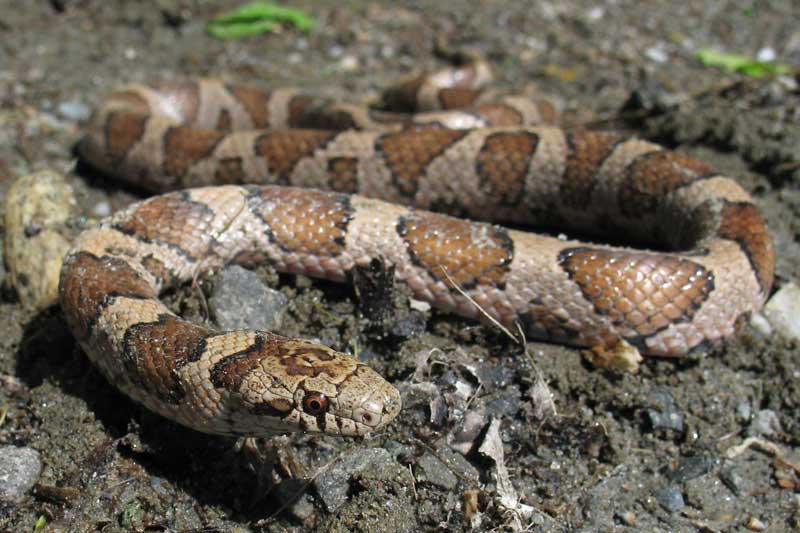
The common but secretive eastern milk snake is harmless to humans. The poisonous northern copperhead, for which it is often mistaken, is not found in either Vermont or New Hampshire. (Photos by Mary Holland)
There is movement in the grass. You catch a glimpse of a snake, just enough to determine that it has a pattern of dark blotches on a lighter background. The fact that it’s not one solid color and that it doesn’t possess stripes helps narrow down the list of possible species. What Massachusetts snake has brown “saddles” on its gray back? Juveniles of a few species, including the black rat, black racer, and northern water snakes, superficially resemble the milk snake (and are also non-poisonous). The harmless eastern hognose snake is also similar in appearance, but its upturned snout and display (when threatened it inflates its body, hisses loudly, lunges and then vomits, rolls over on its back and lets its tongue hang out) are a dead giveaway as to its identity. The only other snake in the northeast which truly has brown patches on its gray back is the poisonous northern copperhead. Fortunately, copperheads don’t live in Harvard, or even close by (a remote area in Norfolk County is the closest population). The only other poisonous snake that is found in the state, the timber rattlesnake, has only one eastern Massachusetts population, also in Norfolk County. Thus, if you happen upon a snake with this pattern near your home, you can relax and enjoy the fact that not only is it harmless to humans, but it is also one of our most efficient live mouse traps.
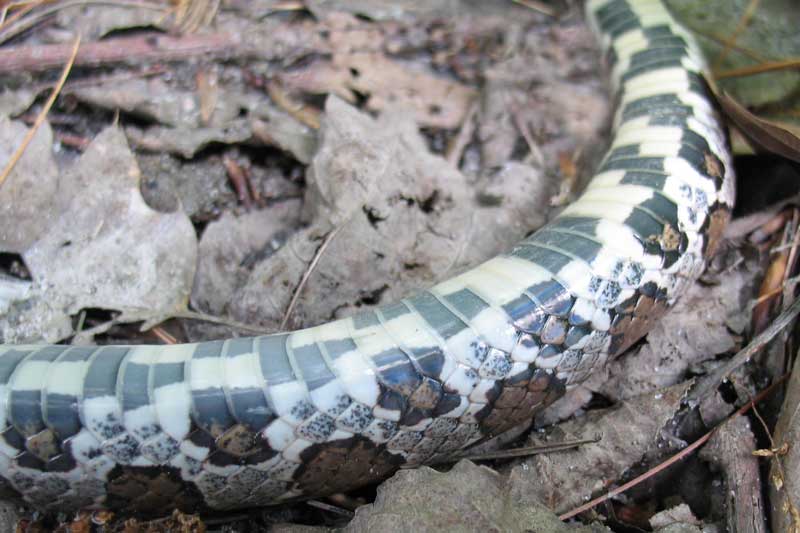
The underside of the milk snake has a checkerboard appearance with random black and white scales.
While the milk snake physically resembles the northern copperhead, it imitates the timber rattlesnake behaviorally by coiling up and vibrating its tail, making a buzzing sound when threatened or sometimes when trying to attract prey. These similarities with the northern copperhead and timber rattlesnake are examples of Batesian mimicry, where a harmless species resembles another species which is armed with spines, stingers or toxic chemistry. The harmless species is afforded protection from certain predators by its resemblance to the potentially dangerous species, which the predator associates with a certain appearance and a negative experience. While these forms of mimicry serve the milk snake well as far as most predators are concerned, they often lead to its demise at the hands of fearful humans. Several years ago, when living on Lovers Lane in Harvard, I was chagrined to find that a neighbor had made a wrong assumption and done away with a perfectly harmless milk snake.
Eastern milk snakes have a history not only of being misidentified but also of being misunderstood. Because they were (and continue to be) frequently seen in and around cow barns, people reasoned that a fondness for milk was what brought them there. Tales of milk snakes attaching themselves to cow teats and sucking them dry were commonplace, to the point where these snakes were actually named for this misconception. There is no dispute about their presence in dairy barns, but the reason for this was totally misinterpreted. Milk snakes are anything but the scourge of dairy farmers—just the opposite; it is rodents, attracted by grain in the barn, that attract milk snakes, not milk.

Unlike most non-venomous snakes, which have black tongues, the eastern milk snake’s tongue is red. Molecular particles are collected in the air by the tongue and then analyzed in a cavity (Jacobson’s organ) in the roof of the snake’s mouth, alerting it as to whether it should give chase or slither away.
Although milk snakes are quite common in Harvard, it is fairly unusual to see one, for they tend to be quite secretive, hiding under the bark of rotting logs, flat stones, or boards. Unlike most snakes, which raise their body temperature by basking in the sun, milk snakes tend to obtain their body heat by having contact with the underside of the sun-warmed objects under which they take cover. In addition to not lingering out in the open where we might see them more frequently, milk snakes are not active when we are, for they tend to hunt mainly at night when rodents, their favorite prey, are active.
Being a constrictor, the milk snake kills larger prey by physically squeezing them to death. The snake grasps its prey by the head and rapidly wraps itself around it. Each time the prey animal exhales, the milk snake coils a little tighter, until the animal in its grasp eventually suffocates. The snake then swallows it whole. If the prey is small enough and doesn’t pose a threat to the snake, it is often swallowed alive. In addition to small rodents and an occasional bird, fish, slug, or insect, the milk snake consumes other small snakes, including poisonous species, where they both inhabit the same area.
Some snakes lay eggs (oviparous) while others give birth to live young (viviparous). After emerging from hibernation and mating in late April or May, the female milk snake lays her 6 to 18 leathery, oval, white eggs in any one of a number of places that satisfy her needs. Once laid, the eggs are left to develop and hatch on their own, so the site in which they are deposited must provide a degree of heat and protection. In addition, the nesting site must also have enough humidity to prevent the eggs from dehydrating. Rotting matter such as a decomposing log or any protected location that gets warm afternoon sun fulfills these requirements. Occasionally these nesting sites are communal, with several female milk snakes gathering together to lay their eggs. In August or September the young snakes hatch and are at the most colorful phase of their lives; all 8½ inches are covered with bright rusty red blotches. Within an hour of birth the young snake sheds its skin and adds about three quarters of an inch to its length.
There is no shortage of small rodents in Harvard and it’s not just dairy farmers who are plagued by their presence. Wherever there is grain, there are mice. Eastern milk snakes, as well as other species of snakes and predators such as foxes, hawks, and owls get the credit for keeping our rodent population under control. Far from reacting to this harmless snake with fear, sit back and appreciate its contribution to the food chain and the balance of nature, as well as to the diversity of life that surrounds us.
Naturalist and writer Mary Holland lived in Harvard for many years before moving to Vermont. She can be contacted at mholland@vermontel.net.