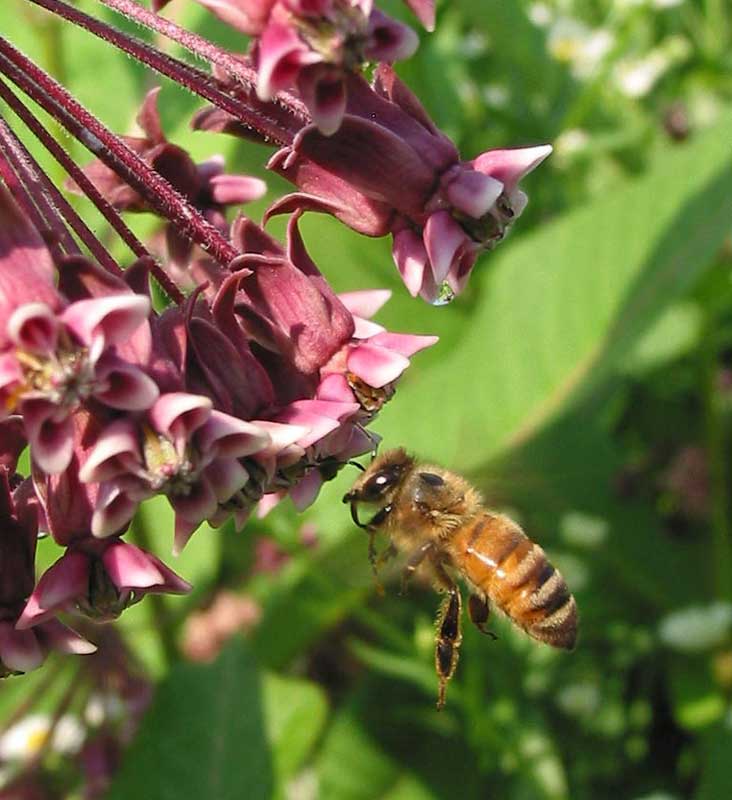
Honeybee in flight. In its lifetime a honeybee collects enough nectar to make about one-half teaspoon of honey. (Photos by Mary Holland)
You are a social being living with 50,000 of your siblings, all but roughly 300 of which are sisters. You will work nonstop from the minute you become an adult until the day you die, a span of anywhere from 32 to 140 days, depending on what time of the year you are born. Your life is devoted to caring and providing for your family, but in so doing you inadvertently provide an invaluable service to humans as well. What are you? A female honeybee (Apis mellifera).
For those not familiar with this insect and its social family structure, a hive consists of three kinds of honeybees. There is one, and only one, queen who never sees the light of day after she takes her nuptial flight, during which she often mates with several males. She then spends the next three to five years laying eggs within the hive (up to 2,000 eggs per day at the peak of her summer laying). The queen’s long and slender abdomen is indicative of the fact that she is the only bee in the hive that lays eggs.
Also present are male bees, otherwise known as drones. There are usually about 300 drones in a hive. A select few get to mate with the queen, but perish as a result (their reproductive part is ripped off during mating, causing the drones to die). The rest of the drones go on to lead a life of luxury, being fed and cared for by the third category of bee, the sterile females, or worker bees. The drones’ short but sweet life (90 days) comes to a sudden end in the fall, however, when, in order to make the honey supply last the winter, the workers force the drones out of the hive. Perhaps this behavior also comes from the workers’ tiring of the inequity of the division of labor.
Worker bees come by their name honestly, for they literally do all the work in the hive: repairing and building the wax cells that contain pollen, nectar, eggs and developing young bees or larvae; feeding the queen and the young larvae; cleaning the hive; keeping the hive around 94 degrees Fahrenheit (collecting water and fanning their wings to cause cooling evaporation in the summer, and clustering and fanning in the winter); guarding and defending the hive from robber bees and other predators; and finally, collecting the nectar and pollen so crucial to the development of the larvae as well as the hive’s ability to survive through the nonflowering winter months.
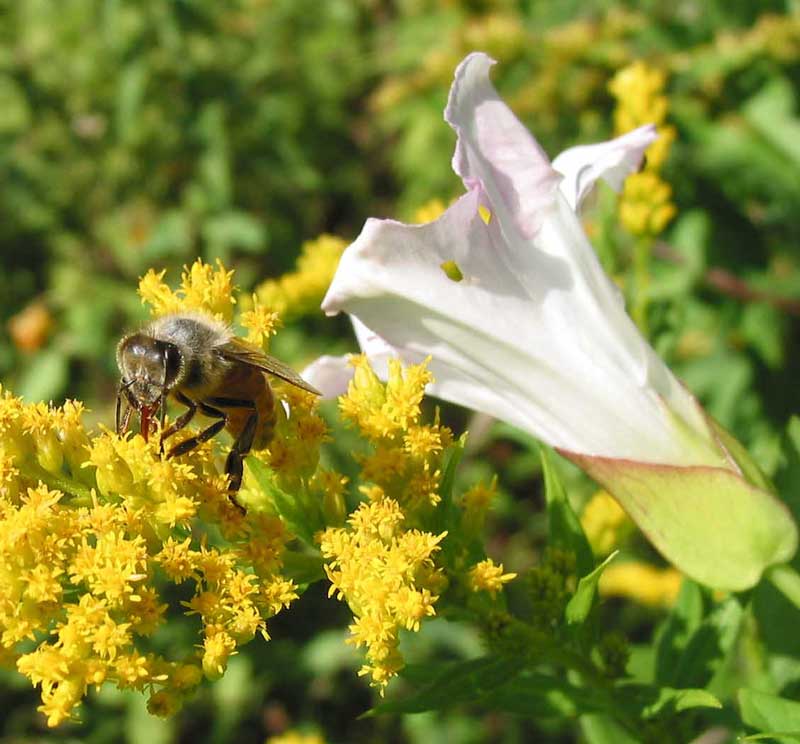
After swallowing nectar the worker bee carries it back to the hive in her “honey stomach.” She then regurgitates it into a wax cell where bees will fan and evaporate it until it’s the consistency of honey.
Each worker bee performs the same series of jobs in her lifetime in the same sequence, culminating with the most dangerous (to bees) yet most beneficial (to humans) job of all: that of leaving the safety of the hive and collecting nectar and pollen. In the process of gathering pollen and drinking nectar to bring back to the hive, workers rub against the anthers (male pollen-producing structures) of the flower. Because the pollen of the flowers visited by honeybees is somewhat heavy and sticky (and thus is not able to be dispersed by the wind, as is the light, fluffy pollen of many tree and grass flowers), a considerable amount gets stuck on the bee’s body. When the bee visits another flower, some of the pollen inevitably falls off, a portion of which often lands on the flower’s stigma (the top of the pistil, or female flower structure) and travels down the pistil to unite with an ovule. Cross-pollination is accomplished and as a result the seeds as well as the fruits that surround them start to develop.
In a single day a honeybee may fly 12 miles and pollinate as many as 10,000 flowers. To make just one pound of honey, bees must visit two million flowers; the average hive needs 40 to 60 pounds of stored honey to sustain it through the winter months. It should come as no surprise to find that honeybees perform 80 percent of insect pollination. Humans reap the benefit of the honeybees diligent gathering in the form of honey, but also many other products. Fully a third of the food we consume exists because of honeybee pollination. A number of agricultural crops are all but totally dependent on honeybee pollination, including almonds, apples, avocados, blueberries, onions, beans, peas, pumpkins, and squash. We are thus indebted to honeybees for some of our most savory fruits, vegetables, and nuts.
It so happens that humans may be in a position to do something for them in return. The mysterious disappearance of entire bee colonies has been observed in many countries for several years. Since the last few months of 2006 this phenomenon, called “Colony Collapse Syndrome,” has been occurring in the United States. For unknown reasons, foraging worker bees never return to the hive, which results in the death of the larvae and the queen. Entomologists are doing their best to determine whether a virus, fungus, mites, poor bee nutrition, pesticides, or a combination thereof are responsible for the demise of up to 30 to 60 percent of honeybees on the West Coast and up to 70 percent in some parts of the East Coast and Texas.
Human research into this disorder is far from altruistic. Honeybees are the most economically valuable pollinators of agricultural crops worldwide. The monetary value of honeybees as commercial pollinators in the United States is estimated at about $15 billion annually (Congressional Research Service Report for Congress, March 2007). About one-third of this value is in alfalfa production, primarily alfalfa hay. Nearly 10 percent of the value of honeybee pollination is in apples and almonds; citrus, cotton, and soybeans each comprise 6 percent to 7 percent of the value.
Between their production of honey and their pollination prowess, the honeybee’s contribution to our palate is significant. Thanks to their work ethic, our sweet tooth is satisfied and fruits and vegetables abound. That a small, seemingly insignificant insect has such a large impact on creatures thousands of times its size speaks to the interconnectedness of every living thing on this planet. Hopefully we can repay the favor that honeybees have bestowed on humans for the past several thousand years by solving the mystery of their recent disappearance and providing a remedy, for their sake as well as our own.