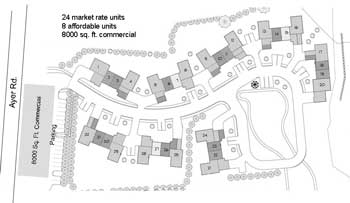
A plan of the Chapter 40B housing and commercial project proposed for the 13-acre site on Ayer Road roughly across the street from the entrance to Old Mill Road. The developer has not drafted plans for the 8,000 square feet of commercial space. The 32 residential units, 8 of which will meet the state definition of “affordable,” will be spread among 8 buildings. CLICK IMAGE TO ENLARGE
If a Chapter 40B housing project at 15 Littleton Road is approved by the Zoning Board of Appeals, heavy trucks would carry fill to the site over a 90-day period. The ZBA learned of this and other information at its July 13 hearing to consider Massachusetts Housing Opportunities Corporation’s comprehensive permit applications for two Chapter 40B housing projects: the Littleton Road project and another on Ayer Road. The hearings were scheduled to continue this week on Wednesday evening.
For 15 Littleton Road, MHOC proposes 12 units of housing and two septic systems that would require 8,985 cubic yards of fill, according to ZBA and MHOC engineers. Speaking for the developer, George Dimakarakos of Acton-based Stamski and McNary estimated 90 days of intermittent heavy truck traffic to bring in the fill and other materials. ZBA Chairman Chris Tracey said that construction vehicles headed for Littleton Road would need to be routed away from the schools.
Ayer Road 40B
At the hearing for 262–264 Ayer Road, MHOC’s president, Gerard Welch, repeated a presentation he had given the night before to the Board of Health, outlining changes that he said would prevent people from converting walk-out basements and lofts into bedrooms, a common practice that can lead to septic overloads and failures. Welch proposed reconfiguring the lofts and finishing the basements as recreation rooms. In a letter sent to the ZBA, the Board of Health said it was “encouraged” by the change. However, the new configuration made each of the eight state-defined affordable homes (one in each of building) an interior unit. MHOC’s site approval letter from the state prohibits that, stating, “Unit dispersion shall assure that some of the affordable units are ‘end units.’” Quarry Lane resident Keith Cheveralls, who serves on the ad hoc committee for a proposed Chapter 40B project on Shaker Road, brought this fact to the board’s attention after Tracey questioned the absence of affordable end units.
The rest of the Ayer Road hearing focused on ZBA consultant Edward Marchant’s financial analysis of the project, which includes 32 housing units in eight buildings and 8,000 square feet of commercial space. Marchant had sent the report to the board in late May and attended the June 13 hearing to take questions. He found the project economically feasible, he said, but noted his “handicap” in assessing the commercial space, for which he had no specifications. Current plans show only the size of the commercial space and that it shares septic with the housing units. The board, he said, should “get some kind of baseline” of the space and “draft a condition” for when it appears before the Planning Board.
MHOC attorney Mark Bobrowski said his client would provide a “vanilla” footprint-style plan of the commercial part to the ZBA and save details for the Planning Board’s future site review of the commercial space. If building the commercial space proves impossible for any reason, MHOC will revert to its original plan of 44 housing units, said Bobrowski.
Marchant also suggested reducing prices for some units and raising the condo fee to create a reserve for major repairs. In discussing the profit margin, which by law cannot exceed 20 percent, Marchant noted that MHOC’s architect and builder were “related parties” and added that he thought the marketing agent might be, too. “They are not in violation of [state] regulations,” he said, but urged that “extra care” be taken in the post-construction audit. Developers can use in-house, or related-party, contractors, as MHOC will do for its construction and some marketing, or hire completely independent contractors. Recent studies by the state’s inspector general show that related-party projects make expenses and profits harder to audit.
Tracey said, “All related profits can go to one entity, for a profit [in this case] of about $3.2 million,” which falls beneath the state-imposed profit cap of 20 percent.
MHOC is incorporated as a nonprofit, but has stated at previous hearings that it will create for-profit, limited liability corporations to take the comprehensive permits and build the Littleton and Ayer roads projects