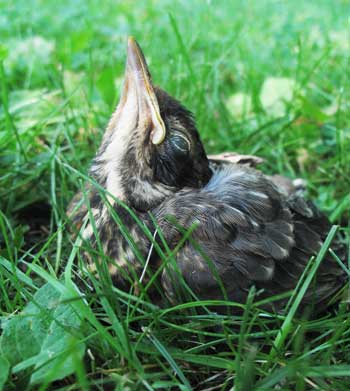
This fledgling robin’s parents are probably hiding in a nearby shrub, responding to its calls, feeding it, and teaching it survival techniques. (Photo by Mary Holland)
Much happens in the natural world during the month of June—turtles migrate to sandy patches to lay their eggs, fawns begin exploring their surroundings, tree frogs start trilling, and as the month progresses, young birds are frequently discovered on the ground, looking helpless and abandoned. Our first reaction when we see such a bird is to “rescue” it, for if it were supposed to be out of its nest, it would be capable of flying away, would it not? This is not necessarily so. Many misconceptions exist about young birds and there’s no better time of year to separate fact from fiction.
Young birds are referred to as altricial (born naked, with eyes closed, and dependent upon parents for warmth and food for a number of weeks), or precocial (born with downy feathers, eyes open, and capable of obtaining their own food within hours of birth). The young songbirds most commonly found on lawns are altricial. For a period of time after they are born they need parental care. Sometimes it is not obvious to us humans whether a bird is receiving this attention and we’re often quick to assume that it is not.
The very first thing you should do upon finding a young bird on the ground is to determine whether or not it belongs there. Human intervention might be appropriate if the bird in question is a nestling—a bird that belongs in a nest. However, a fledgling—a bird who has left the nest—often spends several days hopping around on the ground before it acquires full flight capability, and during this time it is being cared for by its parents.
If the bird in question is a fledgling, the crucial issue becomes whether it is truly an orphan and there is a very simple way of finding out which stage a young bird is in. It involves handling the bird, but do not be concerned. Although you often hear that birds will not have anything to do with their young if they have been handled by humans, this is not true. Birds have a very poor sense of smell and do not appear to recognize (or be concerned) if their young have had contact with humans. I have witnessed tree swallow nestlings being removed from their nest box, handled by an ornithologist, and put back in their nest. Far from rejecting her young, the parent immediately entered the box and fed them.
If you find a very young bird on the ground with its eyes closed, lacking many feathers and unable to hop around, you can assume that it belongs in a nest. If feathers have developed and eyes are open, but you’re still questioning whether it’s a nestling or fledgling, pick it up in your hand and attempt to have it perch on one of your fingers. A general rule of thumb is that if the bird is incapable of firmly gripping your finger, it is a nestling, prematurely out of its nest. This happens, albeit not very often, for a variety of reasons: wind, predators, and jostling from other birds in the nest.
If the nestling is chilled, warm it in your hands and then, if it appears healthy, try to locate its nest. Usually it is close by and well hidden. (Nestlings don’t often take a tumble, so if you find the bird on the ground again, you can assume it’s time for it to fledge.)
If you can’t find the nest, construct a makeshift one out of a berry basket or a butter tub with drainage holes in it and line it with tissue (not fresh grass, as it contains moisture that can chill the bird) and tie it to a nearby branch. Then leave the area.
Once you are out of sight, the parent bird should return to feed it. If you watch the nest from a distance for two or three hours and there is no sign of a parent, or if the bird is injured, then other measures, such as calling Massachusetts Audubon Society (1-800-AUDUBON) or other wildlife rehabilitator, are appropriate.
If the young bird is capable of perching on your finger (it will usually also have feathers and a short tail at this stage) it is a fledgling and should quickly be returned to the spot where you found it, where its parent will hear its calls. You should not put it back into a nest or adopt it. As mentioned before, most fledglings leave the nest before they are capable of sustained flight and before their parents are finished caring for them. They can hop and perhaps fly short distances when they first leave the nest, but for the next week to 10 days, their parents are still feeding them and teaching them skills that they will need to survive.
If the likelihood of predators (i.e., house cats) is high, try to find a bush or thick cover in which to place it. If you’re looking for a mission, you could educate your outside-cat-owning neighbors about the high predation rate (National Audubon Society estimates that cats kill 100 million birds each year in the U.S.) and try to encourage them to keep their cats inside.
Although fledglings are extremely vulnerable, it’s not as though they were a great deal safer in their nest. While nests serve to contain the heat of the parent bird as well as offer the young some protection from the elements, they are also a magnet for predators. Think about it from a raccoon or sharp-shinned hawk’s point of view—a nest is nothing less than a goldmine of very vulnerable, concentrated packages of protein. Consequently, the goal of a parent bird is to have one’s young fledge, or leave the nest, as soon as possible in order for them to disperse and increase their chances of survival.
The reasons for not trying to play Nurse Nightingale to a fledgling are many. To begin with, more often than not there is no need for human intervention. The parents are usually caring for their young fledglings, even if it is not evident to you.
Even with the best of intentions, the most skilled humans do not have nearly as high a success rate as natural parents do in raising young birds. Birds start out life with only a 50 percent chance of surviving long enough to fledge from their own nest, according to Watching Birds by Roger F. Pasquier. Being raised by humans decreases this percentage even more.
Other reasons to let nature take its course are the law, the time commitment involved, and the necessary expertise. To possess a young bird, you must have federal and state permits. Wildlife rehabilitators have such permits.
The amount of time that is required to care for a young bird is staggering: parent birds feed their young every 15 to 20 minutes from sunrise to sunset for several weeks. An adult robin makes about 400 trips every day to feed its young. Even though rehabilitators have come up with very nutritional recipes and find the time for frequent feedings, a majority of young birds in their care usually die.
Finally, for a week or two after leaving the nest, fledglings are not only fed by their parents, but are taught such valuable skills as how to procure food, avoid predators, and communicate with other birds, skills humans obviously can’t teach. Contrary to popular notion, by not taking any action at all on the behalf of a bird, you may very well have saved its life.