A thousand years will come and go,
And thousands more will rise,
My buried bones to dust will grow
And dust defile my eyes.
But when the lark sings o’er the world
And the swallow weaves her nest,
My soul will take the coltsfoot gold
And blossom on my breast.
—Alfred Williams

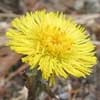
Coltsfoot and dandelions are both in the composite family and superficially look quite similar. However, coltsfoot (above) has tubular (disk) male flowers surrounded by flat (ray) female flowers, while dandelions (below) are composed of mainly flat flowers that possess both male and female structures. (Photos by Mary Holland)

Even though it has been written about, cooked with, and smoked, it is possible that you’ve never made the acquaintance of one of Harvard’s earliest wildflowers—known by many as coltsfoot (Tusilago farfara). If so, you are about to be introduced to an often overlooked and underrated beacon of spring. Granted, it is an introduced species and considered an invasive plant, but few other flowers can lay claim to braving the lingering winter patches of snow, nor can most endure the rugged terrain found on the shoulders of roads. Coltsfoot not only survives but thrives in both of these conditions.
Coltsfoot vs. dandelion
Because of its general appearance, coltsfoot is often mistaken for dandelions. While both plants are in the composite family (in which a single flower head is actually hundreds of individual florets) and both bear brilliant gold flowers, their differences become apparent as soon as you take a closer look. Coltsfoot consists of flat yellow ray flowers (mostly female) surrounding tubular yellow-orange disk flowers (mostly male). Its hairy stem is stout and scaly and leaves do not appear until the flowers have died back. A dandelion consists of mostly ray flowers (containing male and female parts) and has a slender, smooth stalk; its flowers and leaves appear at the same time.
Rise and shine
The techniques employed by coltsfoot to increase its chances of being pollinated are most noticeable in its manner of growth. As it is developing, the flower head bends down toward the ground. When it blooms, the head turns upward to greet visiting insects hungry for nectar and pollen, scarce at this time of year. At night, as well as on cloudy or cool days when pollinators are in short supply, you will find coltsfoot flower heads tightly closed. After most of its flowers are pollinated, coltsfoot folds up its flower head and once again turns down toward the ground to protect the developing seeds.
Long-distance flyer
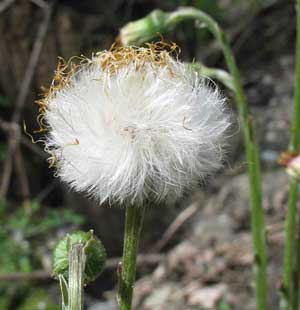
When fully developed, the seeds of coltsfoot are dispersed by the wind, traveling as far as nine miles from their parent plant.

Coltsfoot derives its name from the shape of its leaves, which don’t appear until after the flower has gone to seed.
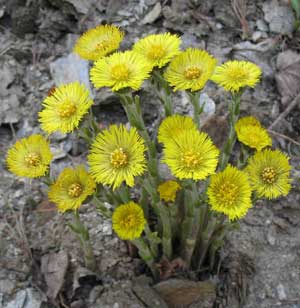
Nothing announces spring’s arrival like a bouquet of golden coltsfoot.
Once the seeds of coltsfoot are fully formed, its head is raised for the last time, displaying its dandelion-like seeds. The down, or pappas, that is attached to each seed acts as a dispersal mechanism and is similar to that of thistles, asters, and dandelions. Goldfinches line their nests with it (as well as with thistle down), and it has also been used as filler for pillows and mattresses in Scotland, much like Americans used milkweed fluff during World War II.
Leaves come later
Romans used to call coltsfoot filius ante patrem, or “son before father,” in reference to the leaves appearing only after the flower has died back. In fact, most people don’t even associate the flower with the leaf as they never see them at the same time. The hoof-like shape of its leaves gives coltsfoot its prevalent common name, although it does have many others, including ass’s foot, horsehoof, foalfoot, sowfoot, and clayweed.
When young, the leaves are covered and somewhat insulated from the cold by a woolly fuzz that eventually falls off as the temperature rises. The white cottony hair that remains on the underside of the leaf is said to have been collected by English villagers and used as tinder.
Coughing cure
Historically coltsfoot has served as a remedy for coughs. Apparently the leaves contain a great deal of mucilage, which coats and soothes an irritated throat. It has been used in every form you can think of. A cough syrup is concocted from the leaves (along with a healthy dose of sugar). A fragrant tea is made from steeped leaves. Coltsfoot extract boiled and sweetened with honey makes palatable cough drops. Dried leaves have even been smoked by asthmatics for relief.
These harbingers of spring are starting to appear along the sides of many of Harvard’s roads. Where you find one, you’ll often find several, if not hundreds, for they reproduce by runners as well as seeds. If you take the time to come face to face with a coltsfoot flower head you will no doubt appreciate Alfred Williams’s poem even more, for there is nothing quite like these splashes of gold to brighten the brown, decaying roadside leaves of winter.
Mary Holland can be contacted at mholland@vermontel.net.